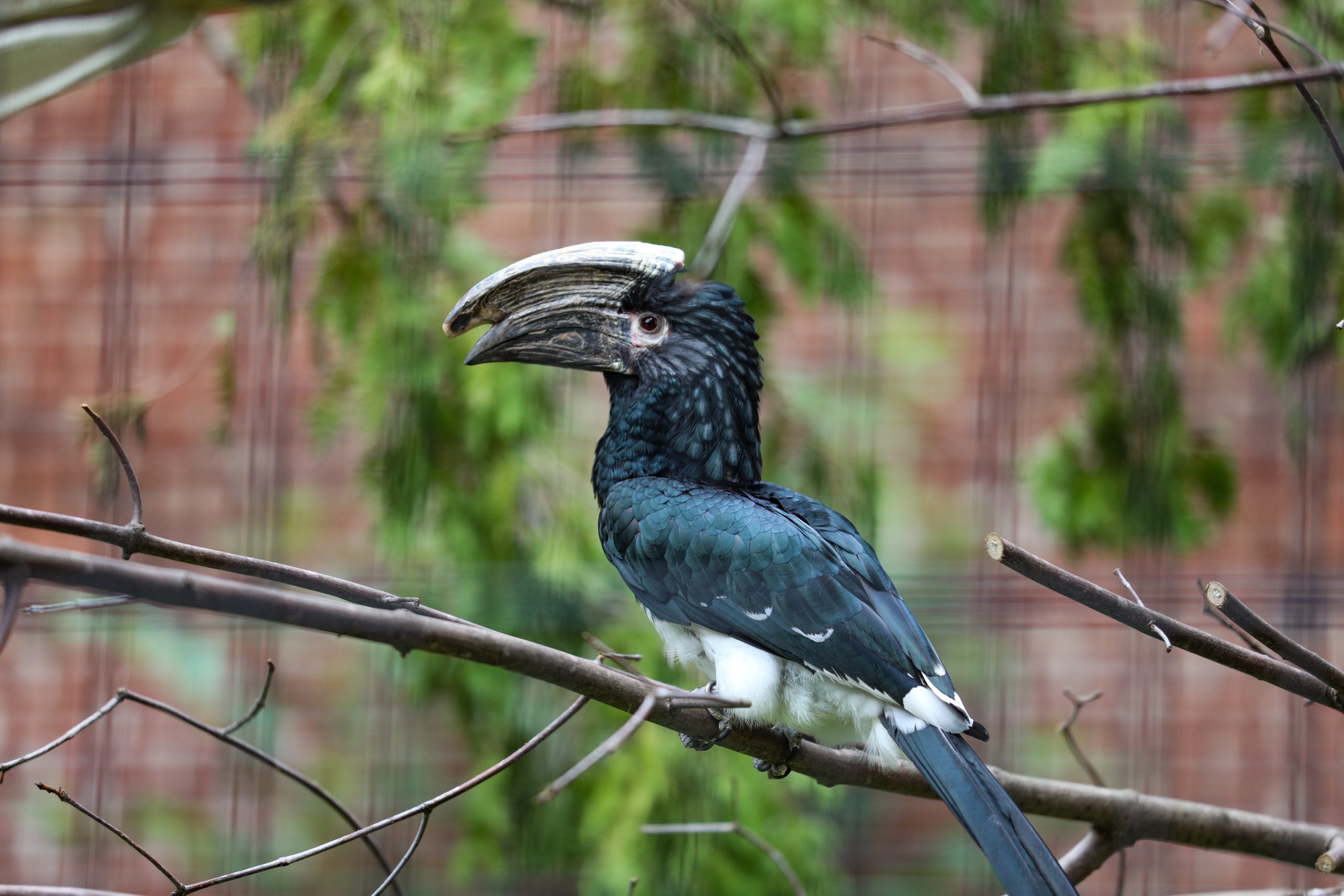
Trumpeter Hornbill Africa: The Wailing Voice of the Forest Canopy
The trumpeter hornbill is one of East Africa’s most audible forest birds. Its call is a series of loud, wailing cries that sound remarkably like a distressed human baby. The sound carries through dense forest and across open water at considerable distances. Once heard, the call is one of the most instantly recognizable sounds in any East African forest environment.
The species inhabits forest, forest edges, and well-wooded riverine habitats across a wide range of eastern and southern Africa. In East Africa, it reaches the northern limit of its distribution and is therefore somewhat localized compared to its abundance further south. Finding trumpeter hornbills in East Africa requires visiting the specific forested habitats where the species is present.
Identification
The trumpeter hornbill is a large bird measuring 58 to 65 centimeters from bill to tail. It shows black upperparts, a white belly, and a red eye ring that is visible at close range. The casque above the bill is smaller and less prominent than those of the silvery-cheeked hornbill. The underwing in flight shows a bold black and white pattern similar to that of related species.
The species is most easily confused with the silvery-cheeked hornbill where both occur together. The trumpeter hornbill is noticeably smaller. Its white belly is more extensive, and the silvery cheek patch of the silvery-cheeked hornbill is absent. The calls of both species are loud and carrying, but the trumpeter hornbill’s wailing cry is distinctively different from the silvery-cheeked hornbill’s harsher cackling.
Groups of trumpeter hornbills move noisily through the forest canopy, calling frequently as they travel between fruiting trees. The group’s arrival at a fruiting tree is preceded by the sound of their calls and the loud wingbeat sounds audible as they approach from a distance.
Diet and Behaviour
Trumpeter hornbills feed primarily on fruit, with figs forming a major component of the diet where available. They also take insects, small lizards, and other small animals opportunistically. The large bill handles fruit of considerable size and extracts seeds and pulp efficiently.
The species is gregarious. Groups of 3 to 10 birds move and feed together through the day. They roost communally at night in sheltered positions within dense canopy cover. The roost group’s morning departure is accompanied by the same wailing calls that characterize their activity throughout the day.
Furthermore, trumpeter hornbills are important seed dispersers in forest ecosystems. They carry fruits away from the parent tree and deposit the seeds in their droppings at distant locations. This dispersal function makes them a key species in the regeneration ecology of the forest types they inhabit.
Where to See Trumpeter Hornbills in East Africa
Tanzania’s Eastern Usambara Mountains provide one of the most reliable trumpeter hornbill destinations in East Africa. The forests at Amani in the Usambaras hold resident groups that are regularly encountered on guided forest walks. The species also occurs in the Arabuko Sokoke Forest on Kenya’s north coast, where it reaches the northern extreme of its East African range.
Kenya’s coastal forests from Mombasa southward carry trumpeter hornbill populations in the larger forest patches that remain between the town developments. The Shimba Hills National Reserve south of Mombasa provides coastal forest habitat accessible on a day trip from Diani Beach.
Additionally, parts of Uganda’s southern forests along the Tanzania border carry trumpeter hornbill populations. These populations are less well-documented than those in Kenya and Tanzania but provide an additional option for birders completing a southern Uganda forest circuit.
Plan Your Birding Safari
Trumpeter hornbill sightings in East Africa require visiting the coastal or highland forest destinations where the species occurs. The Arabuko Sokoke Forest near Malindi in Kenya and the Usambara Mountains in Tanzania are the most accessible and reliable destinations within the established safari circuit.
Both sites combine naturally with coastal extensions after northern circuit safaris. A two-night stay at either destination provides sufficient time for reliable trumpeter hornbill encounters alongside the other forest bird specialties each site offers.
African Wild Trekkers includes Kenya’s coastal forests and Tanzania’s Eastern Arc destinations in birding-safari itineraries. Contact us to plan a safari that combines East Africa’s savanna wildlife with its extraordinary forest bird diversity.