Silvery-cheeked Hornbill: East Africa’s Giant Forest Fruit Eater
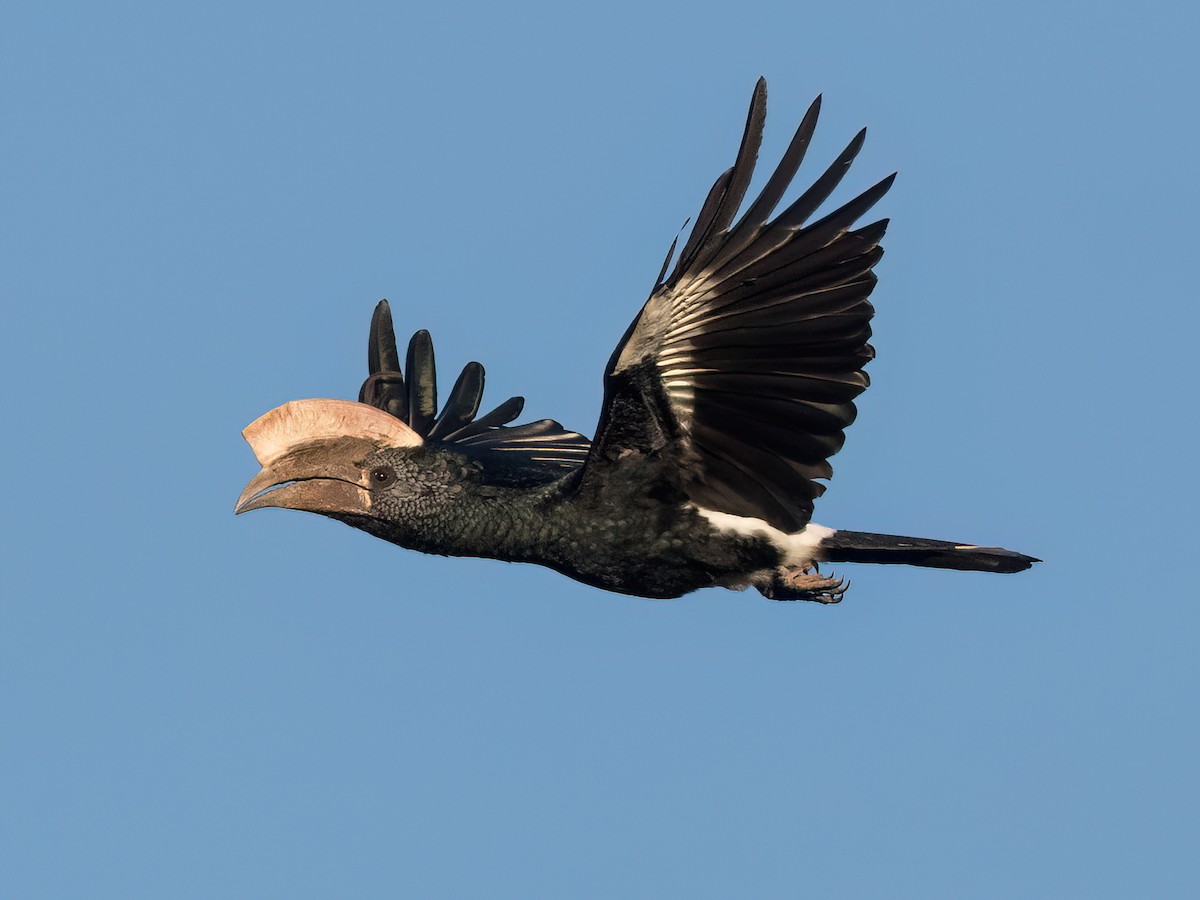
The silvery-cheeked hornbill is one of the largest hornbills in East Africa. It measures up to 75 centimeters from bill tip to tail. The species is immediately identifiable by the large, pale cream casque mounted above its bill. The cheeks are silvery-white, which gives the species its name and distinguishes it clearly from related hornbill species in the region.
This is a forest species. It requires tall, closed-canopy forest with large fruiting trees to sustain its diet and provide the large tree cavities it needs for nesting. Where this forest type exists in East Africa, silvery-cheeked hornbills are often present in noisy, conspicuous groups that announce their presence from a distance through loud, cackling calls.
Identification and Physical Features
The silvery-cheeked hornbill’s size alone distinguishes it from most other hornbills within its range. The male carries a larger, more prominent casque than the female. Both sexes show black body plumage with a white belly and white patches in the flight feathers visible as the bird flies. The underwing pattern of black and white is visible from considerable distance in flight.
The call is a loud, carrying series of harsh cackling notes that a group of birds produces simultaneously. This group calling creates a raucous, overlapping sound that carries through dense forest and announces the birds’ presence well before they come into view.
In flight, the silvery-cheeked hornbill shows a characteristic bounding, undulating flight pattern. The wings produce a loud whooshing sound on each downstroke. This sound is audible at 50 meters in still conditions and helps locate the birds as they move between fruiting trees.
Nesting Behaviour
Silvery-cheeked hornbills nest in large natural tree cavities typical of old-growth forest. The female seals herself into the cavity using mud, droppings, and food remains. The sealed entrance is reduced to a narrow slit through which the male delivers food to the female and later to the chicks.
The female remains sealed inside the cavity for the entire incubation period of approximately 40 days, plus the initial period of chick development. She molts her flight feathers during this confinement period and regrows them before breaking out of the nest with the chick.
The nesting system makes the availability of large, old trees with natural cavities a critical requirement for the species’ breeding success. Forest degradation that removes old-growth trees eliminates nesting opportunities even where fruiting trees and food resources remain available.
Where to See Silvery-cheeked Hornbills
Ethiopia’s highland forests, particularly the Harenna Forest in Bale Mountains National Park, hold some of East Africa’s most accessible silvery-cheeked hornbill populations. Tanzania’s Eastern Arc forests, including the Udzungwa Mountains, carry good populations in the highland forest zones above 1,500 meters.
Uganda’s Budongo Forest near Murchison Falls National Park provides reliable silvery-cheeked hornbill sightings alongside chimpanzee tracking. The birds move through the forest canopy in small groups and concentrate at fruiting trees where multiple individuals feed simultaneously.
Additionally, Kenya’s Kakamega Forest, the country’s only tropical rainforest, holds silvery-cheeked hornbills in its central zone. The species is one of Kakamega’s most visually impressive birds and a reliable target for any birding walk through the forest’s tall canopy sections.
Plan Your Birding Safari
Silvery-cheeked hornbill sightings require forest destinations with intact, tall canopy habitats. Uganda’s Budongo Forest, Kenya’s Kakamega, and Tanzania’s Eastern Arc forest reserves all provide this habitat within established safari circuits.
The species is easiest to locate during fruiting periods when groups concentrate in specific canopy trees. A local guide who knows which trees are currently in fruit dramatically increases sighting success on any given day.
African Wild Trekkers includes East Africa’s highland forest destinations in birding safari itineraries. Contact us to plan a safari that explores the full range of East Africa’s hornbill species across savanna, woodland, and forest habitats.