African Green Pigeon: The Invisible Fruit-Eater of East Africa’s Fig Trees
The African green pigeon is one of East Africa’s most common and most frequently overlooked birds. Its vivid green plumage provides extraordinary camouflage in the canopy of fig trees. A flock of 20 or more birds can feed silently in a fig tree 10 metres above a passing observer and remain completely undetected.
The species becomes apparent when a bird moves on a branch or when the whole flock flushes simultaneously and reveals the distinctive combination of green, yellow, purple, and red in their plumage as they stream away. At that moment, a bird that appeared invisible a second earlier transforms into one of East Africa’s most colourful pigeons.
Identification
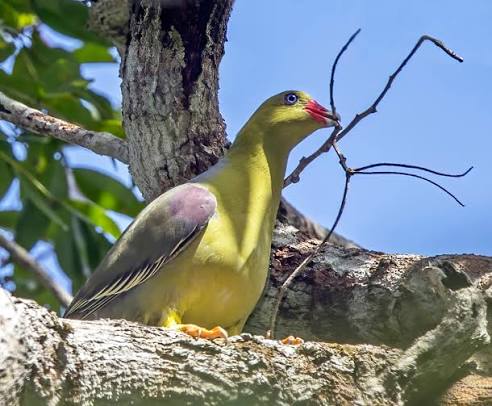
The African green pigeon shows bright green upperparts and underparts that match the colour of fresh fig tree leaves with remarkable precision. The wings show yellow and purple patches visible at rest. The bill is red with a white tip. The legs and feet are a vivid orange-red that contrasts sharply with the green body plumage.
Males and females are similar in plumage, making the species one of the few African pigeons without obvious sexual plumage differences. The iridescent green sheen of the upperpart feathers varies slightly in intensity depending on the light angle.
The call is a series of bubbling, whistling notes quite unlike the cooing calls of most pigeon species. The call is immediately distinctive and helps locate birds that are otherwise hidden in canopy cover. Groups call frequently while feeding and the collective sound of a feeding flock carries clearly through still morning air.
Diet and Behaviour
African green pigeons feed almost exclusively on fruit. Figs are by far the most important food source. The birds specialise in acrobatic feeding in the outer canopy of fruiting fig trees. They hang upside down from branches, reach sideways from unstable perches, and display the full range of gymnastic feeding postures that maximise access to fruit that straight-perched feeding cannot reach.
This acrobatic feeding style is one of the species’ most entertaining behavioural characteristics. A flock of green pigeons working a heavily laden fig tree provides 10 to 15 minutes of continuous movement and colour as individuals shift positions, compete for the best fruit clusters, and perform the athletic manoeuvres that the outer canopy feeding demands.
The species is an important seed disperser in forest and woodland ecosystems. It swallows fig seeds whole and deposits them in its droppings at distances from the parent tree that promote forest regeneration across a wide area.
Where to See African Green Pigeons
African green pigeons are widespread across East Africa wherever fruiting fig trees grow. The species is present in forest, savanna woodland, riverine forest, forest edges, and well-wooded gardens across the region. It is one of the most widely distributed frugivorous birds in East Africa.
In Tanzania, the species is common throughout the northern circuit’s woodland areas. Tarangire National Park’s large fig trees host feeding flocks regularly during the fruiting season. In Kenya, the species is abundant in Kakamega Forest and in the coastal forest strip.
Uganda’s national parks carry large green pigeon populations wherever fig trees occur. The Murchison Falls area’s riverine forest and the Kibale Forest’s fig-rich woodland both provide reliable green pigeon encounters at close range during fruiting events.
Plan Your Birding Safari
African green pigeon sightings are a natural part of any East Africa safari itinerary that includes areas with fruiting trees. The species requires no dedicated search effort at the right time of year. Any guide aware of currently fruiting fig trees can lead a group to reliable sightings within a short drive or walk from camp.
Developing the skill to spot motionless green pigeons in dense fig foliage is a satisfying birding challenge. Once the search image is established, previously invisible birds become visible in trees that appeared empty moments before.
African Wild Trekkers designs East Africa birding itineraries that target fruiting fig events for maximum waterbird diversity. Contact us to plan a safari that reveals the extraordinary diversity of East Africa’s frugivorous bird community.