Cheetah Coalitions in the Maasai Mara
Understanding Male Cheetah Coalitions
Why Male Cheetahs Form Coalitions
Male cheetahs in the Maasai Mara form coalitions of two to five individuals — almost always brothers from the same litter who remain together after dispersing from their mother at approximately eighteen months of age. This sibling bond creates a cooperative hunting and territorial defence capability that individual males cannot match. A coalition of three males holds a territory substantially larger than a single male can defend, expands the range of prey species they can target cooperatively from small gazelle to large wildebeest and topi, and survives aggressive encounters with lions and hyenas that would destroy an individual. Brothers who share genetic material gain fitness by cooperating to maximise the territory and breeding access the coalition controls, even though each individual reproduces less frequently than if he held territory alone.
The Maasai Mara’s open grassland provides ideal conditions for observing cheetah coalition hunting and social interaction. The absence of dense vegetation means that guides and guests can follow a coalition’s movements across long distances without losing visual contact as the animals work through the terrain. Coalitions in the Mara have been individually identified and named by researchers and guides over years of continuous observation. This creates a roster of known individuals whose life histories, territorial ranges, and hunting specialisms are documented in detail that makes encounters informative beyond the pure visual spectacle. A guide who can identify which coalition you are watching and explain their history transforms a cheetah sighting from an observation into a story.
The Most Famous Mara Cheetah Coalitions
The Tano Bora coalition — meaning “Famous Five” in Swahili — occupied the Maasai Mara from approximately 2016 and became one of Africa’s most celebrated wildlife subjects. Five male siblings hunting together was an extraordinary figure for a species in which coalitions of more than three individuals are rare. The coalition’s size allowed them to bring down prey animals — buffalo calves, topi, large wildebeest — that individual cheetahs and even three-male coalitions typically cannot manage. The cooperative hunting sequences that guides filmed and shared widely demonstrated a level of coordinated big-game hunting previously undocumented for the species at this scale. The Tano Bora’s fame brought dedicated visitors specifically seeking encounters with this coalition and established the Mara’s cheetah population as a global wildlife celebrity destination.
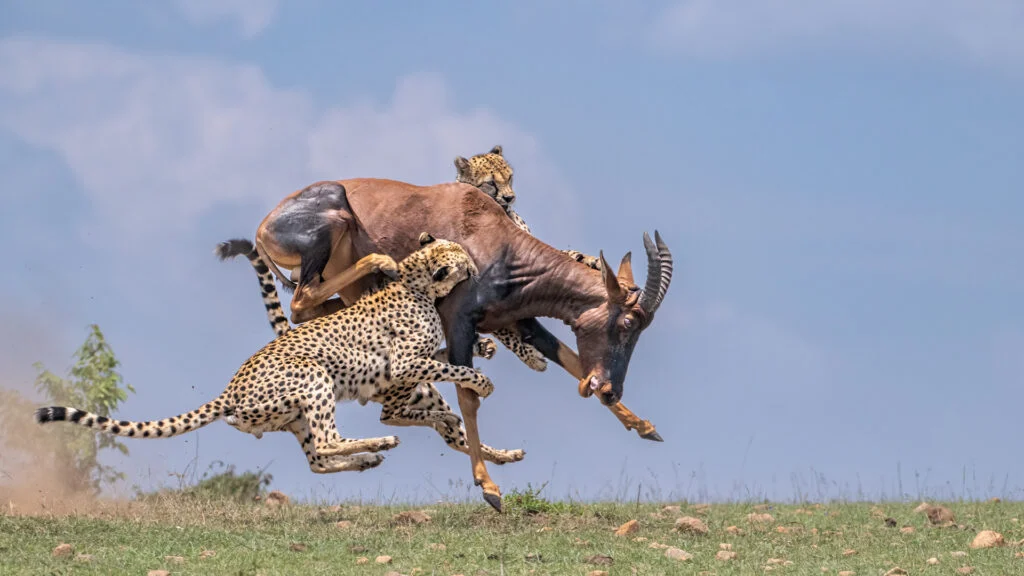
The Oloololo coalition operated in the Mara Triangle’s western sector near the escarpment base. Their territory overlapped with the Tano Bora’s range and produced territorial conflicts that guides with knowledge of both coalitions’ movements could sometimes predict and position vehicles to observe. The Oloololo males — three individuals known for specialising in topi hunting on the Triangle’s open plains — demonstrated a different hunting style from the Tano Bora’s more varied approach. The tight, fast coordination that the Triangle’s more open terrain suited better than the longer stalks the Tano Bora used in the conservancy areas. Watching different coalitions in adjacent territories demonstrate different tactical approaches to the same basic challenge — how to bring down an animal that runs faster than you do — provides one of the Mara’s most intellectually engaging wildlife experiences for guests interested in animal behaviour beyond visual spectacle.
Watching and Photographing Cheetah Coalitions
Following a Hunt: What to Expect
A cheetah coalition hunt in the Mara begins with a period of elevated observation behaviour — individual cats sitting upright on termite mounds, kopjes, or fallen logs to scan the surrounding grassland for potential prey. Guides who have spent time following specific coalitions recognise the transition from resting to active scanning and position vehicles before the hunt begins rather than reacting to it. This provides a significantly longer and more complete observation sequence. The coalition’s attention fixes on a specific individual in a herd — typically a young wildebeest, topi, or Thomson’s gazelle that is lagging behind the group or isolated at the herd’s edge — and one or more individuals begin a slow, crouching approach that covers the ground at walking pace while maintaining a low visual profile.
The final sprint begins when the prey animal detects the approaching cheetah at approximately 30 to 70 metres — typically shorter on the Mara’s shorter grass than in longer vegetation where detection distances increase. The cheetah accelerates from zero to approximately 70 kilometres per hour within three seconds and covers 100 metres in under four seconds, producing the fastest land sprint of any mammal before maximum effort must reduce. In a cooperative hunt, coalition members approach from different angles simultaneously so that the prey’s escape route is blocked by a second or third animal regardless of which direction it flees. The successful conclusion — a trip, a hold on the throat, suffocation over several minutes while the coalition recovers its breath — is followed by a feeding sequence that lasts 15 to 25 minutes before lions, hyenas, or jackals force the cheetahs from the carcass.
Best Times and Locations for Cheetah Coalition Viewing
Morning drives between 06:00 and 10:00 produce the highest cheetah hunting activity rates. Cheetahs hunt during the cooler morning hours when their sprint speed advantage over prey is greatest and when the risk of overheating during a high-speed chase is lowest. Midday heat reduces cheetah activity dramatically, and most coalitions rest in shade from 11:00 to 16:00 with minimal movement. Afternoon drives from 16:00 capture a second activity period that extends until dark. Guides who know a specific coalition’s territory can often predict the afternoon resting location from the morning’s movements and drive directly there rather than searching.
The Mara Triangle’s open short-grass plains in the western reserve sector provide the best cheetah viewing terrain in the ecosystem. The absence of long grass allows guests to observe the full hunting sequence without obstruction from the vehicle. The conservancy areas north of the reserve — Mara North, Naboisho, and Olare Motorogi — also support strong cheetah populations and allow off-road positioning that the national reserve cannot, which makes conservancy sightings better for photography even when the Triangle’s open terrain produces longer sighting distances. Guides in both environments develop reputations for specific individual coalitions they follow consistently and provide guest encounter rates that reflect personal knowledge rather than general park statistics.
Conservation Status of Mara Cheetahs
Threats and Protection of the Mara Population
Challenges Facing Cheetahs in the Mara Ecosystem
Cheetahs in the Maasai Mara face a specific set of pressures distinct from those affecting lions and leopards in the same ecosystem. Cheetahs are the least competitive large predator in the Mara’s hierarchy — they lose carcasses to lions, hyenas, and leopards more frequently than they make successful kills, and the caloric loss from repeated carcass theft creates chronic nutritional stress that affects reproductive success and juvenile survival. In an ecosystem with high lion density, as the Mara’s is, lion predation causes significant cheetah cub mortality and reduces population growth rates below what the adult population’s territory coverage and mating frequency would otherwise produce.
The expansion of human settlement and agricultural activity along the Mara ecosystem’s boundaries creates corridors of risk for cheetahs ranging across community land outside the protected area. Livestock depredation by cheetahs brings them into conflict with Maasai herders whose economic losses can translate into retaliatory killing using traps, poison, or spears. Conservation organisations working in the Mara ecosystem — including the Cheetah Conservation Fund, which has maintained research presence in the Mara — work with Maasai communities to reduce human-cheetah conflict. Livestock protection boma improvements, rapid response compensation systems, and community education about cheetahs’ role in the ecosystem all help change the cultural perception of cheetahs from threats to assets whose presence attracts tourism revenue.
Plan Your Safari
Cheetah coalition viewing in the Maasai Mara delivers best results through guides with long tenure in specific conservancy territories and knowledge of individual coalitions by name, territory, and hunting pattern. African Wild Trekkers matches guests who prioritise cheetah viewing with camps and guides whose expertise specifically covers the Mara’s named coalitions and their current territories.
The package covers accommodation in conservancy camps with off-road driving for photography positioning, specialist guide briefings on current coalition locations before each drive, conservancy and park fees, internal flights, and extended time at active sightings without pressure to move on. Dawn departures timed for peak cheetah hunting activity are confirmed with each camp before arrival.
Contact African Wild Trekkers at africanwildtrekkers.com/contact with your travel dates and cheetah viewing priorities and we will design your Maasai Mara safari within 24 hours.