info@africanwildtrekkers.com

info@africanwildtrekkers.com

blog

How to Photograph Sunsets on Safari: Golden Hour Tips From the Bush

Finding the Right Spot in the Bush

Lenses, Silhouettes, and Compositional Approaches

The silhouette is the most powerful compositional tool available for African sunset photography, because it simultaneously solves the technical challenge of extreme brightness contrast between a glowing orange sky and a dark foreground subject while producing the most graphically striking and emotionally resonant image type that the African bush environment offers. The silhouette photograph requires no complex exposure balancing — expose for the bright sky so that it reproduces with color and detail, and the foreground subject automatically becomes a dark shape defined only by its outline against the luminous background — and the resulting image’s impact depends entirely on the quality of that outline shape. Wildlife subjects with iconic profile forms — the giraffe’s extraordinary neck extending above a flat acacia canopy, the elephant bull’s massive domed head and curving tusks, the acacia tree’s flat-topped spreading crown against a red-orange sky, the lone wildebeest standing on a kopje above the plains — produce silhouette photographs whose immediate visual impact transcends the technical complexity required to produce them. Positioning the vehicle so that the sunset sky forms the background of your chosen subject, without intervening vegetation or horizon clutter that breaks the silhouette’s clean edge, is the single most important compositional decision you make at the sundowner stop.

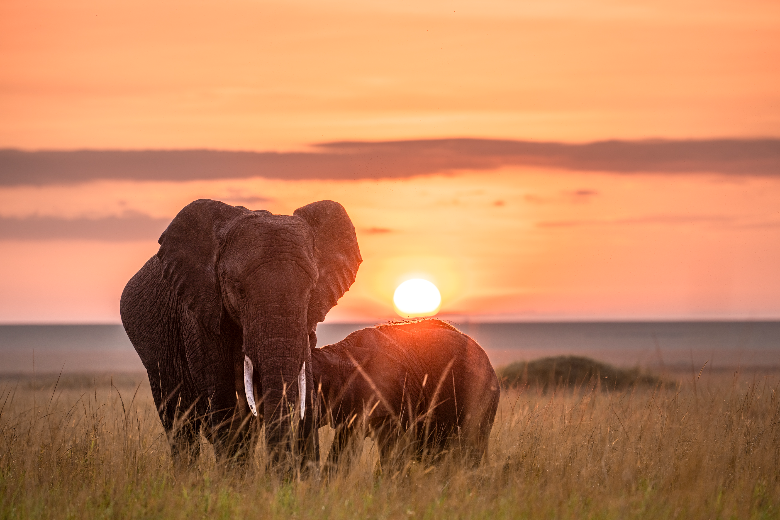
The focal length choice for sunset landscape photography on safari depends on your intended compositional emphasis — whether you want to include wide context that shows the landscape scale that makes African sunsets so distinctive, or to compress distance with a telephoto to bring wildlife subjects into proximity with the sky’s color and detail. A wide-angle lens in the 16 to 35mm range captures the full sweep of an African sky that typically occupies sixty or seventy percent of the image area in genuinely dramatic sunset scenes, but requires interesting foreground elements within three to ten meters of the camera to anchor the composition and prevent it from becoming an empty sky photograph that communicates scale without drama. A telephoto in the 200 to 400mm range compresses the distance between a wildlife subject and a distant orb of the setting sun, allowing the sun’s disk to appear larger in the frame relative to the subject — the classic “elephant in front of the setting sun” composition that most safari photographers attempt at least once and that requires the specific geometry of subject, camera, and sun position to align correctly, which is a function of vehicle positioning and patience at the right moment rather than focal length alone.

Location and Positioning for the Perfect Shot

Finding the Right Spot in the Bush

Working With Your Guide to Find the Best Viewpoints

Your professional guide’s knowledge of the game reserve’s geography is your most valuable asset in positioning correctly for sunset photography, because they understand which elevated ground provides unobstructed western horizon views, which waterholes have wildlife likely to be drinking in the last hour of light, which tracks run east-west and therefore allow vehicle positioning with subjects backlit by the setting sun, and which specific acacia trees are large and dramatic enough to create the iconic silhouette compositions that characterize the genre’s most successful images. Communicating your photographic intentions to your guide early in the afternoon drive — explaining that you want to be at a specific type of viewpoint by a specific time — allows them to plan the drive route around that objective while still covering wildlife-searching ground in the cooler afternoon period before the golden light begins. This is not an imposition on the guide’s judgment; it is exactly the kind of guest preference communication that excellent guides want to receive because it allows them to craft a tailored experience rather than running a generic route.

The traditional sundowner stop — where the guide pulls up at a predetermined viewpoint with drinks and snacks as the sun approaches the horizon — is the standard safari format for sunset appreciation, but photographers who treat it as a photographic session rather than a social occasion maximize the creative potential of the twenty to forty minutes it typically occupies. Positioning yourself on the roof hatches or standing platform of the vehicle before the guide stops, rather than waiting until stationary and then trying to stand up, gives you an additional two minutes of shooting time during the approach when the vehicle’s movement can be used creatively to sweep across a horizon or track a moving subject against a brightening sky. Moving around the vehicle to use different backgrounds, shooting into the sun at specific moments when clouds create natural light diffusion, and photographing fellow guests as silhouettes against the sunset sky rather than as posed portrait subjects all expand the image variety produced during a single sundowner stop into a set of images that tell a more complete story of the evening than a straight sunset landscape series alone provides.

Plan Your Safari

African Wild Trekkers incorporates sunset photography positioning into the planning of every afternoon game drive for guests with a declared interest in landscape and wildlife photography. Our team identifies the specific viewpoints, waterhole positions, and landscape features in each destination that offer the best golden hour photography opportunities across different seasons and light conditions, and advises guests on the specific camera settings and compositional approaches that work best in each environment.

For guests with a serious photographic interest, we can arrange dedicated photography guides for afternoon drives who understand the technical requirements of sunset shooting, position vehicles with photographic geometry rather than just viewing angle, and manage the group’s pace to ensure that the final hour of light is spent in the most productive available location rather than moving between sightings when the real opportunity is to stop, position, and wait for the light to do what African light does in that extraordinary window before dark.

Contact African Wild Trekkers at africanwildtrekkers.com/contact with your photographic interests and safari destination and we will design an itinerary that puts you in the right place at the right time for Africa’s most extraordinary daily spectacle within 24 hours.

Mastering Exposure in Golden Hour Light

The most common technical mistake that photographers make during golden hour safari shooting is allowing the camera’s automatic exposure system to neutralize the very quality that makes the light extraordinary. Modern camera metering systems are calibrated to produce “correct” exposures that reproduce tones as middle grey — an approach that works excellently under flat, neutral light but actively works against the photographer during golden hour by reducing the warm orange cast of sunset light toward a more neutral white balance and brightening shadow areas that the photographer should allow to remain dark in order to preserve the dramatic, high-contrast aesthetic that makes golden hour images immediately recognizable. The correction for this is to shoot in manual exposure mode during the most dramatic sunset light, setting your shutter speed, aperture, and ISO independently based on a meter reading taken from a mid-tone in the scene rather than allowing the camera to continuously rebalance exposure as the sky’s brightness changes. Reducing exposure compensation by one-third to two-thirds of a stop below the camera’s metered recommendation typically preserves the richness of warm sunset tones while retaining detail in the key subject areas — a balance that you can preview in real time on mirrorless camera EVFs that show the exposure effect before capture.

White balance management during golden hour determines whether your sunset photographs retain the warm orange-red-amber quality of the actual light or reproduce as neutrally balanced daylight that looks accurate but emotionally flat. Setting white balance manually to “Daylight” or approximately 5500K rather than leaving it on “Auto White Balance” prevents the camera from correcting out the warmth of sunset light and preserves the tonal character that makes golden hour photographs instantly atmospheric. Shooting in raw file format rather than JPEG makes white balance a completely non-destructive decision — you can adjust it in any direction during post-processing without quality loss — and is the single most important camera setting change that any photographer can make before a safari. The additional file size of raw versus JPEG is marginal relative to the enormous flexibility it provides in post-processing, and the ability to recover a single stop of exposure in either direction without visible quality degradation can save photographs captured during the rapidly changing light of the last fifteen minutes before sunset that would be unrecoverable as JPEG files.

Lenses, Silhouettes, and Compositional Approaches

The silhouette is the most powerful compositional tool available for African sunset photography, because it simultaneously solves the technical challenge of extreme brightness contrast between a glowing orange sky and a dark foreground subject while producing the most graphically striking and emotionally resonant image type that the African bush environment offers. The silhouette photograph requires no complex exposure balancing — expose for the bright sky so that it reproduces with color and detail, and the foreground subject automatically becomes a dark shape defined only by its outline against the luminous background — and the resulting image’s impact depends entirely on the quality of that outline shape. Wildlife subjects with iconic profile forms — the giraffe’s extraordinary neck extending above a flat acacia canopy, the elephant bull’s massive domed head and curving tusks, the acacia tree’s flat-topped spreading crown against a red-orange sky, the lone wildebeest standing on a kopje above the plains — produce silhouette photographs whose immediate visual impact transcends the technical complexity required to produce them. Positioning the vehicle so that the sunset sky forms the background of your chosen subject, without intervening vegetation or horizon clutter that breaks the silhouette’s clean edge, is the single most important compositional decision you make at the sundowner stop.

The focal length choice for sunset landscape photography on safari depends on your intended compositional emphasis — whether you want to include wide context that shows the landscape scale that makes African sunsets so distinctive, or to compress distance with a telephoto to bring wildlife subjects into proximity with the sky’s color and detail. A wide-angle lens in the 16 to 35mm range captures the full sweep of an African sky that typically occupies sixty or seventy percent of the image area in genuinely dramatic sunset scenes, but requires interesting foreground elements within three to ten meters of the camera to anchor the composition and prevent it from becoming an empty sky photograph that communicates scale without drama. A telephoto in the 200 to 400mm range compresses the distance between a wildlife subject and a distant orb of the setting sun, allowing the sun’s disk to appear larger in the frame relative to the subject — the classic “elephant in front of the setting sun” composition that most safari photographers attempt at least once and that requires the specific geometry of subject, camera, and sun position to align correctly, which is a function of vehicle positioning and patience at the right moment rather than focal length alone.

Location and Positioning for the Perfect Shot

Finding the Right Spot in the Bush

Working With Your Guide to Find the Best Viewpoints

Your professional guide’s knowledge of the game reserve’s geography is your most valuable asset in positioning correctly for sunset photography, because they understand which elevated ground provides unobstructed western horizon views, which waterholes have wildlife likely to be drinking in the last hour of light, which tracks run east-west and therefore allow vehicle positioning with subjects backlit by the setting sun, and which specific acacia trees are large and dramatic enough to create the iconic silhouette compositions that characterize the genre’s most successful images. Communicating your photographic intentions to your guide early in the afternoon drive — explaining that you want to be at a specific type of viewpoint by a specific time — allows them to plan the drive route around that objective while still covering wildlife-searching ground in the cooler afternoon period before the golden light begins. This is not an imposition on the guide’s judgment; it is exactly the kind of guest preference communication that excellent guides want to receive because it allows them to craft a tailored experience rather than running a generic route.

The traditional sundowner stop — where the guide pulls up at a predetermined viewpoint with drinks and snacks as the sun approaches the horizon — is the standard safari format for sunset appreciation, but photographers who treat it as a photographic session rather than a social occasion maximize the creative potential of the twenty to forty minutes it typically occupies. Positioning yourself on the roof hatches or standing platform of the vehicle before the guide stops, rather than waiting until stationary and then trying to stand up, gives you an additional two minutes of shooting time during the approach when the vehicle’s movement can be used creatively to sweep across a horizon or track a moving subject against a brightening sky. Moving around the vehicle to use different backgrounds, shooting into the sun at specific moments when clouds create natural light diffusion, and photographing fellow guests as silhouettes against the sunset sky rather than as posed portrait subjects all expand the image variety produced during a single sundowner stop into a set of images that tell a more complete story of the evening than a straight sunset landscape series alone provides.

Plan Your Safari

African Wild Trekkers incorporates sunset photography positioning into the planning of every afternoon game drive for guests with a declared interest in landscape and wildlife photography. Our team identifies the specific viewpoints, waterhole positions, and landscape features in each destination that offer the best golden hour photography opportunities across different seasons and light conditions, and advises guests on the specific camera settings and compositional approaches that work best in each environment.

For guests with a serious photographic interest, we can arrange dedicated photography guides for afternoon drives who understand the technical requirements of sunset shooting, position vehicles with photographic geometry rather than just viewing angle, and manage the group’s pace to ensure that the final hour of light is spent in the most productive available location rather than moving between sightings when the real opportunity is to stop, position, and wait for the light to do what African light does in that extraordinary window before dark.

Contact African Wild Trekkers at africanwildtrekkers.com/contact with your photographic interests and safari destination and we will design an itinerary that puts you in the right place at the right time for Africa’s most extraordinary daily spectacle within 24 hours.

Why African Sunsets Are a Photographer’s Greatest Opportunity

The quality of light that the African savanna produces in the hour before sunset is unlike anything available in European, North American, or Asian landscapes, and understanding why helps photographers position themselves, prepare their equipment, and make compositional decisions that fully exploit the phenomenon rather than responding to it reactively as it unfolds around them. The African sun’s path across a sky unobstructed by significant atmospheric pollution — particularly in arid destinations like the Namib Desert, the Kalahari, and Tanzania’s northern parks during the dry season — produces a golden hour light of extraordinary purity, warmth, and horizontal directionality that wraps around wildlife subjects with a three-dimensionality that photographers working in hazy industrial landscapes rarely encounter. The low angle of the pre-sunset sun creates long shadows that define texture in grass, soil, and tree bark with a precision that overhead midday light entirely flattens, and the warm orange-red color cast that this light adds to every subject it touches produces a tonal richness that camera sensors reproduce beautifully in raw files that require minimal post-processing to achieve the quality that took studio photographers hours in a darkroom to approximate in the film era.

The combination of exceptional light quality with African wildlife’s crepuscular activity peak — the hour before sunset being the period when predators begin to move, prey species gather at waterholes in the afternoon light, and bird species reach their highest activity levels before roosting — creates a convergence of photographic opportunity that no other landscape on earth matches in its combination of light quality, subject variety, and behavioral intensity. The best safari sunset photographs are not lucky captures of incidental beauty; they are the product of deliberate positioning, understood camera settings, pre-visualized compositional approaches, and a patient, informed presence in the right location during the exact window when all the elements align simultaneously. This guide provides the specific technical and strategic knowledge that allows any photographer — from the enthusiastic smartphone user to the experienced system camera operator — to make the most of Africa’s most extraordinary daily light show.

Camera Settings and Technical Preparation

Exposure, White Balance, and Shooting Mode

Mastering Exposure in Golden Hour Light

The most common technical mistake that photographers make during golden hour safari shooting is allowing the camera’s automatic exposure system to neutralize the very quality that makes the light extraordinary. Modern camera metering systems are calibrated to produce “correct” exposures that reproduce tones as middle grey — an approach that works excellently under flat, neutral light but actively works against the photographer during golden hour by reducing the warm orange cast of sunset light toward a more neutral white balance and brightening shadow areas that the photographer should allow to remain dark in order to preserve the dramatic, high-contrast aesthetic that makes golden hour images immediately recognizable. The correction for this is to shoot in manual exposure mode during the most dramatic sunset light, setting your shutter speed, aperture, and ISO independently based on a meter reading taken from a mid-tone in the scene rather than allowing the camera to continuously rebalance exposure as the sky’s brightness changes. Reducing exposure compensation by one-third to two-thirds of a stop below the camera’s metered recommendation typically preserves the richness of warm sunset tones while retaining detail in the key subject areas — a balance that you can preview in real time on mirrorless camera EVFs that show the exposure effect before capture.

White balance management during golden hour determines whether your sunset photographs retain the warm orange-red-amber quality of the actual light or reproduce as neutrally balanced daylight that looks accurate but emotionally flat. Setting white balance manually to “Daylight” or approximately 5500K rather than leaving it on “Auto White Balance” prevents the camera from correcting out the warmth of sunset light and preserves the tonal character that makes golden hour photographs instantly atmospheric. Shooting in raw file format rather than JPEG makes white balance a completely non-destructive decision — you can adjust it in any direction during post-processing without quality loss — and is the single most important camera setting change that any photographer can make before a safari. The additional file size of raw versus JPEG is marginal relative to the enormous flexibility it provides in post-processing, and the ability to recover a single stop of exposure in either direction without visible quality degradation can save photographs captured during the rapidly changing light of the last fifteen minutes before sunset that would be unrecoverable as JPEG files.

Lenses, Silhouettes, and Compositional Approaches

The silhouette is the most powerful compositional tool available for African sunset photography, because it simultaneously solves the technical challenge of extreme brightness contrast between a glowing orange sky and a dark foreground subject while producing the most graphically striking and emotionally resonant image type that the African bush environment offers. The silhouette photograph requires no complex exposure balancing — expose for the bright sky so that it reproduces with color and detail, and the foreground subject automatically becomes a dark shape defined only by its outline against the luminous background — and the resulting image’s impact depends entirely on the quality of that outline shape. Wildlife subjects with iconic profile forms — the giraffe’s extraordinary neck extending above a flat acacia canopy, the elephant bull’s massive domed head and curving tusks, the acacia tree’s flat-topped spreading crown against a red-orange sky, the lone wildebeest standing on a kopje above the plains — produce silhouette photographs whose immediate visual impact transcends the technical complexity required to produce them. Positioning the vehicle so that the sunset sky forms the background of your chosen subject, without intervening vegetation or horizon clutter that breaks the silhouette’s clean edge, is the single most important compositional decision you make at the sundowner stop.

The focal length choice for sunset landscape photography on safari depends on your intended compositional emphasis — whether you want to include wide context that shows the landscape scale that makes African sunsets so distinctive, or to compress distance with a telephoto to bring wildlife subjects into proximity with the sky’s color and detail. A wide-angle lens in the 16 to 35mm range captures the full sweep of an African sky that typically occupies sixty or seventy percent of the image area in genuinely dramatic sunset scenes, but requires interesting foreground elements within three to ten meters of the camera to anchor the composition and prevent it from becoming an empty sky photograph that communicates scale without drama. A telephoto in the 200 to 400mm range compresses the distance between a wildlife subject and a distant orb of the setting sun, allowing the sun’s disk to appear larger in the frame relative to the subject — the classic “elephant in front of the setting sun” composition that most safari photographers attempt at least once and that requires the specific geometry of subject, camera, and sun position to align correctly, which is a function of vehicle positioning and patience at the right moment rather than focal length alone.

Location and Positioning for the Perfect Shot

Finding the Right Spot in the Bush

Working With Your Guide to Find the Best Viewpoints

Your professional guide’s knowledge of the game reserve’s geography is your most valuable asset in positioning correctly for sunset photography, because they understand which elevated ground provides unobstructed western horizon views, which waterholes have wildlife likely to be drinking in the last hour of light, which tracks run east-west and therefore allow vehicle positioning with subjects backlit by the setting sun, and which specific acacia trees are large and dramatic enough to create the iconic silhouette compositions that characterize the genre’s most successful images. Communicating your photographic intentions to your guide early in the afternoon drive — explaining that you want to be at a specific type of viewpoint by a specific time — allows them to plan the drive route around that objective while still covering wildlife-searching ground in the cooler afternoon period before the golden light begins. This is not an imposition on the guide’s judgment; it is exactly the kind of guest preference communication that excellent guides want to receive because it allows them to craft a tailored experience rather than running a generic route.

The traditional sundowner stop — where the guide pulls up at a predetermined viewpoint with drinks and snacks as the sun approaches the horizon — is the standard safari format for sunset appreciation, but photographers who treat it as a photographic session rather than a social occasion maximize the creative potential of the twenty to forty minutes it typically occupies. Positioning yourself on the roof hatches or standing platform of the vehicle before the guide stops, rather than waiting until stationary and then trying to stand up, gives you an additional two minutes of shooting time during the approach when the vehicle’s movement can be used creatively to sweep across a horizon or track a moving subject against a brightening sky. Moving around the vehicle to use different backgrounds, shooting into the sun at specific moments when clouds create natural light diffusion, and photographing fellow guests as silhouettes against the sunset sky rather than as posed portrait subjects all expand the image variety produced during a single sundowner stop into a set of images that tell a more complete story of the evening than a straight sunset landscape series alone provides.

Plan Your Safari

African Wild Trekkers incorporates sunset photography positioning into the planning of every afternoon game drive for guests with a declared interest in landscape and wildlife photography. Our team identifies the specific viewpoints, waterhole positions, and landscape features in each destination that offer the best golden hour photography opportunities across different seasons and light conditions, and advises guests on the specific camera settings and compositional approaches that work best in each environment.

For guests with a serious photographic interest, we can arrange dedicated photography guides for afternoon drives who understand the technical requirements of sunset shooting, position vehicles with photographic geometry rather than just viewing angle, and manage the group’s pace to ensure that the final hour of light is spent in the most productive available location rather than moving between sightings when the real opportunity is to stop, position, and wait for the light to do what African light does in that extraordinary window before dark.

Contact African Wild Trekkers at africanwildtrekkers.com/contact with your photographic interests and safari destination and we will design an itinerary that puts you in the right place at the right time for Africa’s most extraordinary daily spectacle within 24 hours.