How to Photograph Sunsets on Safari: Golden Hour Tips From the Bush
The African sunset is not merely a photographic cliché. safari sunset photography is the culmination of a specific atmospheric and geographic combination. It produces light quality, color saturation, and visual drama genuinely unavailable in most of the world’s other environments. The dust particles suspended in the dry-season air scatter and filter the low-angle evening light.
They saturate the orange and red wavelengths while softening the harsh contrast of midday sun into a warm, direction-giving light. This flatters every subject from a lone acacia silhouette to an elephant herd crossing the plain in the final hour before dark. The flat, open landscape of the African savanna extends the visible horizon to distances of twenty to forty kilometers. It allows the sunset to fill the entire frame without interruption from hills, buildings, or forest canopy.
And Africa’s wildlife provides foreground subjects of inherent dramatic interest. The giraffe against a burning sky, the baobab reduced to a black architectural sculpture by the falling sun, the lion pride filing along a ridge line at golden hour. Photographers in other environments can only envy these subjects. The African sunset photograph earns its ubiquity because the subject genuinely delivers at a level that almost any photographer can capture.
Golden hour photography on safari differs from golden hour photography in most other contexts. The conditions change extremely rapidly in ways that require advance preparation, active positioning, and the willingness to abandon other activity. The African sun does not linger near the horizon in the drawn-out gradient descent of a northern European summer sunset. It drops with the speed characteristic of equatorial latitudes, covering the final fifteen degrees of arc in approximately thirty minutes. The quality of the light within that window moves through distinct stages.
There is the warm but still-bright pre-sunset gold. Then there is the saturated orange of the fifteen minutes around the horizon crossing. Finally there is the brief but spectacular afterglow that colors the sky in pink and purple tones for five to ten minutes after the sun disappears.
Missing the transition from gold to orange because you were mid-conversation means missing the best light of the day. This irreversibility of the photographic opportunity is what distinguishes golden hour planning from the more forgiving light conditions of the rest of the safari day.
Camera Settings and Techniques for Sunset Photography
Getting the Exposure Right at Sunset
Exposing correctly for an African sunset requires understanding that the camera’s automatic metering system will consistently underexpose foreground subjects when left uncorrected. The bright sky and the dark silhouetted foreground create a contrast range that frequently exceeds the dynamic range of a single exposure. The camera’s multi-zone evaluative metering will attempt to average this contrast by splitting the difference between the bright sky and dark foreground.
This produces a sky that is correctly exposed but a foreground that is too dark. Or a foreground that is correctly exposed but a sky that is blown out to white. The practical solution is to decide in advance which element you are prioritizing.
The sky color or the foreground subject detail. Expose deliberately for that element rather than allowing the camera to make a metering compromise that satisfies neither. For the classic African sunset silhouette image, meter deliberately for the sky without the dark foreground in frame. Lock the exposure setting, then recompose to include the foreground silhouette. The foreground renders pure black, which is the intended effect, while the sky retains its full color saturation.
Manual exposure control allows more precise iteration through the rapidly changing light conditions of the golden hour than automatic modes provide. Setting the ISO between 400 and 800 in the pre-sunset period is a good starting point. Choose an aperture of f/5.6 to f/8 that provides adequate depth of field for landscape-scale subjects. Then adjust shutter speed incrementally as the light level falls — typically every two to three minutes.
This keeps the exposure tracking the actual available light rather than jumping erratically as the camera’s automatic system repeatedly recalculates. Most photographers using manual mode find that checking the histogram every four or five frames gives a faster, more reliable guide than the camera’s LCD preview screen. The LCD changes apparent brightness as ambient light falls even when displaying the same photograph. The histogram provides an objective tonal distribution graph that ambient light cannot affect.
Composition Strategies for Golden Hour
The temptation to fill the sky with sunset color and relegate the foreground to a narrow strip at the bottom is the most common compositional mistake in safari sunset photography. It is natural because the sky is so spectacular in the golden hour that the photographer instinctively wants to maximize its representation in the frame.
But it is wrong because a sky-dominant composition typically produces an image with no visual anchor, no sense of scale or place, and no narrative tension. The more effective approach places the horizon line between one-third and one-quarter of the way up from the bottom of the frame. This gives the sky its dominant proportion while providing a foreground band wide enough to contain meaningful subject matter.
A tree silhouette, a waterhole reflection, a vehicle with its occupants, a line of walking elephant. All ground the image and provide the sense of African safari context. The African context of the foreground subject is what makes the sky meaningful. Without it, the sky is just a sky.
Silhouette photography is the most consistently rewarding compositional approach at the African golden hour. The clean black shapes of wildlife, trees, and landscape features against saturated orange and pink sky create images of graphic clarity and immediate visual impact. Identifying potential silhouette subjects in advance transforms golden hour positioning from reactive scrambling to deliberate preparation.
The dead acacia at the edge of the waterhole that has a distinctive twisted shape, the termite mound on the ridge line that reaches exactly the right height against the sky horizon, the position on the track where a giraffe will align with the dropping sun. All of these can be identified in advance. This allows you to move calmly to the right spot before the best light arrives. Arriving late means discovering that the optimal position requires repositioning the vehicle across terrain you cannot cross in the time available.
Wildlife Subjects in the Golden Hour
The practical challenge of combining golden hour landscape photography with wildlife subject photography is that the two activities frequently pull in opposite directions. The landscape composition requires positioning the vehicle with the setting sun behind and the open western horizon in front. But the wildlife that appears during the golden hour often approaches from the wrong direction for the ideal light angle.
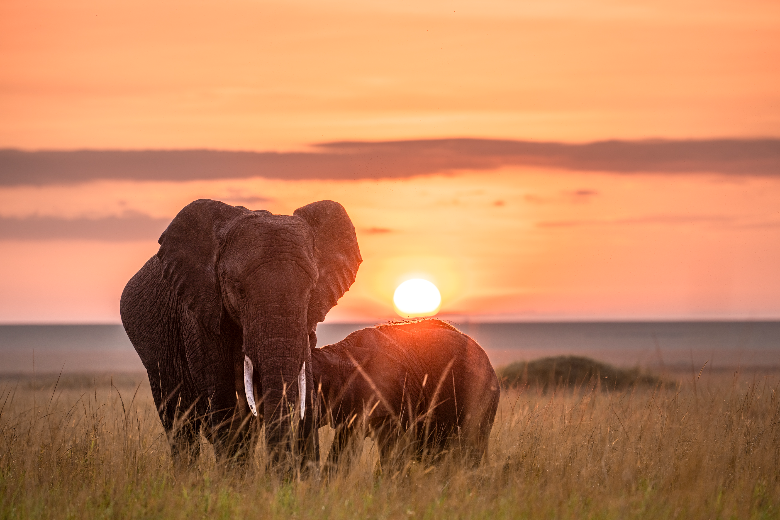
It may stand in a position that places it backlit or side-lit rather than in front-lit condition. Embracing rather than fighting this tension produces some of the most technically interesting sunset wildlife photographs. A bull elephant side-lit in warm orange with a deep shadow on the far side of his body is an example. The texture of his skin is highlighted by the raking low light. Positioned against a sky full of saturated color, he creates an image of greater complexity and visual richness than the same elephant photographed in even midmorning light.
Learning to see the golden hour light direction as a creative variable rather than a problem takes a few hours of practice. But photographers who develop this ability consistently describe their golden hour images as the most emotionally resonant photographs they produce on any African safari.
Plan Your Safari
African Wild Trekkers builds golden hour positioning time into every afternoon game drive schedule in our itineraries. We know from years of guest feedback that sunset encounters consistently produce the most beloved photographs of any safari. Arriving at the right position with sufficient time before the light peaks is the difference between images guests keep forever and images they delete on the flight home. We select lodge positions and afternoon drive routes specifically to include productive golden hour viewpoints.
For guests with a particular interest in wildlife photography, we connect you with lodges that offer dedicated photographic game drives with specialist photography guides. These provide smaller vehicle groups that allow the driver-guide to position the vehicle for each photographer individually. They also provide longer time windows at productive locations that standard game drives cannot provide. The African golden hour rewards patience, positioning, and preparation — and we plan your itinerary to deliver all three.
Contact African Wild Trekkers at africanwildtrekkers.com/contact with your photographic interests and destination and we will design an itinerary that places you in the right light at the right time within 24 hours.