Kirk’s Dik-Dik Facts: The Tiny Antelope With a Lifelong Pair Bond
The dik-dik is the smallest antelope most East Africa safari visitors encounter. Standing 35 to 45 centimetres at the shoulder and weighing 3 to 7 kilograms, a dik-dik is the size of a medium dog — yet it survives among lions, leopards, cheetahs, caracals, African wild dogs, pythons, martial eagles, and crowned eagles. Its survival strategy is not speed, size, or strength. It relies on a precise knowledge of a small home range, an excellent alarm system, a permanent pair bond, and a series of scent-marking behaviours that communicate territorial status to every other dik-dik in the area.
What Is a Kirk’s Dik-Dik?
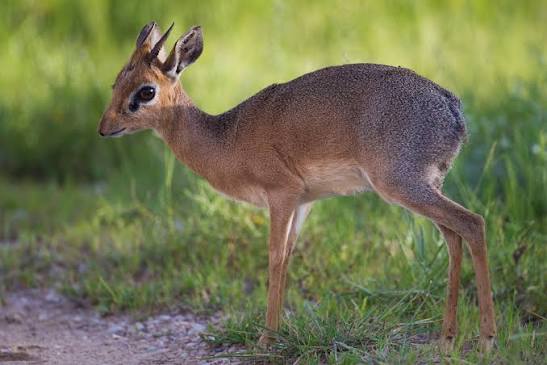
Kirk’s dik-dik, Madoqua kirkii, is the most widespread of the four dik-dik species. Adults weigh between 3 and 7 kilograms. Shoulder height reaches 35 to 45 centimetres. Only males carry horns short, upright, and slightly ridged, reaching 3 to 11 centimetres. The coat is greyish-brown on the back with paler sides and a whitish belly. The face carries a distinctive elongated, flexible snout a small proboscis that functions as a heat-exchange organ, cooling the blood before it reaches the brain in hot conditions. Large dark eyes with a prominent preorbital gland a dark triangular marking in front of each eye complete the instantly recognisable face.
The name comes from the alarm call a sharp, repeated whistle of “zik-zik” or “dik-dik” that both sexes produce when a predator or observer approaches. This call alerts the pair’s partner and warns neighbouring pairs simultaneously.
Lifelong Monogamy: The Pair Bond
Kirk’s dik-dik forms lifelong monogamous pair bonds. A mated pair occupies and jointly defends a territory of 2 to 15 hectares. The pair stays together year-round feeding, resting, and moving together throughout the day. When a predator disturbs one partner, it calls and the other immediately goes on alert. When one partner dies, the survivor often abandons the territory the territory is linked to the pair rather than to the individual. Replacement pairs form quickly when two unattached individuals meet, but a single dik-dik without a partner is highly vulnerable.
Preorbital Gland Marking
The large preorbital glands produce a dark, sticky secretion that both sexes deposit onto twigs, grass stems, and low vegetation at territory boundaries. The dik-dik presses its face against the stem and wipes the secretion off with a deliberate sideways movement of the head. Both partners mark the same boundary points, building up a scent profile that communicates the pair’s identity, presence, and territorial status to neighbouring dik-diks. Dung piles at fixed latrine sites along the boundary supplement the preorbital gland marking, creating a layered scent communication system at the territorial border.
Habitat and Diet
Kirk’s dik-dik occupies dense scrub, thornbush, and dry woodland particularly areas with abundant low browse under 1.5 metres. It does not depend on surface water, obtaining sufficient moisture from leaves, buds, and fruit. This independence from water allows dik-diks to persist in dry-country habitats where most antelope cannot survive without a dry-season water source. Kenya’s Samburu and Tsavo, Tanzania’s Tarangire and Ruaha, and much of the East African dry savanna all hold excellent dik-dik populations in dense bush zones.
Plan Your Safari
Kirk’s dik-dik appears on almost every East Africa game drive in thorny scrub habitat. Samburu National Reserve, Tsavo East and West, and Tarangire National Park produce daily dik-dik encounters — paired individuals stand at the roadside in the early morning, and the alarm call announces them before they are visible. Watching a pair’s preorbital gland marking behaviour, which occurs frequently at territory boundaries throughout the day, rewards patient observation from a stopped vehicle.
African Wild Trekkers designs Kenya and Tanzania safari itineraries through dry-country habitats where dik-dik pairs are a constant companion on game drives. Contact us to plan a safari exploring the full range of East Africa’s antelope diversity.