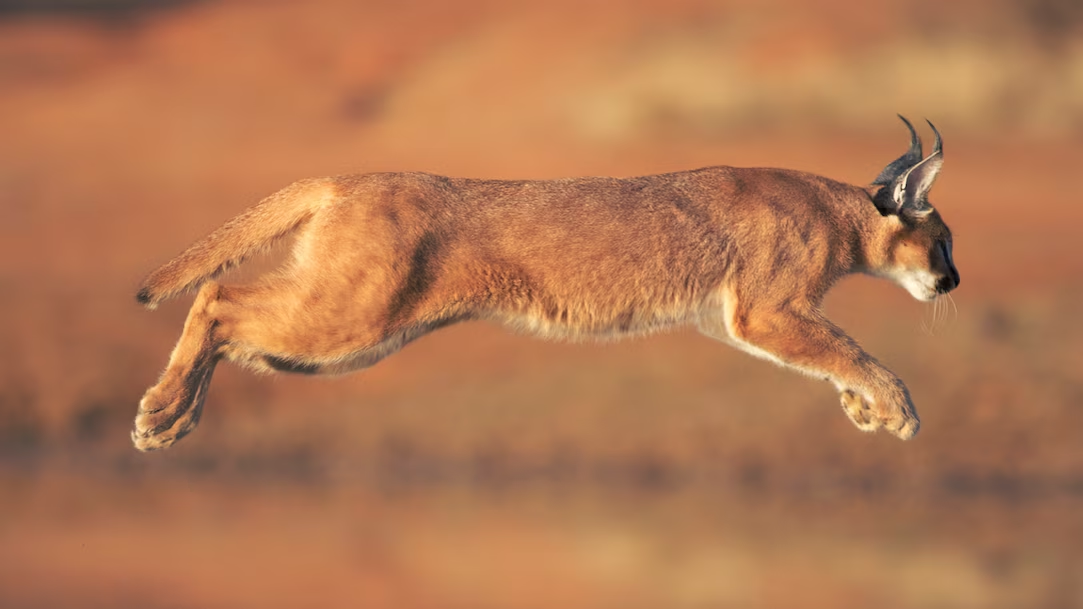
Caracal Hunting Facts: How Africa’s Most Agile Cat Catches Its Prey
A bird bursts from cover. In the same second, a tawny shape launches from the grass. Four meters of vertical leap, two tonsf striking force, and a bird dies in mid-air. The caracal is the master of the aerial strike. No other cat in Africa hunts quite like this, with quite this combination of explosive power and precision.
What Is the Caracal?
The caracal, *Caracal caracal*,*, is a medium-sized wild cat native to Africa, the Middle East, and parts of Asia. In Africa it belongs to two genera in some classifications—Caracalnd Leptailurus—butost taxonomists place it in its own genus,, Caracal. It is the largest of Africa’s small cats and the most powerful for its size.
An adult male caracal weighs between 8 and 18 kilograms. Females are lighter at 7 to 13 kilograms. Shoulder height reaches about 45 centimeters. Body length reaches 85 centimeters. The build is lean, muscular, and long-legged—thenatomy of a sprinting and leaping specialist rather than a pursuit predator.
Those Ears: Function and Purpose
The caracal’s most striking feature is its ears. Each ear is tall, pointed, and topped with a black tuft of hair that extends up to 4.5 centimeters above the ear tip. Twenty-nine separate muscles control each ear independently. The caracal rotates each ear through a wide arc, precisely locating sounds in three dimensions without moving its head.
The ear tufts amplify low-frequency sounds slightly and may improve directional hearing in dense vegetation. They also serve as a social signal—caracalsommunicate mood and intention to other individuals through ear position and tuft orientation. The tufts make ear position highly visible from a distance, conveying information that would be invisible on a shorter-eared cat.
The Aerial Strike: How It Works
The caracal’s most celebrated hunting technique is the aerial capture of birds. The cat approaches a flock of guinea fowl, francolins, or doves on the ground. At the moment of flushing, it springs into the air with its rear legs driving off a crouch position. The front paws swing in wide arcs, striking multiple birds with a batting motion.
High-speed photography has documented caracals striking up to twelve birds in a single leap. The paws move independently and rapidly. Individual birds are pinned against each other in the flock density at the moment of flush. The caracal can kill or stun several birds and collect them in sequence after landing.
The leap height is equally impressive. Caracals jump over four meters vertically from a standing start. This allows them to reach birds in the lower branches of trees, to grab prey that flies directly upward, and to spring over obstacles during ground-level pursuit.
What Caracals Hunt and Eat
Caracals eat rodents, hares, small antelopes, dik-dik, steenbok, and a wide range of birds. Hyraxes form an important part of the diet in rocky areas. In some regions, caracals kill small domestic livestock—sheep and goats—which brings them into conflict with farmers. Their predation of livestock makes them one of the most persecuted cats in Africa.
Caracals cache large prey in trees, like leopards do on a smaller scale. They drag prey several meters and sometimes partially bury it under leaf litter and grass to conceal it from scavengers. They return to a cache for two to three nights before abandoning it.
Habitat and Range in East Africa
Caracals live across Africa except for dense equatorial rainforests. In East Africa they inhabit dry savanna, rocky hillsides, scrubland, open woodland, and high-altitude moorland. Kenya holds strong populations in the Laikipia Plateau, Tsavo, and drier northern areas. Tanzania has them across the Serengeti ecosystem and in drier western zones. Uganda’s drier northern regions around Kidepo hold a population.
Caracal and Livestock Conflict
The caracal’s willingness to take prey larger than itself brings it into direct conflict with sheep and goat farmers across East Africa and southern Africa. In Kenya’s Laikipia and Samburu regions, caracals take young goats and sheep with enough regularity to cause significant economic loss to small-scale pastoralists. Retaliatory killing — trapping, snaring, and shooting — reduces caracal numbers near pastoral communities. The conflict is particularly acute in semi-arid zones where the caracal’s range overlaps densely with pastoral land use.
Research on livestock depredation in Kenya’s drylands shows that caracals account for a smaller proportion of losses than large carnivores but cause disproportionate fear and retaliation because the kills are frequent and the animal is hard to protect against. Unlike lions and leopards, which can be partially deterred by predator-proof bomas, caracals breach most conventional livestock enclosures by jumping. Community conservancies that provide compensation for verified caracal kills have reduced retaliatory killing in some Laikipia areas.
Caracal Conservation Status in East Africa
The caracal is classified as Least Concern by the IUCN globally. African populations are considered stable overall. East African populations outside protected areas face ongoing pressure from persecution. Within protected areas, caracal numbers appear healthy based on camera trap data from Laikipia, Tsavo, Samburu, and Tanzania’s drier western zones.
The caracal’s secretive nature and largely nocturnal habits make population monitoring difficult. Most estimates rely on camera trap indices rather than direct counts. Comparative data from the 1990s and 2020s in Kenya suggest that protected area populations have remained stable while farmland and pastoral land populations have declined in areas with active persecution programs. The conservation picture varies significantly between protected and unprotected landscapes.
Plan Your Safari
Caracals are genuinely difficult to see. They are largely crepuscular and nocturnal, solitary, and cryptically colored in dry grass. Night drives in the Laikipia Plateau and the drier parts of the Maasai Mara ecosystem in Kenya give reasonable odds. Dawn drives in rocky terrain is the other productive approach.
Kenya’s Ol Pejeta Conservancy and the wider Laikipia Plateau produce more consistent caracal sightings than most East Africa locations. The open, rocky terrain and active night drive program give the best chances in the region.
African Wild Trekkers designs Kenya safaris that include Laikipia and the full range of Kenya’s wild cat species. Contact us to build a trip targeting the cats most visitors miss.