Dwarf Mongoose Africa: The Smallest Carnivore With the Most Complex Society
The dwarf mongoose weighs less than 350 grams. It is Africa’s smallest carnivore. Yet it runs a sophisticated social system with a strict hierarchy, a permanent group territory, helpers at the den, and an unlikely partnership with a hornbill that protects the whole group. Small size carries no limit on complexity.
Size and Physical Features
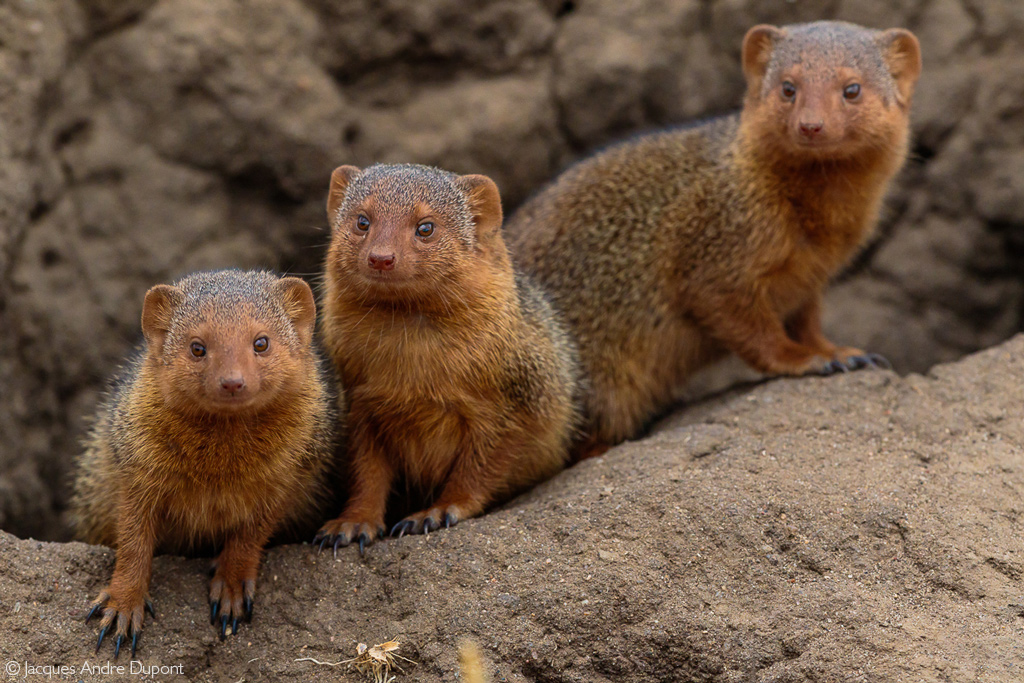
The dwarf mongoose, Helogale parvula, weighs between 210 and 350 grams. Body length reaches about 24 centimeters. The tail adds another 14 centimeters. The coat is a warm grizzled brown with lighter tones on the underside. The face is small and pointed with rounded ears and alert dark eyes.
Despite their tiny size, dwarf mongooses move with confidence. They climb termite mounds, trees, and large rocks. They use elevated positions as lookout posts. The claws are sharp and curved for gripping rough surfaces. The teeth are proportionally strong—capable of crushing insects and killing small lizards with a quick bite.
The Social Hierarchy
Dwarf mongooses live in groups of 8 to 25 individuals. The group has a strict dominance hierarchy. One dominant female and one dominant male lead the group. Only this pair breeds. Subordinate adults help raise the dominant pair’s offspring rather than producing their own.
Dominance depends on age in females. The oldest female in the group is the dominant breeder. When she dies or loses condition, the next oldest takes over. Male dominance is more fluid and involves some degree of competition. The dominant male spends significant time patrolling territory boundaries and scent-marking.
Diet and Foraging Behaviour
Dwarf mongooses eat insects, larvae, spiders, scorpions, small lizards, snakes, and the eggs of small birds. They forage by digging with their front claws and probing cracks in bark and soil. They work as a group through the same patch of ground, each individual taking its share before the group moves on.
Termites and their larvae are a preferred food. The mongooses target termite mounds with precision. They locate larvae by sound and smell before committing to excavation. A large termite mound may occupy a group for 20 minutes as each individual digs and eats in turn.
The Dwarf Mongoose and Yellow-Billed Hornbill: An Unusual Alliance
Dwarf mongoose groups associate closely with yellow-billed and red-billed hornbills. This association is mutualistic—both species benefit. The mongooses forage through grass and leaf litter, flushing insects as they move. The hornbills follow closely above and on the ground, catching insects the mongooses disturb but do not eat.
The hornbills provide a significant return service. They act as aerial sentinels. Their elevated vantage point gives them a wider field of view than the mongooses at ground level. When they detect a hawk or other aerial predator, they call sharply. The mongooses respond immediately to the hornbill’s alarm call, diving into cover faster than they respond to their own alarm system.
The mongooses also respond to the hornbills’ contact calls. If the hornbills are present and calling normally, the mongooses forage more boldly and with less vigilance. If the hornbills go quiet, the mongooses increase their own alertness immediately. The two species communicate across a language barrier through learned associations that develop within each group.
Range and Habitat in East Africa
Dwarf mongooses live across sub-Saharan Africa. They are common throughout East Africa in savanna, open woodland, thornbush, and rocky areas. They live in and around termite mounds, which they use as dens, lookout posts, and food sources. A large termite mound complex may shelter a group for years.
In East Africa, they are most easily found in dry to semi-dry woodland. Uganda’s Kidepo Valley National Park, Murchison Falls, and the northern savannas hold good populations. Kenya’s Tsavo and Samburu hold them in dry thorn bushes. Tanzania’s Tarangire and Ruaha support dwarf mongooses in dry woodland areas.
Predators of the Dwarf Mongoose
Dwarf mongooses face a long list of predators. Martial eagles, tawny eagles, and Wahlberg’s eagles hunt them from above. Slender mongooses, African wild cats, and servals pursue them on the ground. Pythons and puff adders threaten them in and around burrows. The group’s vigilance system and the hornbill partnership reduce predation risk significantly, but a group still loses members to predators several times per year.
The termite mound den system provides critical refuge. A dwarf mongoose group can disappear into a mound’s galleries faster than a predator can respond. Martial eagles—which take more mongooses than any other predator—have the best success rate when catching individuals that stray far from the mound. Groups that maintain a tighter foraging range around their home mound show lower predation rates in field studies. The trade-off is reduced food intake per individual when foraging is restricted.
Dwarf Mongoose Conservation and Population Health
The dwarf mongoose is classified as Least Concern by the IUCN. It is common and widespread across sub-Saharan Africa wherever suitable termite mound habitat exists. Population density is highest in dry woodland and savanna with abundant large mounds. Tanzania’s Tarangire and Ruaha hold particularly dense populations. Kenya’s Tsavo and Samburu also support strong numbers.
The species faces no immediate conservation threat at the population level. The main long-term risk is the loss of large termite mounds through agricultural land clearance. Mounds that take decades to build are destroyed in minutes by a plough. Without existing mound systems, dwarf mongoose groups cannot establish territories. Protecting the structural diversity of the African savanna—which includes its termite mound architecture—is essential for maintaining dwarf mongoose populations across their range.
Plan Your Safari
Dwarf mongooses are among the most rewarding small mammal encounters in East Africa. They are active during daylight hours and tolerate slow-moving vehicles well. The best watching comes around large termite mounds in dry woodland areas. A group will work the same mound for extended periods, giving excellent sustained observation.
Tanzania’s Tarangire National Park is outstanding for dwarf mongoose watching. The park’s ancient termite mounds are enormous. Each mound may house a permanent group. Hornbills associate with every group. The combined behavior of mongooses and hornbills interacting is a safari highlight that many first-time visitors completely overlook.
African Wild Trekkers designs East Africa safaris that include the small, fascinating mammals alongside the famous big game. Contact us to build an itinerary that gives the dwarf mongoose the time it deserves.