Marsh Mongoose Facts: The Waterside Hunter of East African Wetlands
Most mongooses hunt dry ground. The marsh mongoose hunts the water’s edge. It wades into rivers and lake shallows without hesitation, and it hunts crabs, frogs, and fish with the same decisive energy its relatives apply to termite mounds and lizards. It is one of East Africa’s most specialized small carnivores.
What Is the Marsh Mongoose?
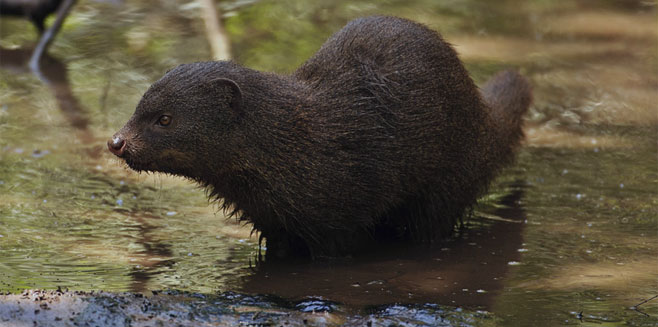
The marsh mongoose, Atilax paludinosus, is a medium-sized mongoose in the family Herpestidae. It is the sole member of its genus. No other mongoose species shares its semi-aquatic lifestyle or its physical adaptations to hunting in water. It ranges across sub-Saharan Africa wherever permanent water bodies provide suitable habitat.
An adult marsh mongoose weighs between 2.5 and 4.1 kilograms. Body length reaches about 55 centimeters. The tail adds another 35 centimeters. The build is stocky and robust compared to most mongooses. The legs are shorter relative to body size than those of drier-habitat species.
Physical Adaptations for Waterside Life
The marsh mongoose’s feet are large and partly webbed. This webbing improves swimming efficiency without committing the animal fully to an aquatic lifestyle. The claws are long and curved — excellent for gripping slippery rocks, prying apart reed stems, and reaching into crevices where crabs shelter.
The coat is dark brown to black, often appearing uniform in poor light. Close inspection reveals slight grizzling and individual variation. The tail is thick and tapering, used as a counterbalance during swimming. The ears are small and can close slightly when the animal submerges its head. The nostrils close fully underwater.
The Marsh Mongoose Hunting Method
The marsh mongoose hunts by wading into shallow water and probing with its hands. It reaches under rocks, into root tangles, and along submerged vegetation. It locates prey by touch rather than sight, particularly in turbid water. The hands are extraordinarily sensitive—the fingers work independently to feel movement and texture in darkness and mud.
Crabs are a dietary staple. The mongoose extracts a crab from its shelter and carries it to dry land. There it bites through the shell with its powerful jaws. It also eats frogs, fish, aquatic insects, mollusks, small snakes, and occasionally small mammals and birds near the water’s edge. On dry land it hunts like a terrestrial mongoose.
Solitary and Secretive Behaviour
Marsh mongooses are solitary outside of breeding season. They hold individual territories along river or lake banks. Territory size depends on food availability. Territories may overlap slightly between neighboring individuals. Boundaries are marked with anal gland secretions deposited on prominent objects along the bank.
Activity peaks in the morning and late afternoon. The marsh mongoose rests in dense waterside vegetation or in burrows during the middle of the day. It is secretive and disappears quickly into reeds or undergrowth when disturbed. Patient watching from a stationary position near water produces the best encounters.
Range and Habitat in East Africa
Marsh mongooses live throughout East Africa wherever permanent water bodies have vegetated banks. Uganda holds strong populations along the shores of Lakes Victoria, Albert, Edward, and George. The Kazinga Channel in Queen Elizabeth National Park is excellent habitat. Rwanda’s Lake Kivu shores and Nyungwe Forest streams shelter marsh mongooses. In Kenya they live along highland rivers and in the Aberdare area. Tanzania has populations around Lake Tanganyika and along major river systems.
The Marsh Mongoose and Wetland Loss
The marsh mongoose depends entirely on permanent water bodies with healthy vegetated margins. Across East Africa, wetland loss and degradation represent the most significant pressure on the species. Lake Victoria’s shoreline has lost large stretches of papyrus and reed habitat to urban expansion, agriculture, and sand mining. The remaining stretches support marsh mongoose populations, but the total available habitat is a fraction of what existed fifty years ago.
Water quality also matters. Heavily polluted sections of rivers and lake shores support fewer crabs, frogs, and fish—the marsh mongoose’s primary prey. Agricultural runoff, urban effluent, and industrial discharge reduce water clarity and prey availability simultaneously. Marsh mongooses in polluted waterway sections show lower body condition and smaller territory sizes than individuals in clean water areas. The correlation between water quality and marsh mongoose health is direct and strong.
Marsh Mongoose Conservation Status
The marsh mongoose is classified as Least Concern by the IUCN at the continental level. However, regional populations show signs of stress in degraded wetland areas. Uganda’s Lake Victoria shoreline populations have declined in areas with the most intense habitat modification. Rwanda’s wetland populations benefit from the country’s strong wetland protection legislation. Kenya’s highland river populations are relatively secure within protected areas.
The marsh mongoose is rarely a target of deliberate hunting. It does sometimes enter fish traps set by local fishers and drowns. This bycatch mortality is not tracked systematically but may be locally significant in areas with intensive small-scale fisheries. Community-based wetland management programs that reduce overfishing and maintain vegetated buffer zones around water bodies benefit marsh mongooses indirectly without targeting the species directly.
Plan Your Safari
The marsh mongoose rewards patience and attentiveness near water. Boat safaris on the Kazinga Channel in Uganda produce regular sightings along the bank. Dawn walks near riparian vegetation in any East African park with permanent water may produce encounters. The marsh mongoose moves slowly when hunting and often allows close observation before retreating.
African Wild Trekkers includes boat safaris on the Kazinga Channel in Uganda in its itineraries. Contact us to design a trip that covers Uganda’s exceptional waterway wildlife alongside its gorillas and open-country game.