Olive Baboon Diet: What East Africa’s Most Adaptable Primate Eats
The olive baboon eats almost anything it can find. This dietary flexibility is the foundation of its extraordinary success across sub-Saharan Africa. It thrives in rainforest, savanna, semi-desert, and farmland edges. It eats grass, fruit, insects, vertebrates, and crops. Understanding the olive baboon diet explains both its ecological dominance and its frequent conflict with human communities.
The Core Plant Diet
Grasses form the largest component of the olive baboon’s diet in savanna habitats. Specifically, baboons dig up grass corms—the starchy underground storage organs—with their fingers and teeth. Grass corms provide carbohydrates and moisture during dry seasons when surface vegetation is scarce. Baboons in the Amboseli ecosystem spend up to 40 percent of their foraging time digging corms in open grassland.
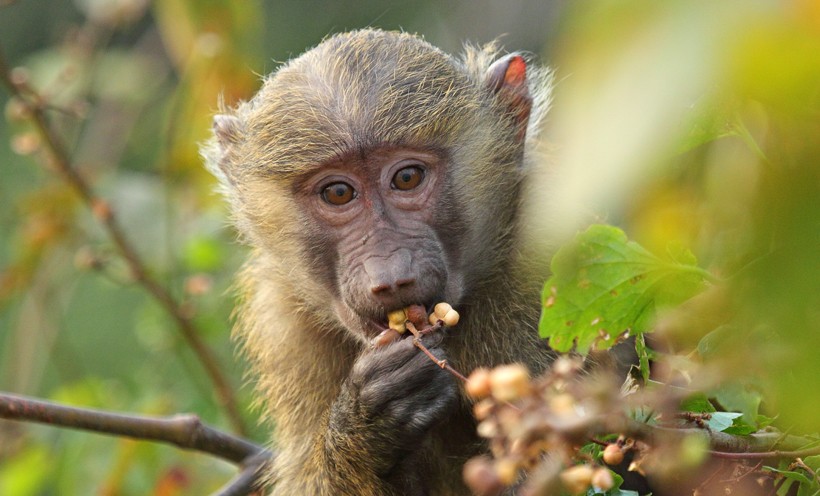
Fruits supplement the grass diet whenever available. Figs are a particularly important fruit source across East Africa. Baboons track fig tree fruiting cycles and travel long distances to access ripe figs. Other fruits — berries, pods, and wild dates — are eaten opportunistically. Flowers, leaves, bark, and fungi are consumed in smaller quantities, particularly during the transition between dry and wet seasons when preferred foods are temporarily scarce.
Insects and Invertebrates
Baboons eat insects extensively. They overturn rocks, peel bark, and dig soil to expose beetles, termites, scorpions, and ants. Foraging for invertebrates is particularly intensive in the wet season when termite alates emerge in large numbers. A troop at a termite emergence can consume thousands of individuals in under an hour. Termites provide protein and fat at a density that surface vegetation cannot match.
Scorpions are eaten with the sting removed. Adult baboons remove the metasoma and sting tip before consuming the body. Juvenile baboons sometimes eat the whole animal and learn through the painful consequences. This learning process represents genuine observational and trial-and-error learning over the juvenile period.
Meat-Eating: When Baboons Hunt
Olive baboons kill and eat vertebrate prey with some regularity. Adult males are the primary hunters. Prey includes vervet monkeys, hares, young Thomson’s gazelles, newborn wildebeest calves, small antelopes, and birds. A male baboon pursues and kills small prey alone. Group chasing of larger prey occurs occasionally. Meat is rarely shared willingly — it is contested aggressively and consumed quickly to prevent theft.
Hunting frequency varies widely between individuals and between troops. Some male baboons develop a clear hunting specialization and hunt several times per week. Others in the same troop rarely attempt to hunt. The driver of individual hunting behavior is not fully understood. Social rank does not predict hunting frequency reliably. Personal behavioral tendencies appear to be more important than social position.
Seasonal Diet Shifts
The olive baboon’s diet shifts substantially between wet and dry seasons. In the wet season, new grass shoots, flowers, and invertebrates are abundant. Diet quality is high and foraging time is relatively short. In the dry season, baboons rely more heavily on corms, seeds, and dry pods. Foraging time increases. Troop ranging distances expand to find sufficient food. Body condition declines in troops in poor habitat during prolonged dry periods.
Baboons in riparian and wetland habitats show less seasonal variation than those in drier savanna. Permanent water bodies support productive vegetation year-round. Troops that include river and swamp edges in their range have more stable food supplies than purely open-country troops.
Crop Raiding and Human Conflict
The same dietary flexibility that makes baboons successful in wild habitats makes them effective crop raiders. Maize, sorghum, sweet potatoes, cassava, and garden vegetables are nutritionally superior to most wild foods. A troop that discovers a farm enters systematically and efficiently. Sentinels post on high ground while others feed. The troop retreats at the approach of humans and returns when the threat passes.
Crop raiding causes real economic harm to subsistence farming communities near national parks and reserves. Management responses include hazing, guard dogs, beehive fences, and community-based ranger patrols. None eliminates raiding entirely. The problem is most acute at park boundaries in Uganda, Kenya, and Tanzania, where agricultural land abuts protected areas without buffer zones.
Plan Your Safari
Watching olive baboons forage gives genuine insight into primate intelligence and dietary flexibility. The Amboseli ecosystem in Kenya and Uganda’s Queen Elizabeth National Park both offer excellent troop observation opportunities. Spending an hour watching a troop dig corms, crack seeds, and navigate social interactions around food reveals a level of behavioral complexity that surprises most first-time observers.
African Wild Trekkers includes primate watching as a core component of East African safaris. Contact us to build a trip that gives time to the continent’s primates alongside its great game.