African Lion Facts: Everything You Need to Know Before Your East Africa Safari
The lion is Africa’s apex predator in the popular imagination — and the most eagerly sought animal on every first safari. Understanding its actual biology before you arrive transforms every encounter. The lion is not simply a large, dangerous cat that sleeps and occasionally chases wildebeest. It is a social animal with complex alliances, sophisticated hunting coordination, and a life shaped by competition, drought, and the relentless pressure of raising cubs in a landscape full of threats.
Size and Physical Features
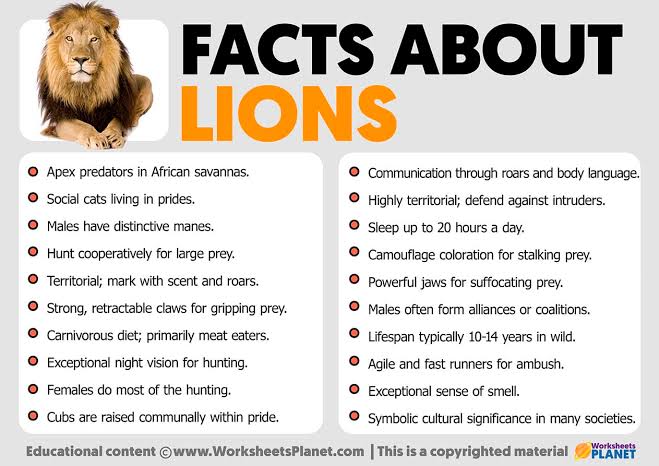
The African lion, Panthera leo, is the world’s second-largest cat after the tiger. An adult male weighs between 150 and 250 kilograms. Females weigh 120 to 182 kilograms. Body length in males reaches 1.7 to 2.5 metres, with a tail adding another 70 to 100 centimetres. Shoulder height in males is about 1.2 metres. The tawny coat is uniform over most of the body. Cubs carry spotted coats that fade to the adult tawny within the first year.
The male’s mane a ruff of longer hair around the head, neck, and chest develops from about 12 months old and reaches full development by 5 years. Mane colour ranges from pale gold to black. Darker manes correlate with higher testosterone levels, better body condition, and cooler habitat temperatures. In the Maasai Mara and Serengeti, adult males commonly develop full, dark-fringed manes by 5 to 7 years of age. In very hot environments the Tsavo ecosystem males often have little or no mane.
Pride Life: Social Structure
Lions are the only truly social wild cat. A pride consists of 2 to 40 individuals most commonly 3 to 12 adult females, their cubs of various ages, and a coalition of 1 to 4 adult males. The female members of the pride are related mothers, daughters, sisters, and aunts. This matrilineal core is permanent. Males join from outside through competitive displacement of resident males and leave when displaced in turn.
Female lions in a pride cooperate in hunting, cub-rearing, and territorial defence. Cubs nurse from any lactating female. When one female hunts, others guard the cubs. When a male threatens the cubs, multiple females respond collectively. This cooperative defence of shared offspring is the core functional benefit of group living for female lions.
Hunting: Females Do the Work
Lionesses perform most of the pride’s hunting. The male’s mane reduces his stealth and his larger body requires more energy to accelerate making him a less efficient ambush predator than the smaller, mane-free females. Females hunt cooperatively, using coordinated stalks that position individuals on multiple sides of a prey group. Prey is ambushed at ranges of 20 to 30 metres. The chase is short lions do not have the endurance for long pursuits and abort hunts after 150 to 300 metres if they have not made contact.
Lions kill through suffocation gripping the throat of the prey animal in the jaws and holding until asphyxiation. Large prey like buffalo may take 10 to 15 minutes to die. A pride killing a buffalo simultaneously attacks the throat, the hindquarters, and any available grip point to hold the animal still through the suffocation process.
Lion Range and Conservation
African lions once ranged across all of sub-Saharan Africa and into northwest India. Today fewer than 25,000 survive, concentrated in sub-Saharan Africa’s largest protected areas. East Africa holds the most significant populations. The Serengeti-Mara ecosystem supports over 3,000 lions the largest contiguous lion population remaining. Tanzania’s Selous-Nyerere, Kenya’s Tsavo, and Uganda’s Queen Elizabeth and Murchison Falls all hold significant but declining populations. The species is classified as Vulnerable on the IUCN Red List.
The primary threats to lions outside the great protected areas are human-wildlife conflict, retaliatory killing after livestock losses, prey base depletion from bushmeat hunting, and habitat loss. Inside large, well-managed ecosystems, lion populations are stable or growing. Outside them, the trend is consistently downward.
What a Safari Visitor Actually Sees
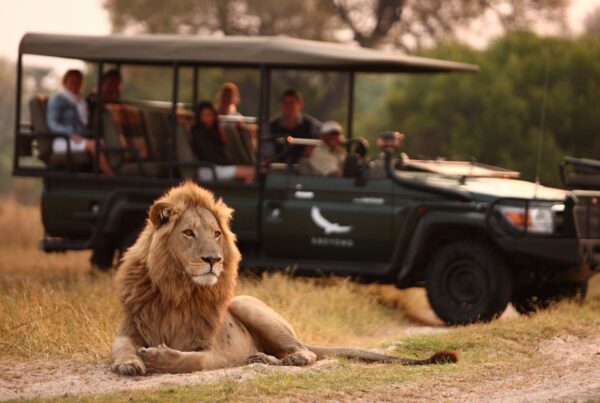
On a typical game drive in a lion-rich ecosystem, you are most likely to encounter lions resting. Lions sleep 16 to 20 hours per day. A resting lion is not a boring lion watch the social interactions between pride members, the cubs’ play, the males’ greeting rituals, and the subtle shifts in alertness when prey passes nearby. A pride that has not hunted since the previous evening is alert in a way that a recently fed pride is not. Reading these states turns a resting lion sighting into a detailed behavioural observation.
Plan Your Safari
The Maasai Mara and Serengeti are East Africa’s premier lion destinations. Both support dense lion populations with extensive research histories and experienced guides who know individual prides by name. Tanzania’s Ngorongoro Crater a contained ecosystem with one of Africa’s highest lion densities virtually guarantees multiple lion sightings on a full-day descent. Uganda’s Queen Elizabeth and Murchison Falls both hold lions, with Queen Elizabeth’s tree-climbing lions of Ishasha adding a unique dimension.
African Wild Trekkers builds East Africa lion safaris around the Maasai Mara, Serengeti, and Ngorongoro. Contact us to design an itinerary that puts you with lion prides at the right time and place.