Cheetah Facts Africa: Speed, Survival and the Open Plains Specialist
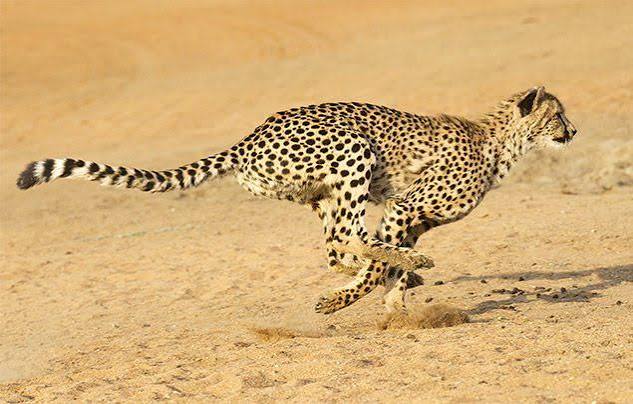
The cheetah holds one record that no other animal challenges: the fastest land speed ever recorded for any mammal. At 112 kilometres per hour in a timed sprint, it outruns every other creature on the planet on the ground. But the cheetah’s story is not really a story about speed. It is a story about trade-offs. Every physical system that makes the cheetah the fastest animal on land also makes it the most fragile of Africa’s big cats.
Physical Features and the Speed Anatomy
The cheetah, Acinonyx jubatus, is immediately recognisable. An adult male weighs between 21 and 72 kilograms. Females weigh 21 to 63 kilograms. Body length reaches 1.1 to 1.5 metres. The coat is tawny with solid black spots distinct from the rosette pattern of the leopard. The face carries black teardrop marks running from the inner corner of each eye down to the corner of the mouth. These marks reduce glare from the sun during daytime hunts on open plains.
The speed anatomy is comprehensive. The spine flexes and extends with each stride, adding 75 centimetres to the effective stride length. The large nasal passages, enlarged heart and lungs provide oxygen delivery at rates five times resting level during a sprint. Semi-retractable claws the only cat that cannot fully retract its claws grip the ground like running spikes. The long tail acts as a counterweight during rapid direction changes. The lightweight frame 15 to 30 percent less body mass than a leopard of equivalent length reduces the energy cost of acceleration.
The Cost of Speed: Physical Fragility
The same lightweight frame and large respiratory systems that produce speed create vulnerability. The cheetah’s jaws are smaller than a leopard’s or lion’s of the same body size the larger nasal passages occupy skull space that would otherwise hold jaw musculature. The cheetah cannot fight other large predators effectively. It cannot defend its kills against a single hyena. It loses kills to lions, leopards, and wild dogs routinely.
A sprint hunt exhausts the cheetah in under a minute. After a successful kill, the cheetah must rest for 20 to 30 minutes before it can eat gasping, panting, vulnerable. This recovery period is when scavengers locate and steal kills most frequently. In areas with high lion and hyena densities, a cheetah may lose 50 percent of its kills before eating a meaningful portion.
Hunting: The Daylight Specialist
The cheetah is the only big cat that hunts primarily in full daylight. Lions, leopards, and hyenas hunt predominantly at dawn, dusk, and night. The cheetah uses the midday hours when its competitors are resting and less likely to detect and steal its kills. This temporal separation reduces competition despite habitat overlap.
The hunt begins with a long stalk to within 30 to 70 metres of the target. The cheetah selects a specific individual usually a young, old, or slightly separated animal and commits to that individual exclusively. The sprint lasts 200 to 300 metres at maximum. Kill success averages 50 percent per attempt. After the kill, the cheetah suffocates the prey by gripping the throat, then moves it to cover before recovering.
Conservation Status: Vulnerable
Fewer than 7,000 cheetahs survive in the wild. The species is classified as Vulnerable on the IUCN Red List. The Maasai Mara-Serengeti ecosystem holds approximately 1,000 individuals the largest single cheetah population remaining. Habitat loss, human-wildlife conflict, prey base reduction, and the illegal pet trade (cheetah cubs trafficked from East Africa to Gulf States) all contribute to population decline.
The cheetah’s low genetic diversity the result of a severe population bottleneck approximately 10,000 years ago makes it susceptible to disease and reduces its adaptive flexibility. All living cheetahs are so closely related that skin grafts between unrelated individuals are accepted without rejection.
Range in East Africa
Kenya’s Maasai Mara ecosystem and the conservancies surrounding the reserve hold the best cheetah population in East Africa. Tanzania’s Serengeti and Ngorongoro Crater, along with the Manyara Ranch corridor, support significant numbers. Kenya’s Amboseli ecosystem and the Laikipia Plateau hold smaller but growing populations managed through community conservancies.
Plan Your Safari
The Maasai Mara’s open conservancies Naboisho, Mara North, and Olare Motorogi are the most reliable cheetah locations in East Africa. Long grass-plain game drives starting before 7 am produce the best hunting and movement sightings. Ngorongoro Crater descent days consistently produce cheetah encounters on the open crater floor. Amboseli’s short-grass swamp edge is also excellent for cheetah family groups.
African Wild Trekkers designs Kenya and Tanzania safaris specifically timed to cheetah activity patterns. Contact us to plan a safari that gives this extraordinary sprinter the attention it deserves.