Sable Antelope Africa: The Jet-Black King of Africa’s Miombo Woodland
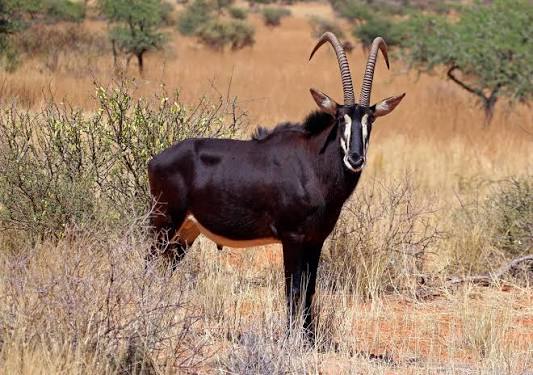
Few African antelopes generate the visual impact of an adult male sable. The body is jet black above and stark white below. The face carries bold white markings. The horns curve back in a sweeping scimitar arc that can exceed 1.5 metres. A dominant sable bull standing broadside on a woodland edge is as dramatic as anything Africa’s wildlife has to offer and the species has a justified reputation as one of the continent’s most sought-after safari sightings.
What Is a Sable Antelope?
The sable antelope, Hippotragus niger, belongs to the horse antelope teamthe same group as the roan antelope and the oryx. An adult male weighs between 200 and 270 kilograms. Females weigh 190 to 230 kilograms. Shoulder height reaches 1.1 to 1.4 metres. Both sexes carry horns the male’s are longer, heavier, and more strongly curved, reaching 81 to 165 centimetres. The female’s horns are thinner and shorter but still impressive by the standards of most antelopes.
The sexual dichromatism is striking. Adult males are coal black above the flanks. Females and young males are rich reddish-brown to dark chestnut. Calves are born pale tawny and darken progressively to the female’s chestnut, and then in males to the adult black. The final transition from chestnut to black in males takes two to three years and occurs gradually, producing a range of intermediate shades in sub-adult males that make age estimation from coat colour possible in the field.
Miombo Woodland Habitat
The sable antelope is a specialist of miombo woodland the broad-leafed Brachystegia and Julbernardia woodland that covers much of Tanzania’s south and west, Zambia, Zimbabwe, and parts of Mozambique and Angola. It requires a specific habitat mosaic: open areas with short grass for grazing alongside denser woodland for cover and shade. The miombo woodland’s seasonal dry-wet cycle drives the sable’s movements herds concentrate on mineral lick sites and permanent water during the dry season, dispersing widely during the wet season when water and new grass growth are abundant.
In East Africa, Tanzania’s Ruaha National Park and the Selous Nyerere ecosystem are the most accessible sable antelope locations. The Katavi National Park in western Tanzania holds excellent populations in remote wilderness. Rwanda’s Akagera National Park holds sable on its open savanna and woodland mosaic.
Territorial Bulls and Herd Structure
Sable live in breeding herds of 10 to 30 females and young animals, accompanied by a single dominant male. This dominant bull vigorously defends the breeding herd against rival males. Male sable in competitor confrontations adopt a kneeling posture both front legs on the ground and match horn angles and strength in a pushing contest. The kneeling posture prevents the long scimitar horns from over-penetrating and causing fatal injuries during what is intended as a dominance test rather than a fight to the death.
Bachelor herds of sub-adult and non-territorial males range separately from the breeding herds. These bachelor groups move more widely and are less predictable in their locations than breeding herds, which remain in the territory of the dominant male.
Conservation Status
The sable antelope is listed as Least Concern globally, but subspecies vary significantly. The giant sable of Angola Hippotragus niger variani is Critically Endangered. In East Africa, Tanzania’s Selous and Ruaha hold the most significant populations. The species has declined in many areas due to poaching for trophies, prey reduction from bushmeat hunting, and habitat loss from agriculture encroaching on miombo woodland margins.
Plan Your Safari
Tanzania’s Ruaha National Park is the most accessible East Africa destination for sable antelope. The park’s remote, wild character and low visitor numbers give sightings an undisturbed quality rare in East Africa’s more famous parks. Rwanda’s Akagera National Park has a recovering sable population that produces reliable vehicle sightings on game drives through the park’s open woodland zone. Both parks reward visitors who make the effort to reach them with wildlife encounters of exceptional quality.
African Wild Trekkers designs Tanzania southern circuit and Rwanda itineraries that include Ruaha and Akagera. Contact us to plan a safari that covers East Africa’s woodland antelope specialists.