oan Antelope Africa: The Second-Largest Antelope and Its Declining Range
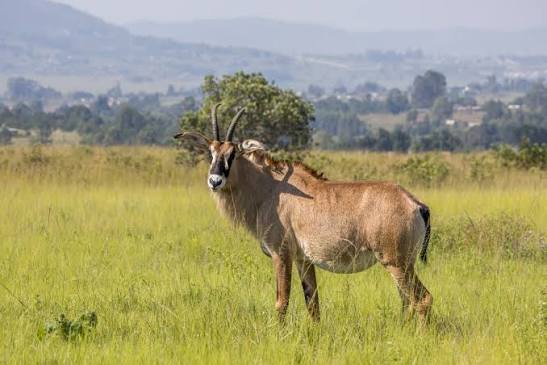
The roan antelope is the second-largest antelope in Africa after the eland. It has a horse-like build, long tufted ears, short backward-curving horns, and a reddish-fawn coat with a bold black-and-white face mask. It carries itself with a quality of composed confidence — older bulls in particular project a presence that commands attention even in a landscape full of impala and zebra. And yet the roan is disappearing from much of its former East Africa range. Understanding why requires understanding what it needs and what East Africa’s busier parks no longer provide.
What Is a Roan Antelope?
The roan antelope, Hippotragus equinus, belongs to the horse antelope team the same group as the sable. An adult male weighs between 220 and 300 kilograms. Females weigh 200 to 260 kilograms. Shoulder height reaches 1.4 to 1.6 metres. Body length approaches 2.4 metres. The species name equinus meaning horse like reflects the robust, upright-shouldered build and the mane of stiff, dark hair on the neck that is strongly reminiscent of a horse’s mane in appearance and function.
The horns curve backward in a short, compressed arc shorter than the sable’s sweeping scimitar reaching 55 to 99 centimetres. Both sexes carry horns, with the male’s slightly longer and heavier. The face carries a black-and-white mask black above the eyes and on the muzzle, white on the cheeks and around the eyes that is bold and immediately distinctive. Long, dark ear tufts extend beyond the rounded ear tips.
Habitat Requirements: Why Roan Are Declining
The roan antelope has specific and relatively demanding habitat requirements. It needs tall, medium-density grass taller than 30 centimetres alongside open woodland for shade and cover. t requires mineral lick sites and reliable water within daily walking distance of its home range.
It does not tolerate very high densities of other large grazers the competition for tall grass from wildebeest, buffalo, and zebra in high-density areas reduces grass height below the roan’s preferred level.
This sensitivity to grass competition is the primary reason roan have declined across East Africa’s most famous parks.
The Serengeti and Maasai Mara support wildebeest densities that maintain short grass across most of the ecosystem ideal for wildebeest and zebra, inadequate for roan.
Roan persist in areas the migratory herds do not dominate: remote woodland savanna, low-density grazing ecosystems, and parks where wildebeest populations are below their ecosystem maximum.
Social Structure and Herd Defence
Roan antelope live in herds of 6 to 35 individuals a dominant bull, several adult females, and their offspring. The dominant bull defends the herd with genuine aggression. When a predator approaches, the roan does not simply flee. The dominant bull charges toward the predator directly. Lions are displaced by charging roan bulls in documented encounters. The bull’s determination in defence is one of the roan’s most notable behavioural features and distinguishes it from the more purely flight-dependent responses of impala and gazelle.
The long tufted ears are highly mobile and provide excellent sound detection. The large body size allows the roan to break through thick bush at speed during flight it does not need clear terrain for fast escape in the way that smaller antelopes do.
This combination of detection, defensive aggression, and brute-force flight makes the roan a difficult prey animal despite its large body size.
Range in East Africa
Uganda’s Queen Elizabeth National Park and Murchison Falls National Park hold roan antelope populations in their open woodland zones. Tanzania’s Katavi National Park in western Tanzania supports a significant roan population one of the best remaining East Africa populations. Rwanda’s Akagera National Park holds roan on the open savanna and Brachystegia woodland margins. In Kenya, roan are essentially absent from current protected area populations.
Plan Your Safari
Uganda’s Murchison Falls National Park north bank game drives produce the most accessible roan antelope sightings in East Africa. The park’s open woodland savanna, away from the high wildebeest and buffalo densities of other ecosystems, maintains the tall grass that roan require.
Tanzania’s Katavi is more remote but rewards those who make the journey with roan encounters in a genuinely wild, uncrowded landscape. Rwanda’s Akagera is the most accessible option for visitors already including Rwanda in their itinerary.
African Wild Trekkers includes Murchison Falls and Katavi in East Africa itineraries for visitors targeting the full range of savanna antelope diversity. Contact us to design a safari that goes beyond the famous species to East Africa’s rarer and equally remarkable wildlife.