Spotted Hyena Clan: The Matriarchal Society of Africa’s Most Misunderstood Predator
The spotted hyena is Africa’s most successful large predator by biomass. It kills more prey than any other carnivore on the continent. It has the most complex social system of any African carnivore outside of primates. Its clan structure, female dominance, and sophisticated communication have been studied in more depth than almost any other African mammal. And yet the spotted hyena remains one of the most consistently misunderstood animals in Africa’s wildlife story.
Clan Structure: Female Dominance at Every Level
A spotted hyena clan is built around a strict female dominance hierarchy. Every female in the clan outranks every male — including the largest, most physically imposing males. The highest-ranking female controls the clan’s core territory and den site. Her daughters inherit their mother’s rank. The rank inheritance in spotted hyena clans is the most rigid and complete matrilineal inheritance system known in any mammal species.
Clan sizes range from 5 to over 80 individuals. Large clans in prime habitat — the Maasai Mara, Serengeti, and Ngorongoro Crater — reach 80 or more individuals. These large clans hold extensive territories, dominate lion prides within those territories, and produce more cubs per female than smaller clans. Clan size is a direct measure of competitive success in the spotted hyena world.
The Den: The Centre of Clan Life
The clan den is typically an old aardvark burrow enlarged and connected into a burrow system with multiple entrances. The den is used for birthing and cub-rearing. Only cubs and their mothers use the burrow interior. Adult males and non-maternal females rest near the den but do not enter. Dens are used for years, sometimes decades, by successive generations of the same clan lineage.
Cubs spend the first weeks of their lives underground. Spotted hyenas give birth to one or two cubs. Unlike most carnivores, spotted hyena cubs are born with eyes open and teeth erupted. This early development reflects the extreme sibling competition that begins at birth—within hours of birth, cubs in two-cub litters compete aggressively, and the dominant cub frequently kills the subordinate in what is called “obligate siblicide.” Siblicide rates vary by prey availability and maternal condition.
The Hyena as Hunter
The image of the hyena as a scavenger waiting at lion kills is dramatically overstated. In the Ngorongoro Crater — which holds the most studied hyena population in Africa — hyenas kill over 95 percent of the food they eat. They scavenge the remainder. Lions in the same area scavenge from hyena kills more than hyenas scavenge from lions.
Spotted hyenas are capable, powerful hunters. They pursue wildebeest, zebra, and topi at speeds of up to 65 kilometers per hour. They hunt cooperatively in groups for large prey and alone for smaller animals. Night hunting is preferred—hyenas are primarily nocturnal. They can detect a kill or a potential hunt from kilometers away using smell and sound. The spotted hyena’s hearing range extends well below the frequencies audible to most other predators.
Communication: The Calls of the Clan
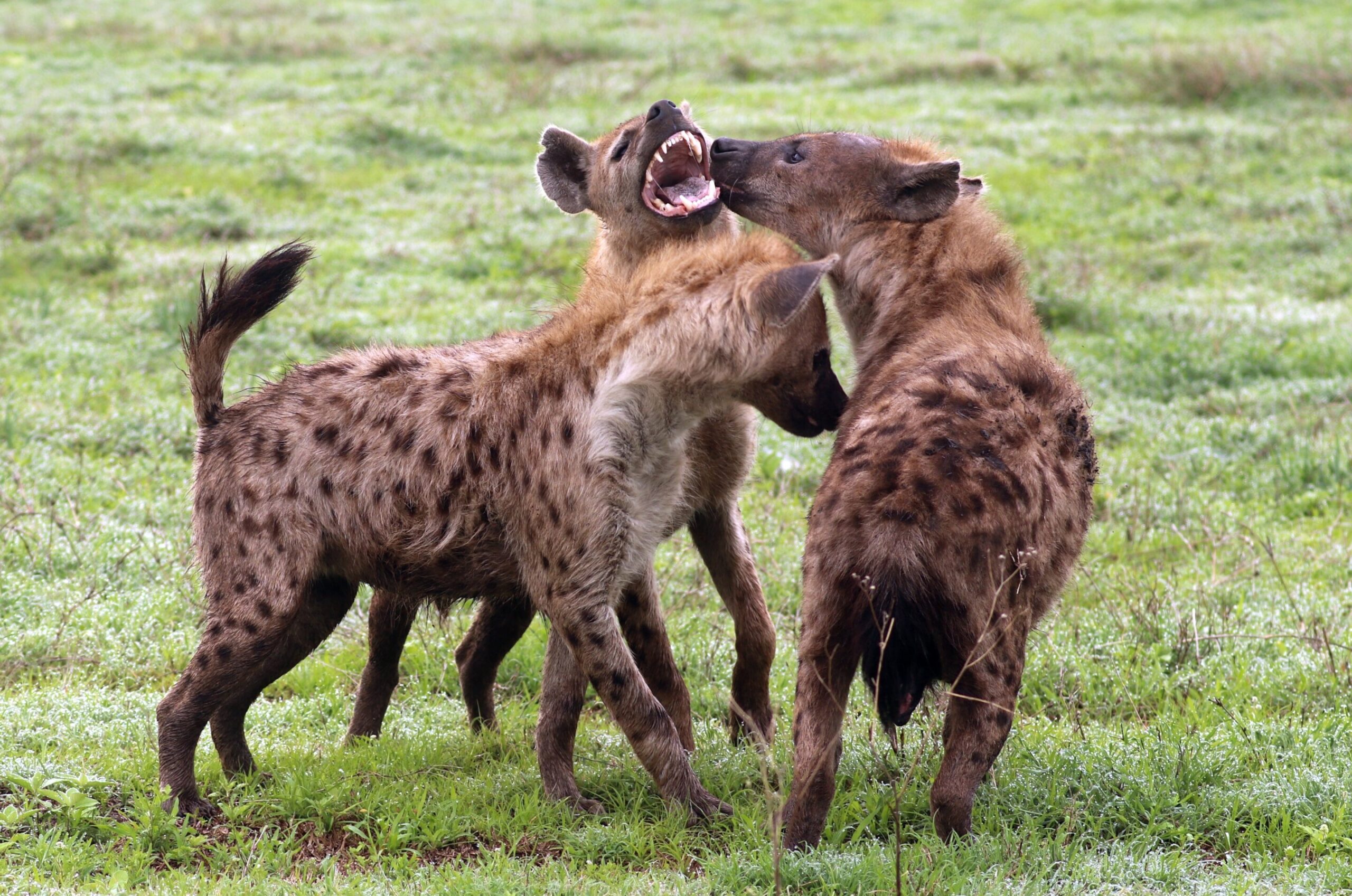
Spotted hyenas produce a larger call repertoire than any other terrestrial carnivore. The “whoop”—a rising call that ends in a distinctive upward inflection—carries over 5 kilometers and summons clan members to a kill or a territorial dispute. The famous “laugh” is not laughter at all. It is a submission call produced by subordinate individuals during aggressive interactions. High-ranking hyenas rarely produce it. Low-ranking ones produce it frequently under social pressure.
Each individual’s whooping call is uniquely identifiable to other clan members. Hyenas recognize clan members’ voices and distinguish them from the voices of strangers. When a clan member whoops from a new location, other clan members update their mental map of where that individual is. This spatial awareness of clan member locations is a sophisticated cognitive capacity that supports the clan’s coordinated territorial defense.
Competition With Lions
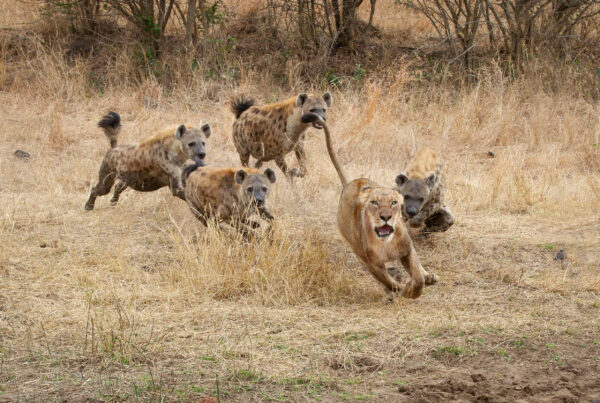
The relationship between spotted hyenas and lions is one of the most dynamic interactions in the African savanna ecosystem. Large hyena clans displace lion prides from kills regularly. Lions displace hyenas equally often. The outcome depends on the relative numbers on each side. Three or more hyenas can displace a single lioness. A coalition of two or more male lions displaces even a large hyena group. The balance of power shifts constantly based on who is present at any given moment.
Plan Your Safari
The Ngorongoro Crater in Tanzania is the best location in East Africa to observe spotted hyena clan behavior. The crater’s confined ecosystem supports unusually high hyena densities with well-habituated clan groups. Night drives in the crater produce hyena hunting and feeding encounters with high regularity. Kenya’s Maasai Mara also holds large, well-studied clans. The Mara’s conservancies—particularly Naboisho—offer night drives where hyena clan activity is a reliable feature.
African Wild Trekkers designs Tanzania and Kenya itineraries with night drive access in the key hyena habitats. Contact us to plan a safari that shows Africa’s carnivores after dark.