Wild Dog Hunting Strategy: Why Africa’s Painted Wolf Rarely Fails
A lion kills roughly one in every five hunts it attempts. A cheetah succeeds perhaps one in three times. The African wild dog kills in seven out of ten attempts — sometimes more.
This remarkable consistency does not come from superior speed, size, or individual skill. It comes from a hunting strategy refined over millions of years of social evolution.
Understanding how wild dogs hunt explains why they are the most formidable pursuit predators in Africa.
Prey Selection: Choosing the Right Target
Wild dogs are deliberate in choosing their prey. Before committing to a hunt, the pack surveys a herd and identifies vulnerable individuals. Impala, Thomson’s gazelle, wildebeest calves, and young zebra are the most common targets across East Africa.
Within a herd, dogs select individuals that move stiffly, limp, are visibly thin, or show delayed reaction times.
This selective pressure for the unhealthy means wild dogs are disproportionately important cullers of weakened individuals from prey populations.
Prey size selection is influenced by pack size. A small pack of four or five dogs hunts small antelope almost exclusively.
A large pack of twelve or more dogs regularly takes adult wildebeest and occasionally young zebra.
The relationship between pack size and prey size is among the most direct ecological relationships in African predator-prey systems.
The Chase: Endurance Over Speed
The wild dog’s speed during a hunt—60 to 65 kilometers per hour—is not as fast as a cheetah’s peak of 110 kilometers per hour. But wild dogs sustain their hunting speed for 3 to 5 kilometers.
A cheetah is exhausted after 400 meters. A wild dog can pursue prey across 6 kilometers of open savanna without stopping.
This endurance advantage means that prey, which initially outpaces the pack, simply runs until it cannot run anymore.
The pursuit is directionally intelligent. Dogs anticipate where fleeing prey will turn. Pack members at the rear of the chase cut corners as the prey runs in an arc, reducing the distance they need to cover.
The pack does not simply run in a straight line behind the target—it flows around the chase, maintaining flanking positions that reduce the prey’s escape options without requiring every individual to maintain top speed throughout.
The Kill: Fast and Specific
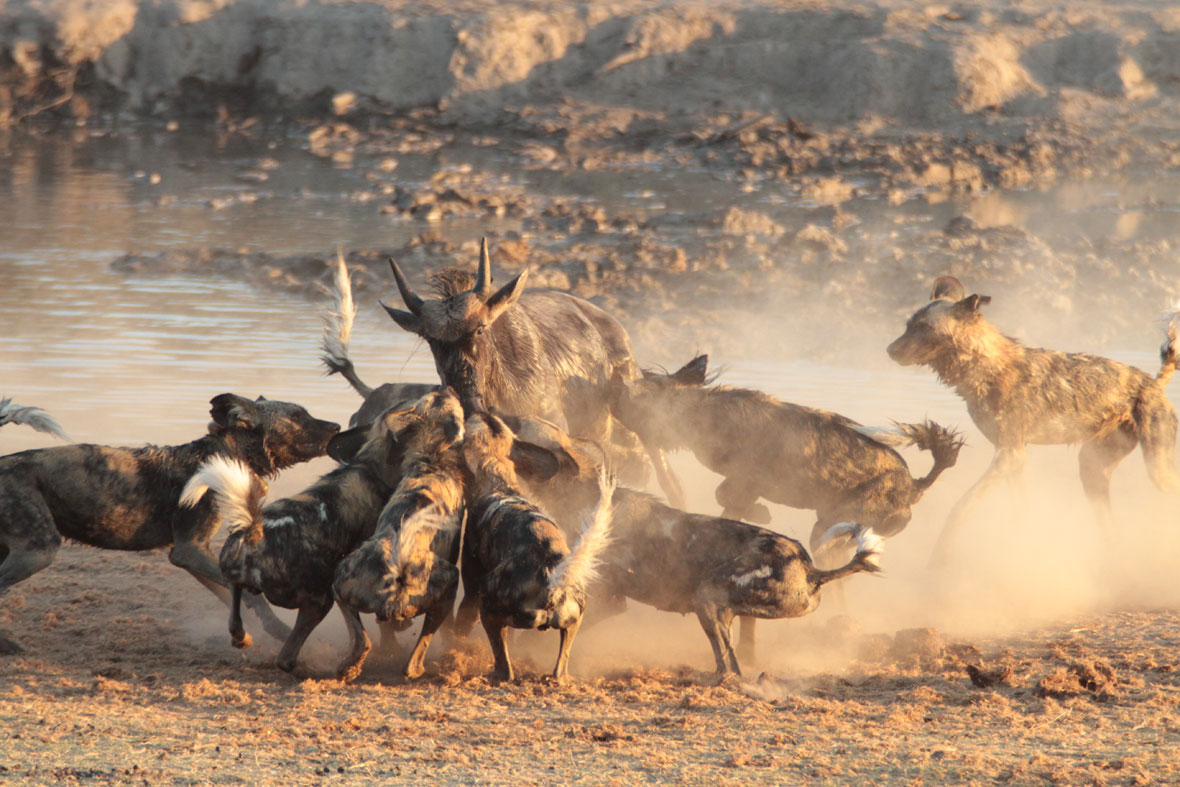
Wild dogs do not kill by throat grip in the way a lion or leopard does. They kill by disembowelment — biting the flanks and abdomen while the prey is running, then pulling it down from multiple directions simultaneously.
This method is brutal but fast. A pack of six dogs drops an impala within seconds of the first contact.
The absence of a prolonged throat grip means the prey does not strangle slowly—it dies from shock and blood loss within moments of the dogs’ collective contact.
Critics of this method mistake speed for cruelty. The disembowelment kill is nearly always faster than a lion’s suffocation.
A pride of lions killing a wildebeest by throat grip may take ten minutes to complete the kill. A wild dog pack drops and kills prey of comparable size in under two minutes in most documented cases.
Why Wild Dogs Succeed Against Larger Predators
Wild dogs lose more than half of their kills to lions and spotted hyenas in areas where these competitors are abundant. Despite this kleptoparasitism, their hunting success rate remains high because they hunt frequently.
A wild dog pack may hunt twice daily. They also hunt in full daylight—minimizing competition with the primarily crepuscular and nocturnal lions and hyenas. The overlap in activity time is lower than it appears on a daily schedule.
Some packs have adapted to exploit competitor behavior deliberately. Packs that hunt at dawn in the Selous complete their kills and consume the carcass before hyenas locate the kill.
This speed of consumption — ten dogs can strip an impala carcass in under ten minutes — reduces the food lost to competitors to a manageable fraction of total hunting output.
Learning Within the Pack
Hunting skills in wild dogs develop over years. Young pack members aged one to two years contribute to chases but are inefficient hunters individually. They learn through participation, gradually taking on more coordinated roles as they mature.
Packs with experienced hunters have higher success rates than packs composed primarily of young adults.
This experience differential means that pack stability — maintaining the core experienced hunters over time — directly improves hunting outcomes.
Plan Your Safari
Watching wild dogs hunt is one of the peak wildlife experiences in Africa. Tanzania’s Nyerere National Park, Zimbabwe’s Mana Pools, and Kenya’s Laikipia Plateau offer the best hunt-watching opportunities.
Nyerere’s open floodplain habitats allow vehicle tracking of hunts in progress. Early morning drives — beginning before 6 am — coincide with peak wild dog hunting activity.
African Wild Trekkers builds Tanzania and Kenya safari itineraries timed to maximize wild dog activity. Contact us to plan a safari around Africa’s most successful predator.