African Wild Dog Pack: The Social System Behind Africa’s Most Efficient Hunter
No African predator succeeds at hunting as consistently as the wild dog. Success rates of 70 to 80 percent per hunt are documented across East Africa — roughly three times the success rate of a lion and four times that of a leopard. The reason is not speed, not strength, and not size. The reason is the pack. The wild dog’s social system is the engine of its hunting success, and understanding that system transforms every wild dog encounter on safari.
Pack Structure and the Dominant Pair
An African wild dog pack—also called painted wolves—revolves around a single breeding pair. This dominant male and female are the only pack members that produce All other adults suppress their own reproduction and direct their energy toward the breeding pair’s offspring. This is an extreme form of social organization called “cooperative breeding,” and it is one of the most developed examples of this system among all carnivores.
Pack sizes range from 2 to over 30 individuals, though the average functional pack across East Africa numbers between 6 and 12 adults. Larger packs are more successful at raising pups and defending territories but are harder to maintain because they require more prey. The ideal pack size balances territorial defense, pup survival, and hunting efficiency.
How the Pack Hunts
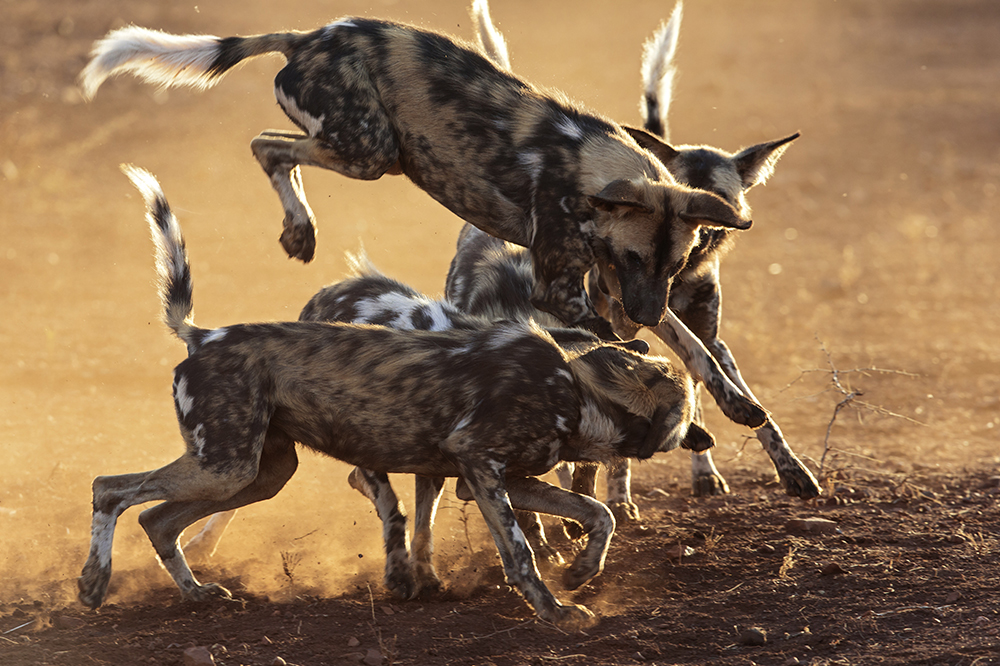
A wild dog hunt begins with an excitement ceremony—a ritualized greeting session in which pack members run together, vocalize, and touch noses and flanks. This ceremony builds arousal before the hunt. Packs that complete the ceremony are more likely to initiate a hunt than those that interrupt it early. The ceremony appears to coordinate the group’s willingness to commit to the energy expenditure a hunt requires.
The hunt itself is a sustained pursuit. Wild dogs select a target animal from a herd and pursue it relentlessly at 60 to 65 kilometers per hour. If the target escapes into cover, the pack abandons it and selects again. Once a clear target is isolated, the pack harasses it from multiple angles — biting at the flanks and hind legs — until the animal collapses from exhaustion or blood loss. The kill is fast. The feeding begins before the prey has stopped moving.
Food Sharing and Pack Feeding
Wild dogs share food at kills—a behavior unique among African carnivores. Pups at the den feed first. Adults that remained at the den with the pups received food regurgitated by returning hunters. Even injured, sick, or aged pack members that cannot hunt receive food. This universal sharing is one of the most striking aspects of wild dog social life. A pack member that has not fed in 48 hours will be fed by a hunting partner. This social safety net is part of what makes pack living so advantageous.
Pup Rearing: The Pack’s Priority
When the dominant female gives birth—litters of 6 to 16 pups—the entire pack shifts its behavior. Some adults remain at the den as guards while others hunt. Guards defend pups against lions, hyenas, and eagles. The den site is moved several times during the pup-rearing period to reduce predator detection through accumulated scent. Pup mortality is highest in the first two months and declines sharply as pups grow mobile and stronger.
Pack members other than the parents invest in pup care with genuine commitment. Sub-adult pack members play with pups, groom them, and allow them to eat from regurgitations before the adults feed themselves. This investment from non-parental adults is the mechanism by which the pack’s cooperative breeding system works. Young pack members practice parental behaviors on the breeding pair’s pups, preparing for their own eventual reproductive opportunities.
Territory and Ranging
Wild dog territories are enormous relative to the pack’s body size. A pack of ten dogs may hold a territory of 400 to 1,500 square kilometers in savanna habitats. This large territory reflects the energy requirements of the pack and the need to follow prey migration circuits. Packs overlap territories with other packs along boundary zones. Territorial encounters are loud and sometimes violent, but packs generally avoid direct conflict when possible.
Plan Your Safari
The Selous-Nyerere ecosystem in Tanzania holds one of the largest wild dog populations remaining in Africa. Zimbabwe’s Mana Pools and Botswana’s Okavango also offer outstanding sightings. In East Africa, Kenya’s Laikipia Plateau and the Maasai Mara ecosystem support growing populations. Sightings are never guaranteed, but a guide who knows current pack locations and territory boundaries dramatically improves the odds.
African Wild Trekkers plans Tanzania southern circuit safaris specifically around wild dog activity in Nyerere National Park. Contact us to build an itinerary with the best possible wild dog encounter.