Lesser Kudu Kenya: The Elegant Dry-Country Antelope of Northern Kenya
Where the greater kudu inhabits dense woodland and thicket across East Africa’s wetter zones, the lesser kudu occupies a different ecological space entirely. It lives in dry, semi-arid acacia bush and thornbush the same scrubby landscape as the gerenuk and beisa oryx in the dry north of Kenya and northeast Tanzania. It is smaller than its greater cousin, more delicately built, and even more difficult to see. But its coat markings are among the most striking of any East African antelope.
What Is a Lesser Kudu?
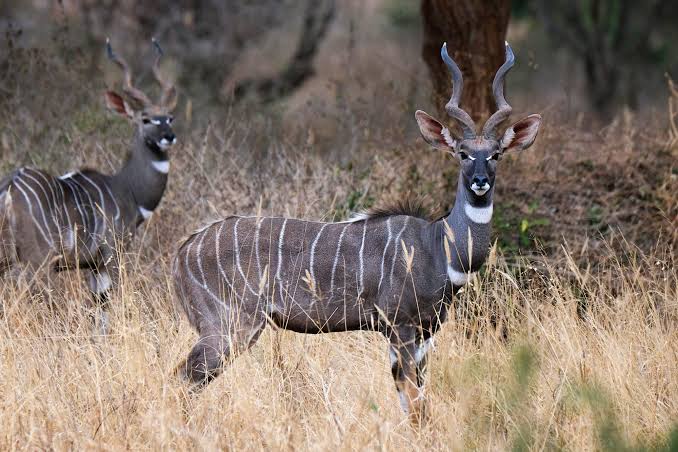
The lesser kudu, Tragelaphus imberbis, belongs to the spiral-horned antelope family. An adult male weighs between 92 and 108 kilograms. Females weigh 56 to 70 kilograms. Shoulder height in males reaches about 95 to 105 centimetres noticeably shorter than the greater kudu’s 1.4 to 1.5 metres. The lesser kudu lacks the throat fringe the beard that the greater kudu’s adult males develop. The ears are very large, rounded, and highly mobile.
The coat is particularly beautiful. The base colour is grey-blue in males and more rufous in females. Both sexes carry 11 to 15 vertical white stripes on the flanks more numerous and more clearly defined than those of the greater kudu. White chevrons mark the face one between the eyes and one across the muzzle. Two white throat patches complement the facial markings. The overall effect is a coat pattern of exceptional intricacy and visual impact in good light.
Habitat: Dry Acacia Thornbush
The lesser kudu occupies semi-arid and arid acacia thornbush at altitudes below 1,200 metres. It requires dense bush for cover but feeds on a broad browse diet leaves, shoots, pods, and fruit from a wide range of acacia and commiphora species. Water independence is significant lesser kudu in dry-season studies have gone weeks without surface water, extracting moisture from the succulent leaves of certain plant species.
This water independence allows it to remain in dry-season habitats that push other browser species to areas near permanent water. The lesser kudu’s ability to persist through Kenya’s long dry periods in habitat where no other antelope of its size can survive gives it a significant niche advantage in a competitive ecosystem.
Behaviour: Secretive and Crepuscular
Lesser kudus are the most secretive of East Africa’s large antelopes. They detect threats at long range and disappear into dense bush before a vehicle reaches the detection point. They are primarily active at dawn and dusk, resting in deep shade during the midday heat. Their habit of freezing rather than running when mildly alarmed makes them invisible in medium-density thornbush the vertical white stripes align with the vertical forms of thornbush stems in exactly the way the greater kudu’s stripes align with tall woodland.
Males are usually solitary. Females and young form small groups of 2 to 5 individuals. Males visit female groups during the breeding season. The mating system is not territorial males range widely to find receptive females rather than holding a fixed territory and waiting for females to pass through.
Range in East Africa
In Kenya, lesser kudus live in the dry northern and northeastern zones Samburu, Buffalo Springs, Shaba, Tsavo East’s drier northern sections, and the Tana River corridor. In Tanzania, the dry interior zones around the Ruaha and the Rift Valley’s drier areas hold populations. The species is absent from the wetter highlands and from the Maasai Mara ecosystem.
Plan Your Safari
Samburu National Reserve is the most reliable and accessible lesser kudu location in Kenya. The reserve’s dry acacia scrub is ideal habitat and game drives along the Ewaso Nyiro riverine bush regularly produce lesser kudu sightings in the morning and late afternoon hours. Tsavo East’s northern sections also produce sightings, though the habitat is denser and encounters less frequent. A Samburu stay dedicated to the dry-country specialists combining gerenuk, reticulated giraffe, beisa oryx, Grevy’s zebra, and lesser kudu in one circuit is one of Kenya’s most rewarding safari experiences.
African Wild Trekkers designs northern Kenya safaris based in Samburu and Laikipia. Contact us to plan a Kenya trip that captures the full range of the country’s dry-country wildlife.