Hippo Territorial Behaviour: Fights, Yawns and the Politics of River Dominance
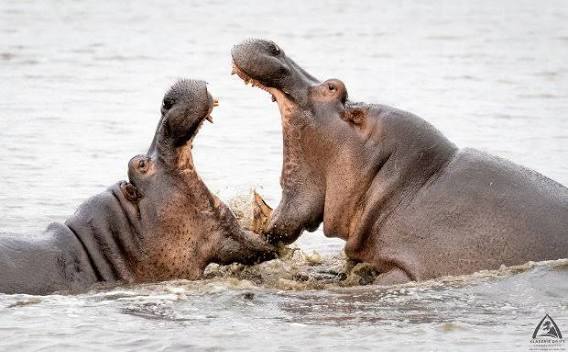
A hippo opens its mouth. The jaw swings to nearly 180 degrees. The canine tusks up to 50 centimetres long — catch the light. This is not a yawn for comfort. It is a precise display of weaponry directed at a rival. Every gesture in a hippo’s social toolkit is built around its most dangerous asset the jaws. Understanding hippo territorial behaviour means understanding the economics of managing access to resources that every hippo in the pod needs to survive.
Why Territory Matters to a Hippo Bull
Adult male hippos are territorial within the water. The river or lake territory is the resource that controls mating access to females. All females and subordinate males in a pod exist within the dominant bull’s territory. The bull mates with every receptive female in his territory. Territorial tenure is therefore directly equivalent to reproductive success. A bull that holds a prime stretch of river near feeding areas, with good banks and deep pools will sire more calves per year than a peripheral bull with a poor territory.
Territory quality varies considerably along any stretch of hippo habitat. Deep pools allow immersion during the hot midday. Accessible bank slopes allow females easy exit to nurse and rest with calves. Proximity to good grazing reduces the nightly distance females need to travel, keeping them within the bull’s territory rather than wandering into a neighbour’s. A dominant bull with a high-quality territory retains his pod more reliably than one with a marginal stretch.
The Yawn Display: Threat Without Combat
The wide-open jaw display the “yawn” as it appears is the primary threat signal between hippos. The gape angle and the size of the tusks revealed communicate fighting capacity to a rival. A subordinate bull confronting a dominant’s display assesses the tusk size and gape angle and decides whether to submit or escalate. Most confrontations are resolved by the display stage without physical contact.
The display is supplemented by dung-spraying the tail is whirled at high speed while defecating, scattering dung widely. This behaviour marks territory boundaries and communicates identity and status to any hippo investigating the boundary. Bulls investigating another’s dung-spray show interest-then-retreat or interest-then-approach responses that suggest the chemical information in the dung communicates dominance, reproductive status, and individual identity.
Bull Fights: When Display Fails
When two bulls are sufficiently matched that display alone does not resolve the contest, physical fighting follows. Hippo fights are among the most violent mammal conflicts in Africa. The combatants charge each other, deliver tusk blows to the head and neck, and attempt to bite the rival’s head and neck with the full force of the jaw. Wounds from bull fights are deep, wide, and frequently become infected. A defeated bull may carry injuries that suppurate for months.
Deaths from hippo fights are relatively rare compared to the severity of the wounds inflicted, because the thick skin provides some resistance and because a defeated bull can usually retreat into the water before injuries become fatal. But infection from poorly healed tusk wounds does kill bulls particularly in dry-season conditions when water quality is lower and wounds heal more slowly.
Pod Hierarchy: Below the Dominant Bull
Within the dominant bull’s territory, a social hierarchy exists among the adult females and among the subordinate males. The dominant female controls access to the best resting spots within the pod. She determines when the pod moves to and from the water. Subordinate females defer to her in spatial competition but are otherwise tolerated within the territory provided they show deference.
Subordinate males within the territory are tolerated by the dominant bull if they show regular submission approaching with head lowered, producing submission vocalisation, and not approaching receptive females. A subordinate male that challenges the dominant by approaching a female in oestrus or by refusing to submit is immediately attacked. The dominant bull tolerates submission but not competition.
Plan Your Safari
The Kazinga Channel boat safari in Uganda’s Queen Elizabeth National Park is the finest hippo behavioural watching venue in East Africa. The two-hour cruise passes dozens of hippo pods at close range. Bull territorial displays, female social interactions, and mother-calf pairs are visible throughout the cruise. The absence of the viewing limitations imposed by a game vehicle gives the boat safari a quality of intimate observation unavailable on land-based drives.
African Wild Trekkers includes the Kazinga Channel boat safari in all Uganda safari itineraries. Contact us to plan a Uganda trip that captures the full range of this extraordinary country’s wildlife.