Giraffe Necking Behaviour: The Neck Combat That Determines Breeding Dominance
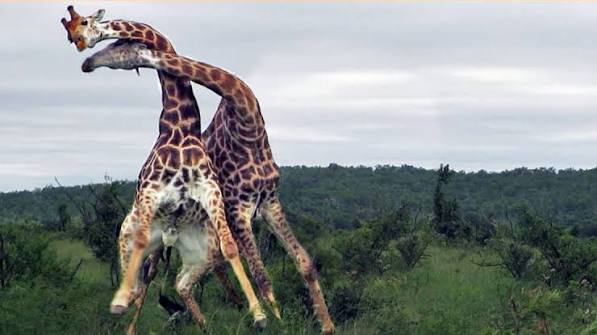
Two bull giraffes stand shoulder to shoulder. One swings his neck in a slow pendulum arc. His ossicones connect with the other bull’s flanks — a deep, resonant thud audible from 50 metres. The struck bull staggers, braces his legs, and swings back. Necking is the male giraffe’s primary competitive behaviour. Access to females runs through it. The giraffe’s neck is not only a feeding tool — it is a weapon, and understanding necking changes every observation of male giraffes into a reading of rank, history, and competitive status.
What Is Necking?
Necking is male giraffe combat using the neck as a pendulum and the ossicones and skull as impact points. A bout begins when two bulls come into proximity near a receptive female, at a favoured food tree, or at a water site. The bulls stand parallel and swing the neck in wide, slow arcs. Blows land on the rival’s flanks, neck, chest, and sometimes the legs. Force escalates from mild contact to full swings that can knock a smaller bull sideways.
A bout ends when one male withdraws. Serious injury is rare but documented powerful rib blows can fracture them. Deaths occur occasionally when a powerful blow strikes the head. The fallen male then cannot rise quickly enough to avoid further strikes. Lethal outcomes are unusual most bouts end in submission without injury.
The Anatomy of Necking: Ossicones and Skull Mass
Both sexes carry ossicones from birth. In females and young males, they stay slender, hair-covered, and small. Adult males develop thicker ossicones over time. Calcium deposits accumulate around the bone cores. Repeated impact wears the tips bare and rounded. An old bull’s ossicones reach 10 to 12 centimetres with smooth, calloused ends where hair has long since gone.
The skull itself gains mass with age. Older bulls carry significantly heavier skulls than younger males — the bone thickens in response to repeated impact stress. This is analogous to the boss development in old buffalo bulls. An older bull giraffe’s head is literally a more powerful weapon than a younger one’s.
The Dominance Outcome: Size and Age Win
Necking outcomes correlate strongly with neck length and body mass. Larger, older males win most bouts against smaller rivals. A longer neck delivers more momentum per swing. A heavier skull carries more force on impact. Taller bulls land blows higher on the rival’s neck or back a more effective strike zone than the rival’s lower-landing return blows.
Giraffe mating success skews heavily toward the largest, oldest males. Young bulls lose consistently to older rivals. They practice necking extensively in these years building technique, neck muscle, and the skull mass that will eventually make them competitive.
Necking in the Field: What to Watch For
Well-matched bull bouts last minutes to half an hour. The deep thud of each impact carries clearly to 50 metres in still air often the first sign a bout is underway. Slower, more deliberate swings carry more power than fast glancing contacts. Watch the legs of the struck bull: they stiffen and splay after a powerful hit as the force travels down through the body. A bull whose hindlegs slide outward under a hit is approaching his submission threshold.
Plan Your Safari
Male giraffe necking encounters occur most often where adult males gather at favoured food trees or near receptive females. The Maasai Mara, Serengeti, Samburu, and Amboseli all deliver male giraffe competition. The best sightings come from areas where multiple adult males consistently use the same Acacia patch daily encounters there produce everything from mild sparring to full-force combat. Patient observation at a site where two adult males are regularly visible is the most reliable approach.
African Wild Trekkers designs East Africa safari itineraries with experienced guides who identify male giraffe social interactions and position vehicles for the best observation. Contact us to plan a safari that reveals giraffe behaviour beyond the iconic silhouette.