Wildebeest Calving Facts: Tanzania’s January Spectacle and the Synchronised Birth Strategy
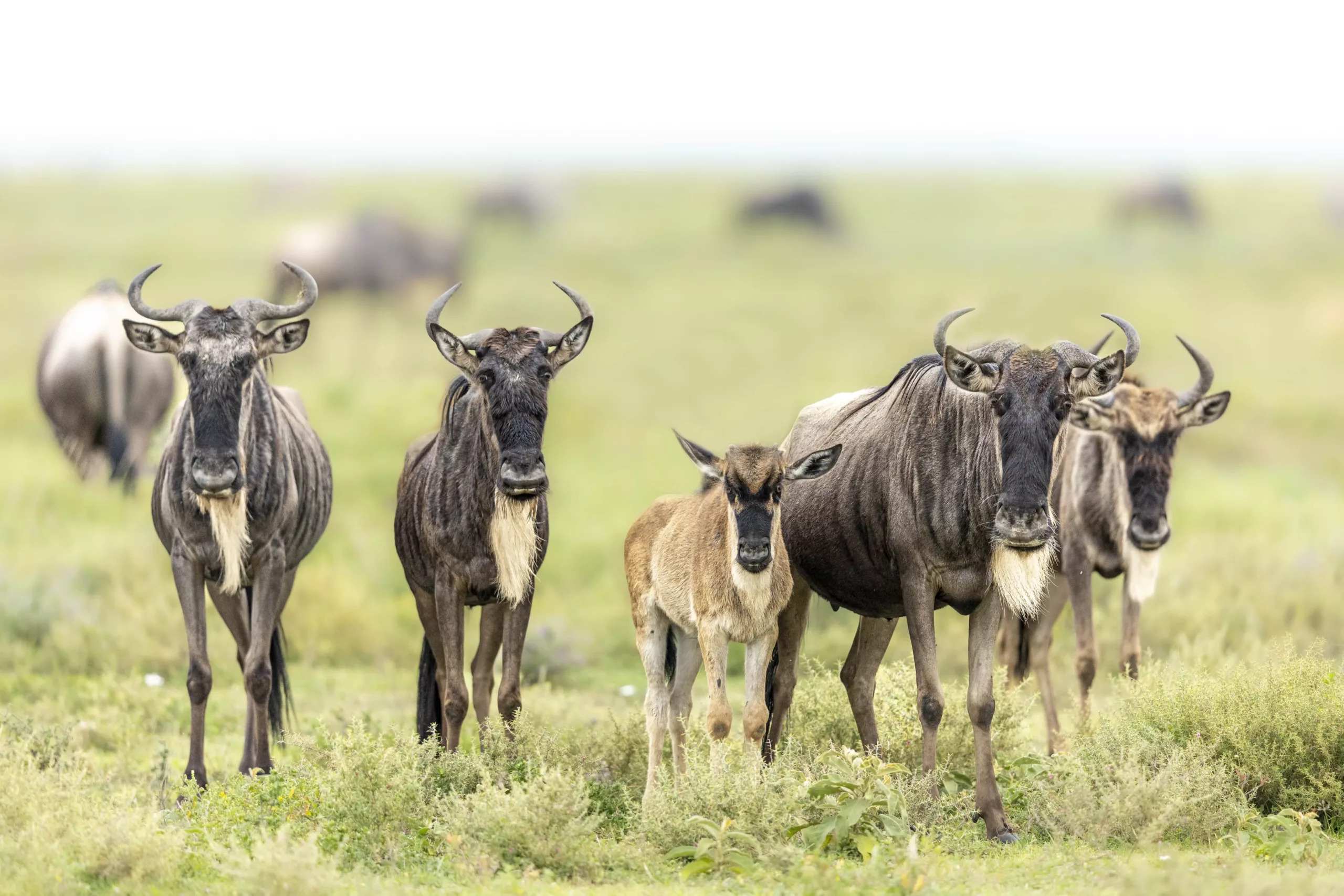
In January and February, approximately 500,000 wildebeest calves arrive on Tanzania’s southern Serengeti plains and the adjacent Ndutu area within three to four weeks. This is the largest synchronized birth event of any mammal on earth. A calf stands within minutes. Hours later, it runs with its mother. The strategy behind this synchronization—one of evolution’s most elegant answers to predation—is as remarkable as the spectacle itself.
The Calving Grounds: Ndutu and the Southern Serengeti
The migration cycle brings herds south from the Maasai Mara and northern Serengeti in December, following the short rains onto the short-grass plains of the southern Serengeti and Ndutu. The timing is not random. Volcanic soils underlie this zone, rich in calcium and phosphorus. Those minerals produce grass with exceptional protein and mineral content — precisely what a lactating female wildebeest needs. Herds reach the nutritionally optimal location exactly when calves begin to arrive.
Lake Ndutu and the surrounding acacia woodland form the core calving habitat. Open short-grass plains extend south toward Olduvai Gorge. Low grass lets females spot approaching predators at long range. Mineral lick sites around Ndutu’s soda lake draw lactating females in enormous numbers during peak calving weeks.
The Birth: Minutes to Standing
A wildebeest calf drops to the ground from a standing mother in a fast, efficient delivery. The calf emerges in a diving position with forelimbs extended—minimizing delivery time and maternal vulnerability. Within two minutes, the calf attempts to stand. Most calves reach their feet within five to ten minutes. By twenty minutes, they can run with the herd, if not yet fast enough to escape a determined cheetah.
This developmental speed surpasses any comparable mammal. Predator pressure alone drove it. A calf that cannot stand quickly faces death before its mother’s bonding instincts can fully engage. Millions of years of selection pushed the result toward the physiological limit.
Synchronised Births: The Predator Swamping Strategy
Five hundred thousand births in three weeks is not coincidence. Evolution shaped this timing as an anti-predation strategy called predator swamping. Predators — lions, cheetahs, leopards, hyenas, wild dogs, and jackals — can kill only a finite number of calves per day. Simultaneous births overwhelm that capacity. Most calves survive by outnumbering what predators can take.
A calf born out of phase with the mass birth event faces the full predator community alone. No dilution of attention helps it. Spread those same predators across 500,000 calves in a short window, and their hunting capacity falls short of the population’s replacement rate.
Predator Activity During Calving
The calving season drives the most intense predator activity in East Africa. Every large carnivore in the southern Serengeti concentrates on the calving grounds. Lions leave pride territories to follow the herds onto the open plains. Cheetahs work the plains’ edges where they can take calves without immediately drawing lions. Wild dog packs time their own pup births to coincide with calving—ensuring high-energy food for lactating females and growing pups at once.
Plan Your Safari
January and February are the peak calving months at Ndutu and the southern Serengeti. A safari timed to this period, based at one of the Ndutu camps within the Ngorongoro Conservation Area, delivers one of Africa’s most overwhelming wildlife experiences. The concentration of herds, calves, and every predator species operating simultaneously on open short-grass plains has no parallel anywhere else in Africa.
African Wild Trekkers designs Tanzania calving-season safaris based at Ndutu for the peak weeks of January and February. Contact us to plan a Tanzania trip around this extraordinary annual event.