Springhare Facts Africa: The Kangaroo-Hopping Rodent of East Africa’s Savanna
You sweep a spotlight across the open savanna on a night drive. Two orange eyes appear at knee height—too large for a mongoose, too close to the ground for a hare. Then the animal moves.
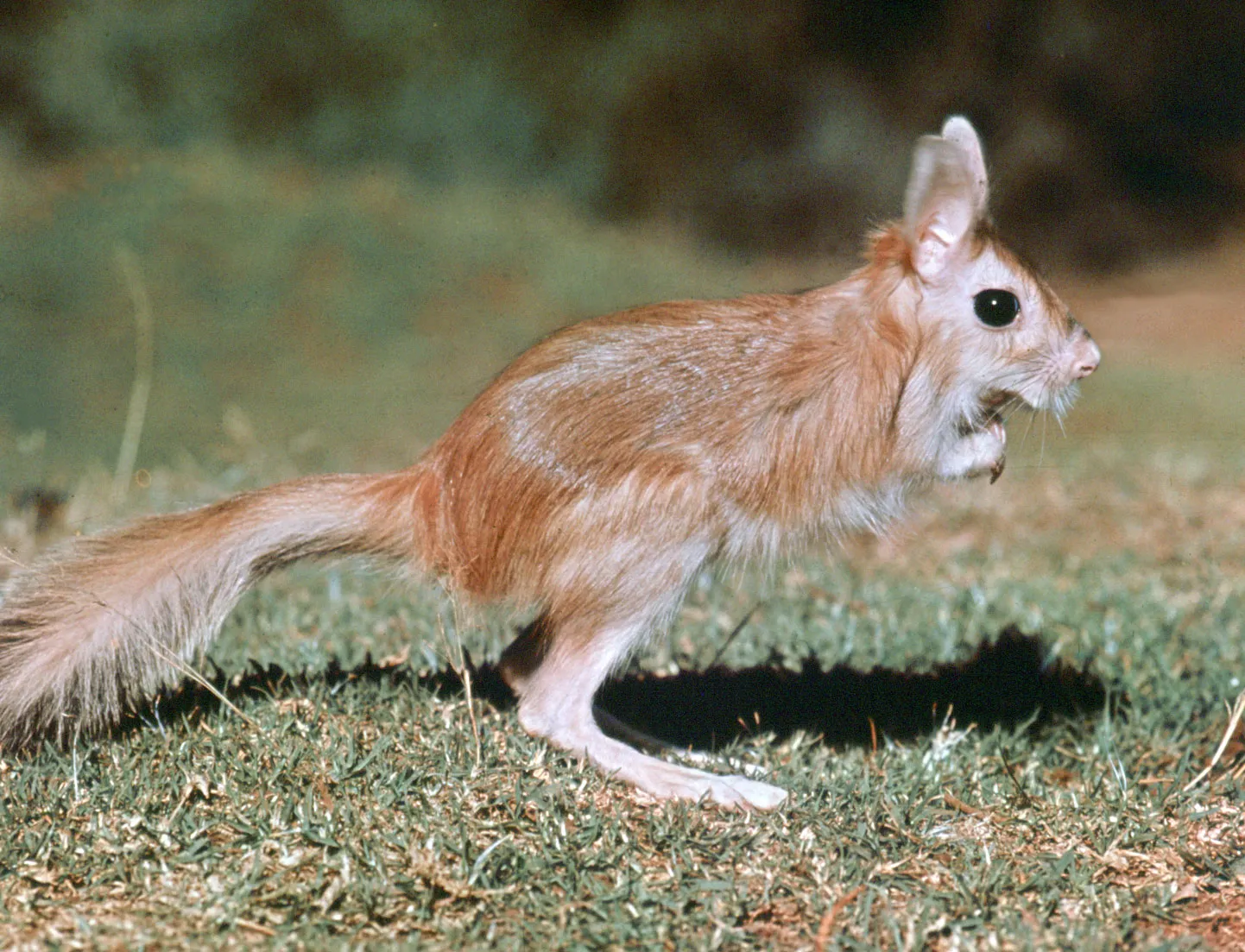
It bounds away in a series of two-meter leaps, upright on large hind legs, small forelegs tucked against the chest, and a long tail streaming behind.
The springhare looks like a miniature kangaroo. It is not a kangaroo—it is a rodent and one of East Africa’s most entertaining night-drive encounters.
What Is a Springhare?
The springhare, Pedetes capensis, is the sole member of the family Pedetidae. It is not closely related to hares, kangaroos, or any other superficially similar animal. It belongs to a lineage of rodents that evolved its kangaroo-like form independently in Africa.
An adult springhare weighs between 3 and 4 kilograms. Body length is 36 to 43 centimeters. The tail adds another 36 to 47 centimeters long, with a dark or black tip that is held horizontally while the animal hops.
The hind legs are long and heavily muscled—proportionally similar to a kangaroo’s. The hindfoot is large and broad, providing the surface area for powerful push-off during each bound.
The forelegs are short and end in sharp, curved claws used for digging. The ears are long and donkey-like. The eyes are very large, providing excellent low-light vision for nocturnal life.
Hopping Locomotion
The springhare moves exclusively by bipedal hopping. It does not walk. Each hop covers between 1.5 and 3 meters. Speed in full flight reaches 48 kilometers per hour—fast enough to outrun jackals and servals over short distances.
The hopping gait is energetically efficient at this speed range in the same way kangaroo locomotion is efficient—the tendons in the hind legs store and release energy elastically during each bound, reducing the muscular effort required to sustain speed.
When moving slowly, the springhare takes shorter hops and uses its tail as a balance strut, pressing the tail tip against the ground between bounds. When feeding, it sits upright on the hindlegs in a vertical posture with the forelegs free to manipulate food items.
This tripod sitting position is characteristic of many large-hindlimbed rodents.
Nocturnal Life and Burrows
Springhares are strictly nocturnal. They spend the day in burrow systems they dig themselves. Each individual maintains several burrows within a home range of 25 to 100 hectares.
The burrows are dug with the sharp foreleg claws—excavation produces characteristic fan-shaped mounds of loose soil at the entrance. A springhare plugs the entrance from the inside before resting, reducing predator access and maintaining burrow temperature.
After dark, springhares leave the burrow to forage on grasses, tubers, and roots. They carry food to the burrow entrance to eat in relative safety rather than consuming it at the foraging site.
This behavior—consistent in multiple observed individuals—reduces exposure time away from the burrow escape route.
Habitat and Range in East Africa
Springhares inhabit open, short-grass savanna and semi-arid grassland with sandy or light soil suitable for burrowing. They are absent from forest, dense bush, and areas with clay-heavy soils that do not dig well.
In East Africa, they occur across Kenya’s open savanna zones—Laikipia, the Maasai Mara periphery, and northern Kenya’s dry plains. Tanzania’s Serengeti short-grass plains hold populations.
In Uganda, they are most commonly recorded in the Karamoja region’s drier grasslands.
Plan Your Safari
Night drives in Kenya’s Laikipia conservancies produce regular springhare sightings. The animals’ large eyes produce bright, distinctive eyeshine in a spotlight, and their hopping flight is immediately recognizable once seen.
Tanzania’s Serengeti night drives also yield spring hare encounters on the open short-grass plains. Any open, sandy-soiled savanna area in East Africa is potential springhare habitat—a slow drive with a spotlight covering the ground between bushes is the reliable search method.
African Wild Trekkers builds night drive options into Laikipia and Serengeti itineraries. Contact us to plan an East Africa safari that includes the nocturnal savanna alongside the famous daytime game.