Dik-Dik Facts Africa: The Smallest Antelope and Its Surprisingly Complex Life
The dik-dik weighs less than 7 kilograms. It reaches 40 centimeters at the shoulder. It fits in the space between two acacia bushes, and it is the smallest antelope in East Africa and one of the most common—yet it consistently surprises safari visitors who take the time to watch it.
The dik-dik is monogamous, fiercely territorial, and equipped with a nose that is simultaneously an air conditioner and a scent-marking organ. There is more biology in this tiny antelope than its size suggests.
What Is a Dik-Dik?
Several dik-dik species occur in East Africa. Kirk’s dik-dik, Madoqua kirkii, is the most widespread and the one visitors most commonly encounter in Kenya and Tanzania.
Günther’s dik-dik occurs in the dry acacia zones of northern Kenya. The common name is onomatopoeic—the sharp “dik-dik” alarm whistle produced by the female as she runs from disturbance.
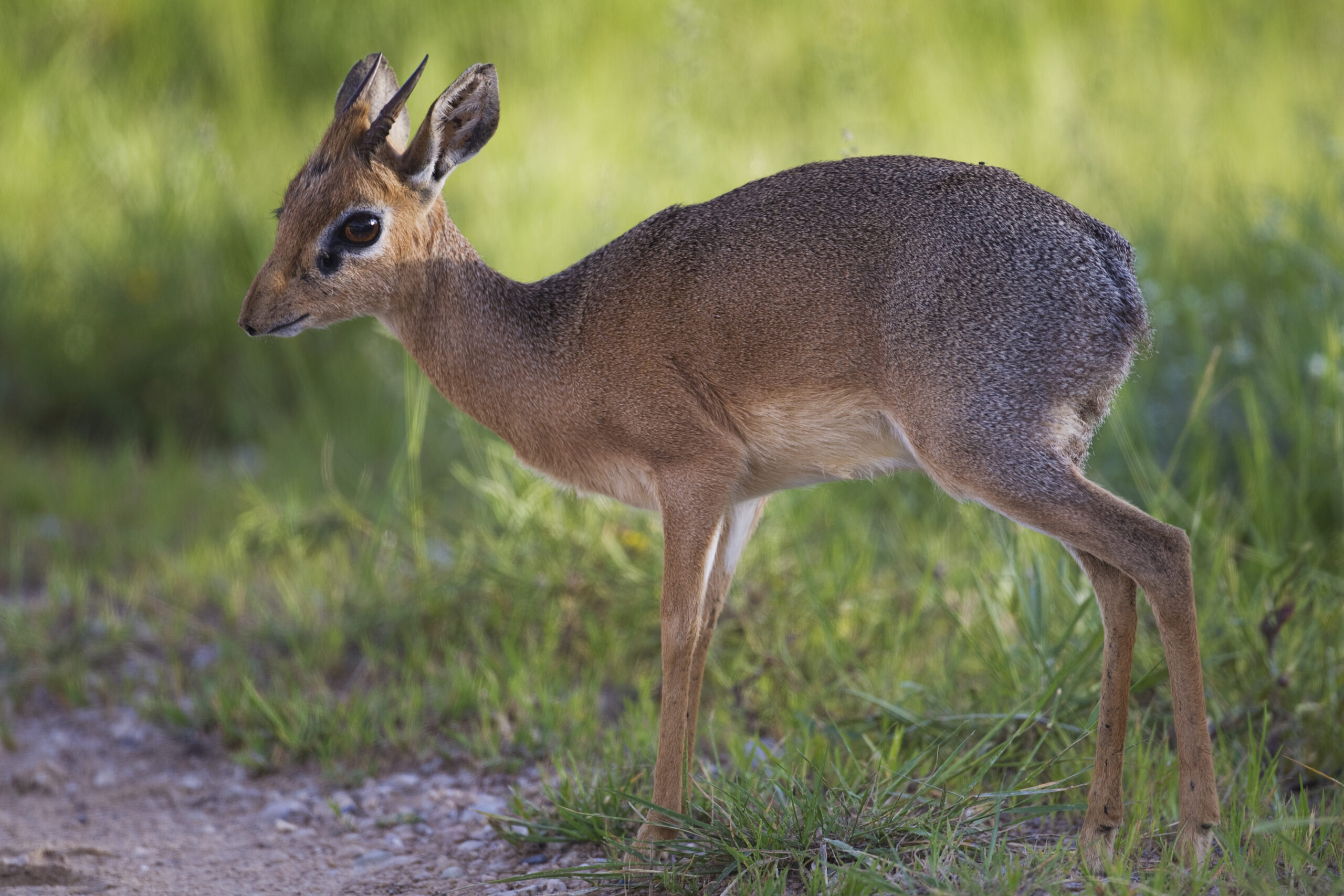
An adult Kirk’s dik-dik weighs between 3.8 and 7.2 kilograms. Body length is 52 to 67 centimeters. The coat is greyish-yellow above with white underparts. The eye is very large relative to the skull size.
Only males carry horns—small, ridged, and vertical, reaching 3 to 11 centimeters. The most distinctive feature is the elongated, mobile snout—a tubular nose that extends significantly beyond the mouth.
The Elongated Nose: A Thermoregulation Organ
The dik-dik’s elongated nose contains a large surface area of moist mucous membrane. As warm air from the lungs passes over this surface during exhalation, moisture evaporates and cools the blood in the nasal capillaries before it returns to the brain.
This countercurrent cooling—similar in principle to the oryx’s carotid rete—allows the dik-dik to maintain brain temperature below ambient in hot conditions without excessive sweating.
The result is remarkable thermal tolerance for a very small animal in a hot environment. A small mammal has a large surface-area-to-volume ratio that makes it prone to overheating and dehydration.
The dik-dik’s nasal cooling system and its ability to derive water from food allow it to survive in dry thorn scrub that dehydrates larger antelopes with surface-area advantages.
Monogamy and Territory
The dik-dik is one of the few genuinely monogamous African antelopes. A bonded pair occupies a territory of 3 to 30 hectares. They maintain this territory jointly for years.
Both partners scent-mark the territory boundaries using secretions from the large preorbital glands—dark, wet patches of bare skin in front of each eye.
The pair inserts a grass stalk into the pre-orbital gland opening and deposits scent onto vegetation along the territory boundary.
Pairs are rarely more than a few meters apart during daily activities. When one individual is alarmed, the other reacts immediately. When one feeds, the other maintains a vigilance posture.
This partnership extends the effective predator-detection radius of each individual and allows the pair to occupy a territory too small for a solitary animal to defend alone against neighboring pairs.
Predators and Survival Strategy
The dik-dik’s small size makes it vulnerable to an enormous range of predators. Martial eagles, crowned eagles, servals, caracals, leopards, pythons, jackals, and even baboons all kill dik-diks.
The dik-dik’s response to predation pressure is to be invisible rather than flee. It freezes when threatened, relying on its cryptic coloration and small size to avoid detection.
Only when a predator approaches within a few meters does it bolt—producing the sharp alarm whistle and the stiff-legged bounding run that warns the partner.
Plan Your Safari
Kirk’s dik-dik is abundant in Kenya’s Amboseli, Tsavo East and West, and in Tanzania’s Tarangire and Ruaha.
They are habituated to vehicles in most parks and can be watched at very close range from a slow-moving vehicle in dry acacia scrub. Pairs are reliably found together—if you find one dik-dik, look carefully in the surrounding bush for its partner.
The Samburu ecosystem in northern Kenya holds both Kirk’s and Günther’s dik-dik in different habitat zones.
African Wild Trekkers designs Kenya and Tanzania safaris that give proper attention to East Africa’s smaller wildlife alongside the big game. Contact us to plan a trip that captures the full spectrum of East Africa’s extraordinary mammals.