Klipspringer Facts: The Antelope That Walks on Its Hooftips
The klipspringer walks on the tips of its cylindrical hooves—the equivalent of balancing on four pencil erasers on a vertical rock face. This is not a temporary position. Instead, it is how the animal walks, runs, and leaps.
Its hooves are designed for standing on rock rather than wrapping around surfaces. The soft, rubber-like core creates grip through friction instead of mechanical attachment.
Therefore, every movement becomes a controlled balance act on one of Africa’s most demanding landscapes.
What Is a Klipspringer?
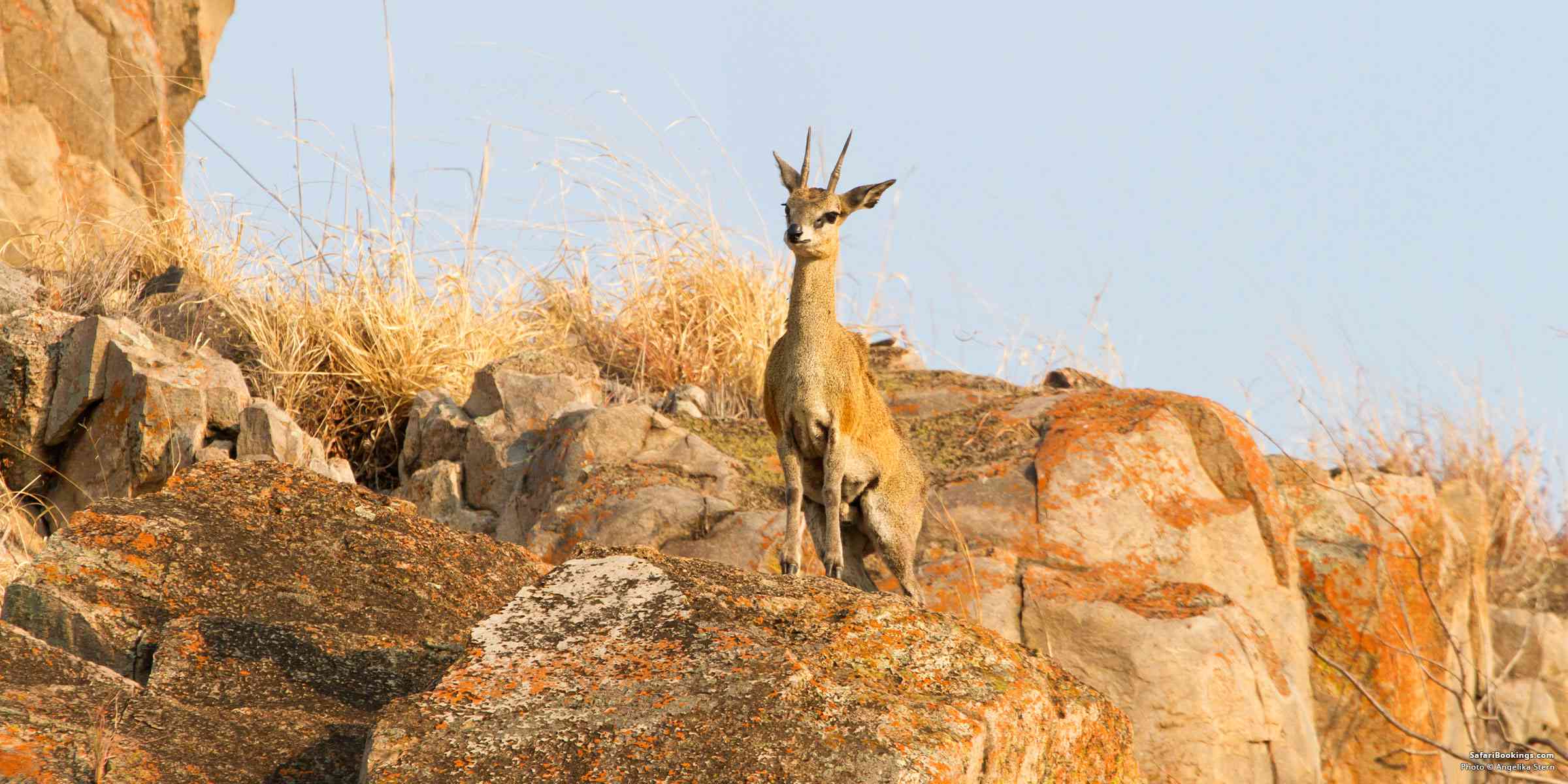
The klipspringer, Oreotragus oreotragus, is a small antelope from the Bovidae family. Its name comes from Afrikaans and means “rock jumper.” Adults weigh between 8 and 18 kilograms, while their body length reaches 75 to 115 centimeters.
The coat is coarse and speckled grey-olive. Each hair is hollow and filled with air, which provides insulation on cold rock faces. Additionally, this unique coat helps cushion impacts during movement.
Only males grow horns. These horns are short, straight, and slightly divergent, reaching 7 to 15 centimeters.
The klipspringer’s body reflects its rocky lifestyle. It has short muscular legs, a compact frame, rounded hindquarters, and a very short tail. Its side-facing eyes provide a wide field of view, helping it detect predators approaching across open rock.
Hoof Anatomy: A Rock-Specific Adaptation
The klipspringer’s hoof is one of the most specialized among antelopes. The outer hoof wall is hard, blunt, and cylindrical. Unlike many hoofed animals, it does not curve under the foot. Instead, the animal stands on the flat end of each hoof.
Inside the hoof, a soft and flexible core improves traction. As the hoof presses against rock, this inner layer creates grip through elastic movement. In many ways, this works like a natural climbing shoe.
Furthermore, the klipspringer’s compact body absorbs the impact of powerful leaps. Its hollow coat hairs and strong muscles help reduce stress when landing.
A klipspringer can jump between rocks several meters apart and land on narrow surfaces with remarkable accuracy. Even on difficult terrain, it maintains balance with almost effortless precision.
Rocky Habitat Specialisation
Klipspringers live only among rocky landscapes. They inhabit kopjes, cliffs, boulder fields, and rocky gorge walls. As a result, they rarely appear on flat ground.
The same rocky outcrop that guides use as a landmark across the Serengeti can provide a permanent home for a klipspringer pair.
In Tanzania, they occur around the Ngorongoro Crater rim, central Serengeti kopjes, and Ruaha’s rocky hills. In Kenya, Tsavo’s rocky areas support populations, while Uganda’s Kidepo Valley provides another important habitat.
Territories are relatively small, covering about 7 to 49 hectares of rocky terrain. A pair usually remains within the same rock system for years. Therefore, they know every ledge, escape route, and hiding place in their territory.
This knowledge creates a strong advantage. A predator entering unfamiliar rocks cannot match the klipspringer’s understanding of the landscape.
Monogamy and Pair Behaviour
Klipspringers form monogamous pairs. A bonded pair can share the same rocky territory for many years.
Both animals remain alert while feeding. While one grazes, the other watches for danger. Consequently, their teamwork provides almost constant protection in exposed habitats where hiding places are limited.
The male marks the territory using scent from glands near his eyes. He rubs vegetation around the edges of their rocky home. The female also contributes to maintaining the pair’s chemical boundary.
Together, their scent markings help define and protect their territory.
Plan Your Safari
Klipspringers are best observed around rocky kopjes in Tanzania’s Serengeti. The Simba and Moru kopjes are especially good locations for sightings.
Additionally, Ruaha National Park offers excellent viewing opportunities among rocky hills near the Great Ruaha River.
In Uganda, Kidepo Valley National Park supports healthy klipspringer populations. During a safari, look for animals standing high on rocky points and silhouetted against the sky.
These elevated positions allow klipspringers to monitor their surroundings. Therefore, the highest rocks often reveal one of Africa’s most perfectly adapted mountain antelopes.
African Wild Trekkers builds kopje and rocky outcrop stops into Serengeti and Ruaha game drives. Contact us to plan a Tanzania or Uganda safari that captures East Africa’s full range of specialized habitats and their unique wildlife.