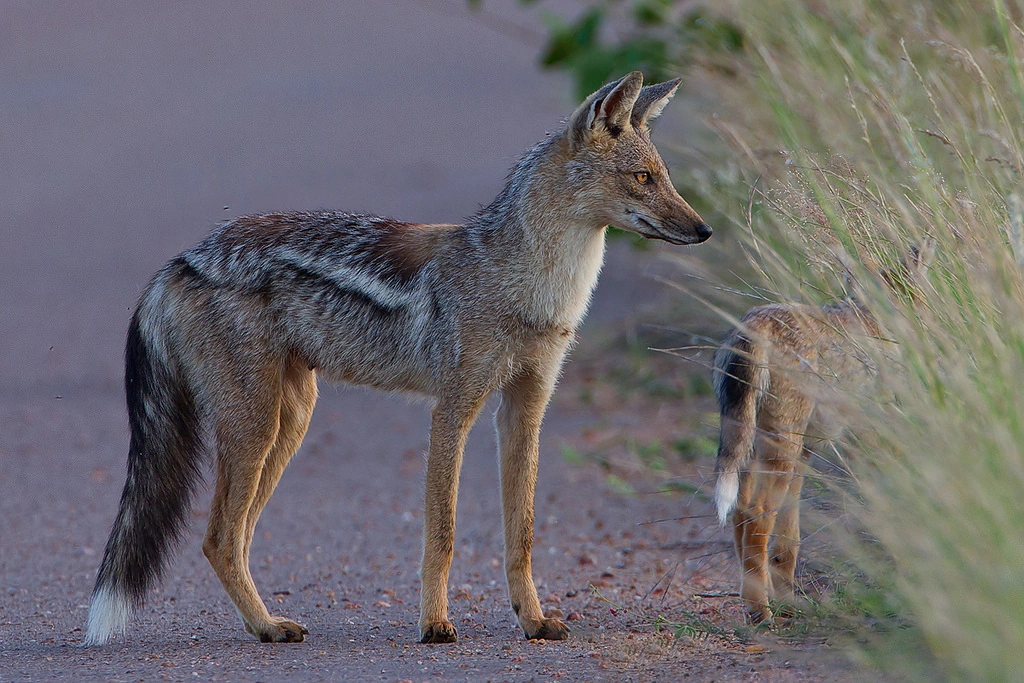
Side-Striped Jackal: East Africa’s Forest-Edge Jackal Explained
Most East African visitors know the black-backed jackal from the open plains. Far fewer notice the jackal that lives in the forests, wetlands, and woodland edges. The side-striped jackal is quieter, less conspicuous, and often overlooked. It is also the most widespread jackal in Africa — just not the most visible.
What Is the Side-Striped Jackal?
The side-striped jackal, Lupulella adusta, is one of three jackal species in Africa. It is the least studied of the three. It belongs to the same genus as the black-backed jackal but differs significantly in habitat preference, appearance, and behavior. Scientists reclassified both African jackals from Canis to Lupulella in 2019, reflecting their distinct evolutionary lineage from Eurasian jackals and wolves.
An adult side-striped jackal weighs between 6.5 and 10 kilograms. It stands about 40 centimeters at the shoulder. It is similar in size to the black-backed jackal. Its body shape is slightly stockier. The legs are shorter relative to the body.
How to Identify the Side-Striped Jackal
The side-striped jackal lacks the dramatic black saddle of its relative. Its coat is a dull greyish-brown. A white stripe runs along each flank from shoulder to hip—this is the “side stripe” that gives it its name. A second dark stripe below the white one creates a layered effect on the flank.
The most reliable field mark is the tail. The side-striped jackal’s tail ends in a white tip. The black-backed jackal’s tail ends in black. This difference holds consistently and separates the two species at any distance where the tail is visible. The ears of the side-striped jackal are also more rounded and shorter than those of the black-backed.
Diet and Feeding Behaviour
The side-striped jackal is a generalist feeder. It eats small mammals, birds, eggs, insects, carrion, fruits, and vegetables. It scavenges at carcasses when the opportunity arises. Fruits and plant material form a larger proportion of its diet than for the black-backed jackal.
This flexible diet suits its forest-edge and wetland habitat. Rodents are common in these areas. So are fruiting trees. The side-striped jackal forages alone or in pairs. It hunts less cooperatively than the black-backed jackal. It relies more heavily on scavenging and opportunistic feeding.
Behaviour and Territorial Marking
Side-striped jackals are monogamous. Pairs defend a territory together using scent marking and calling. Their call is softer and more owl-like than the harsh wail of the black-backed jackal. Many people hear it at night in woodland areas without recognizing its source.
Helpers from previous litters sometimes assist parents in raising new cubs. This cooperative breeding behavior is well-documented in jackals generally. It increases cub survival rates significantly. Side-striped jackals tend to be less bold than black-backed jackals near human habitation. They retreat more readily when approached.
Where to Find Side-Striped Jackals in East Africa
The side-striped jackal has the widest range of any African jackal. It extends from West Africa through Central Africa and across all of East Africa. In Uganda it is the common jackal species. It lives around Queen Elizabeth National Park and Murchison Falls and across the woodland and grassland mosaic landscapes.
In Kenya it occupies highland forest edges, Aberdare woodland, and wetland margins. In Tanzania it is widespread in woodland and higher-rainfall zones. It avoids the open short-grass plains where black-backed jackals dominate. You will often see side-striped jackals at dusk on game drives through woodland areas of Uganda and western Kenya.
The Side-Striped Jackal at Night
The side-striped jackal is more nocturnal than the black-backed jackal. It is most active in the two hours after sunset and the two hours before sunrise. On dark, overcast nights it forages well into the middle of the night. On moonlit nights it tends to rest earlier. This activity pattern reduces overlap with diurnal predators but increases exposure to nocturnal hunters like leopards and large owls.
Night foraging brings the side-striped jackal into habitats the black-backed jackal uses less. Dense riverine forest, thicket edges, and wetland margins are productive at night for frogs, small mammals, and invertebrates. The side-striped jackal navigates these areas confidently. Its slightly shorter legs and more compact build suit movement through dense understory better than the long-legged black-backed jackal’s build does.
Conservation Status and Population
The side-striped jackal is classified as Least Concern by the IUCN. It is common across its range and shows no evidence of significant population decline. It tolerates modified habitats, including cultivated land, secondary forest edges, and peri-urban zones, better than many carnivores. In Uganda, it is the most frequently recorded wild canid in camera trap studies across multiple protected areas.
The main threats are habitat loss, road mortality, and occasional persecution. Side-striped jackals are less frequently targeted by farmers than black-backed jackals because they are less associated with livestock predation. Their woodland and forest-edge habitat is also less directly threatened than open savanna in some parts of East Africa. Population monitoring remains limited due to the species’ secretive behavior, but existing evidence suggests a stable and widespread population across the region.
Plan Your Safari
The best places to watch side-striped jackals in East Africa are Uganda’s savanna-woodland parks. Queen Elizabeth National Park, particularly around Mweya Peninsula, produces regular sightings. The parkland edges and woodland tracks in Murchison Falls are also productive at dawn and dusk.
Side-striped jackals are most active in the morning and evening. They rest in shade during the heat of the day. Unlike black-backed jackals, they rarely associate with large predator kills in open plains. Your best encounters will come on slower, more patient drives through wooded and mixed habitat rather than on wide-open savanna.
African Wild Trekkers designs Uganda safaris that cover all the park landscapes where side-striped jackals live. Contact us to build a trip that takes in the full range of Uganda’s small carnivores alongside its gorillas, chimps, and big game.