Black-Backed Jackal: Africa’s Most Adaptable Predator and Scavenger
At dawn across the East African savanna, a sound rises above the grass. Sharp, wailing, insistent. It carries the kilometers. The black-backed jackal is announcing the new day. This animal is everywhere on the African plains. It is fast, clever, and misunderstood and eats almost anything. It kills surprisingly large prey and raises its young as a team.
Identifying the Black-Backed Jackal
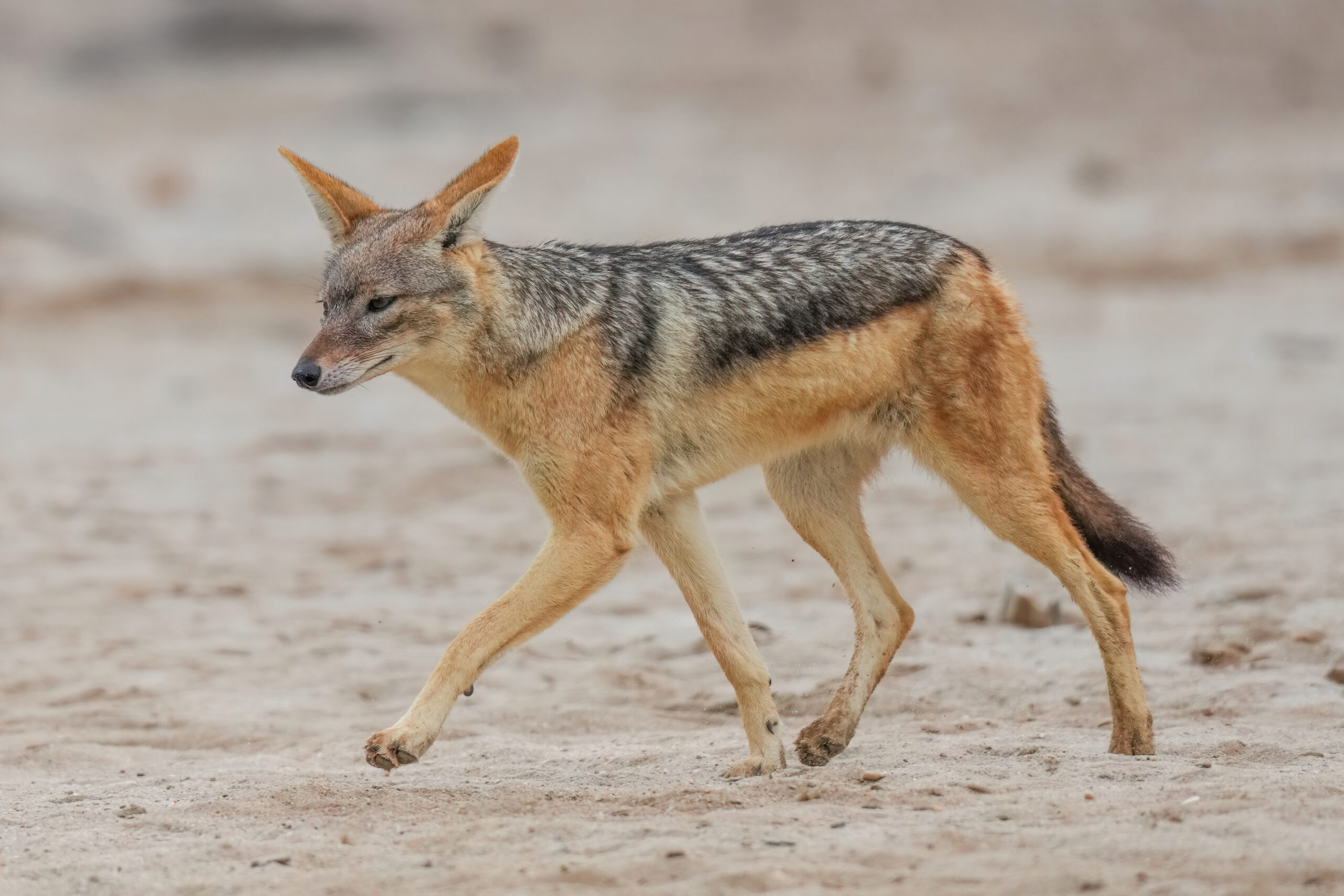
The black-backed jackal, Lupulella mesomelas, is the most easily identified of Africa’s three jackal species. A broad saddle of black and silver hair runs from the back of the neck to the base of the tail. The rest of the body is rufous brown. The tail is black-tipped and bushy.
Adults weigh between 6 and 10 kilograms. They stand roughly 40 centimeters at the shoulder. The face is sharp and fox-like. The ears are large, erect, and mobile. The legs are long relative to the body—built for covering ground quickly over long distances.
Diet: Hunter, Scavenger, and Opportunist
The black-backed jackal eats everything it can find. Small mammals make up the largest portion of its diet. It hunts rodents, hares, young Thomson’s gazelles, impalas, and springbok lambs. It kills prey up to its own weight with a bite to the back of the neck.
Jackals also scavenge extensively at lion and leopard kills. They push into hyena groups at carcasses. They steal food from cheetahs, which lack the confidence to defend a kill against multiple jackals. At the coast and on lake shores, jackals eat fish, marine invertebrates, and seal pups. Few African carnivores eat as wide a range of food.
Hunting in Pairs: A Coordinated Strategy
Mated pairs of black-backed jackals hunt cooperatively. This teamwork allows them to catch prey they could not catch alone. Two jackals working together can separate a young impala from its mother. One distracts the mother while the other takes the lamb.
Studies of black-backed jackal pairs in the Serengeti showed that hunting success doubled when both animals worked together compared to solitary hunting. Pair-bonded jackals also raise significantly more cubs per year than single individuals. The pair bond strengthens through cooperative hunting and shared cub-rearing.
The Black-Backed Jackal and Large Predators
Black-backed jackals live alongside lions, leopards, cheetahs, hyenas, and wild dogs. They compete with all of them for food at various points and follow lions closely and wait for kills. They mob cheetahs and steal fresh kills within minutes of a successful hunt and defer to spotted hyenas at large carcasses but snatch pieces from the edge.
Lions, leopards, and hyenas kill jackals opportunistically. Yet jackal populations remain high. Their intelligence and speed reduce predation risk. They sleep in a different location each night and watch their surroundings constantly. They run at the first sign of a serious threat.
Range and Habitat in East Africa
The black-backed jackal lives across eastern and southern Africa. In East Africa it is common throughout Kenya and Tanzania. It ranges from sea level to above 3,000 meters. It lives in open savanna, grassland, scrubland, semi-desert, and even suburban fringes near Nairobi.
The Maasai Mara and Serengeti ecosystems hold particularly dense populations. The availability of large predator kills and abundant prey make these areas ideal. Amboseli, Tsavo, and the Laikipia Plateau in Kenya also hold strong numbers.
Jackal Calling and Communication
The black-backed jackal produces one of the most evocative sounds in Africa. The dawn call—a rising wail that breaks into a series of sharp yips—carries several kilometers across open country. This call reinforces the pair bond between mated individuals. It also communicates territorial occupancy to neighboring pairs. Each individual jackal has a slightly different call signature. Experienced researchers recognize individuals by voice alone.
Jackals also communicate with a wide range of shorter vocalizations. A rapid yipping series alarms the pair to a nearby predator. A soft churring call between pair members maintains contact during close-range foraging. A sharp bark drives competitors away from a food source. Pups produce a persistent whine that triggers feeding responses in both parents and older sibling helpers. The call repertoire of the black-backed jackal is one of the richest in the canid family.
Human Conflict and Population Status
Farmers across eastern and southern Africa regard the black-backed jackal as a livestock threat. In some areas, jackals do take lambs, kid goats, and poultry. This triggers trapping, poisoning, and organized drives that kill thousands of jackals each year. The species nonetheless maintains high population densities near human settlement. Jackals are intelligent enough to learn trap locations quickly. They often remove poison bait without consuming it. Control programs have had little long-term effect on population size.
The IUCN classifies the black-backed jackal as Least Concern. It is one of the most abundant wild canids in Africa. In protected areas, jackal populations are dense and behaviorally natural. On farmland, they exploit human food waste and livestock to supplement wild prey. They are among the carnivores most likely to persist in a modified landscape, provided persecution does not reach the levels that drive local extinctions.
Plan Your Safari
Black-backed jackals are one of the easiest carnivores to watch in East Africa. They are active throughout the day and easy to approach in a vehicle. The most entertaining viewing comes at lion or cheetah kills, where you can watch jackals negotiate their share against much larger competition.
Dawn and dusk are the most active periods. The calling behavior at dawn—which can involve multiple individuals answering each other across the plains—is one of Africa’s great wildlife experiences. The Maasai Mara and Serengeti deliver this every morning during game drives.
African Wild Trekkers designs Kenya and Tanzania safaris that cover the full range of plains predators. Contact us to build a trip that gives you time at hills and open plains where jackal behavior is most visible.