Red-tailed Monkey Facts: The Fruit-Eating Guenon of Uganda’s Forest Canopy
The red-tailed monkey is the most abundant and frequently encountered forest monkey in Uganda. Its vivid white nose spot against a dark face makes it immediately identifiable at any distance in dappled forest canopy. Red-tailed monkeys associate readily with other primate species joining mixed groups with blue monkeys, mangabeys, and colobus in the same canopy zone. This multi-species association reduces individual predator detection effort, dilutes predation risk across more individuals, and gives each member access to the alarm calls and vigilance of multiple species simultaneously.
What Is a Red-tailed Monkey?
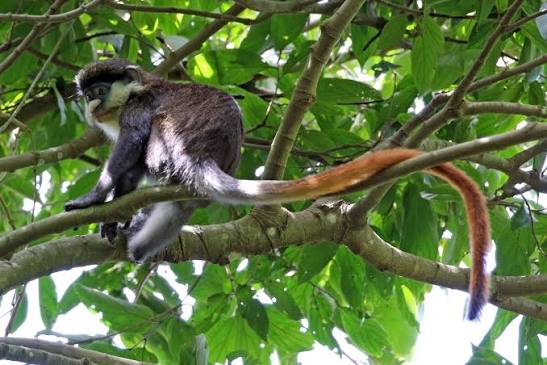
The red-tailed monkey, Cercopithecus ascanius, is a medium-sized Old World monkey in the guenon family. Adults weigh between 2.5 and 4.5 kilograms. Body length reaches 35 to 46 centimetres with a tail significantly longer than the body reaching 50 to 72 centimetres, reddish-chestnut toward the tip, giving the species its name. The face is black with a prominent white, heart-shaped nose patch the species’ most distinctive feature, visible from 30 metres in good light. The coat is dark olive-brown on the back and grey on the underparts. Cheek pouches store food items gathered from fruiting trees, allowing rapid collection during competition at productive food sources.
Diet: Fruit and Insects
Red-tailed monkeys eat fruit, insects, leaves, and gum from tree bark. Fruit dominates the diet when available the cheek pouches allow rapid harvesting of ripe items from a fruiting tree before competitors arrive. Insects provide essential protein. The monkeys actively search bark, dead wood, and leaf surfaces for beetles, caterpillars, and other invertebrates during the mid-day period when fruit feeding slows. This dietary combination of fruit and insects produces a nutritionally complete diet year-round without the seasonal stress that pure fruit specialists face when forest fruiting declines.
Social Structure and Mixed-species Groups
Red-tailed monkeys live in groups of 7 to 30 individuals usually one dominant male and multiple adult females with offspring. The dominant male produces loud territorial calls that advertise the group’s presence and warn rival males from the territory. Males transfer between groups at sexual maturity. Females remain in their birth group. Group cohesion relies on contact calls a constant chittering and chirping that keeps dispersed individuals in audio contact while feeding in different parts of a large fruiting tree.
Mixed-species associations with blue monkeys develop consistently in Kibale Forest. The two species share food resources without significant competition their different body sizes and dietary preferences reduce direct competition. Both species benefit from the expanded vigilance network the mixed group provides. Red-tailed monkeys respond to the alarm calls of blue monkeys even when the alarming individual is hidden from view the call itself triggers an appropriate response without the need for visual confirmation of the threat.
Range in Uganda
Red-tailed monkeys occupy Uganda’s forest parks Kibale, Bwindi, Budongo, and the forest margins throughout western Uganda. They also appear in Kenya’s Kakamega Forest and Tanzania’s western forest zones. Kibale Forest holds one of the highest red-tailed monkey densities recorded anywhere in Africa. The species tolerates secondary forest and fragmented forest patches better than more specialised forest primates, making it the most frequently encountered monkey in Uganda’s forest-edge habitats.
Plan Your Safari
Uganda’s Kibale National Park is the premier destination for red-tailed monkey observation. The park’s chimpanzee tracking trails pass through areas of extremely high red-tailed monkey density groups appear overhead on every forest walk. The Kanyanchu circuit produces daily multi-species canopy encounters where red-tailed monkeys, blue monkeys, grey-cheeked mangabeys, and black and white colobus occupy the same forest simultaneously.
African Wild Trekkers designs Uganda forest safari itineraries combining Kibale chimpanzee and primate walks with gorilla tracking in Bwindi. Contact us to plan a Uganda primate circuit that captures this extraordinary country’s full forest wildlife.