African Jacana Behavior: The Lily Trotter With Reversed Family Roles
The African jacana is one of East Africa’s most behaviourally fascinating waterbirds. Its enormous toes and claws allow it to walk across floating lily pads and aquatic vegetation as if walking on solid ground. This adaptation gives the species access to a feeding zone in the centre of open water that no other small waterbird can exploit on foot. The sight of a jacana striding confidently across a mat of floating lily pads, picking invertebrates from the leaf surfaces, is one of East Africa’s most charming wetland wildlife moments.
Beyond its walking ability, the African jacana has one of the most remarkable family systems of any bird in Africa. Females are larger than males, more brightly coloured, and aggressively territorial. They maintain harems of up to 4 males within their territory. Each male incubates the eggs and raises the chicks entirely alone. The female contributes nothing to incubation or chick rearing beyond laying the eggs.
Walking on Water
The African jacana’s feet have evolved to the extreme of the bird world’s long-toed spectrum. The toes are extremely long and spread widely from the foot centre. The claws add additional length beyond the toe. When the foot is placed on a floating lily pad, the load of the bird’s body is distributed across a surface area that prevents the pad from sinking under the bird’s weight.
The jacana walks across lily pad mats with quick, confident steps. It pauses at each pad to scan the leaf surface for insects, spiders, and small invertebrates before moving to the next. The long toes are held spread wide during each step, creating the maximum possible surface contact with each leaf.
Young jacana chicks are equally adept at lily pad walking from very early in life. The enormous feet proportional to the chick’s tiny body give the juveniles an endearingly oversized appearance that is one of the most charming sights in any East African wetland.
Reversed Sex Roles and Polyandry
The African jacana’s social system reverses the typical bird sex role pattern completely. Females are larger — approximately 75 percent heavier than males. Females are more brightly coloured, with more vivid plumage in the breeding season. defend large territories that contain the smaller territories of multiple males.
The female visits each male in her harem in turn. She lays a clutch of eggs in each male’s territory. After laying, she moves on to the next male while the previous male begins incubating the eggs alone. The male incubates the eggs for 26 to 28 days and raises the chicks without any assistance from the female.
The male’s chick-carrying behaviour is one of the most remarkable in the bird world. When a predator approaches the nest or young chicks, the male gathers the chicks under his wings. Only the chicks’ legs dangle below the wing feathers. The male walks off carrying the hidden chicks to a safer position. This strategy allows the chicks’ camouflage to benefit from the male’s larger body concealment while remaining mobile in response to a threat.
Identification
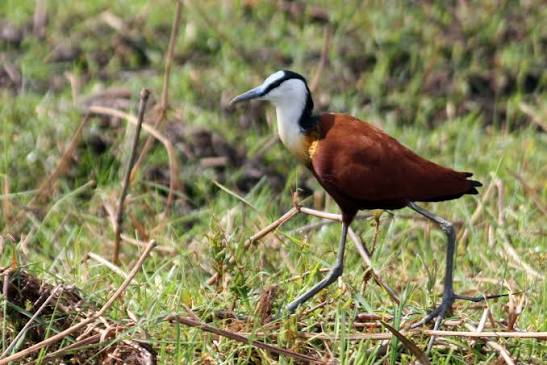
The adult African jacana is a chestnut-brown waterbird measuring 23 to 31 centimetres. The head is black with a blue frontal shield and bill. The neck is white. The body is chestnut-rufous. The extremely long toes are immediately visible when the bird walks across floating vegetation and are the most distinctive physical feature of the species.
The female is larger than the male but otherwise identical in plumage. The blue frontal shield is slightly larger in females and is used in territorial displays against rival females. The shield colour brightens in aggressive encounters and may flush to a more vivid blue during intense territorial interactions.
Where to See African Jacanas in East Africa
African jacanas are present throughout East Africa wherever floating aquatic vegetation — particularly water lilies — covers still or slow-moving shallow water. Uganda’s papyrus lake margins, Kenya’s Rift Valley lake vegetation mats, and Tanzania’s lake margin vegetation all carry accessible jacana populations.
Lake Naivasha in Kenya’s Rift Valley provides one of the most productive African jacana environments in East Africa. The lake’s extensive water lily coverage provides ideal walking habitat and the species is visible from boats navigating through the lily mat zones in large numbers throughout the day.
Uganda’s Bigodi Wetland and the vegetated margins of Queen Elizabeth National Park’s lakes carry jacanas in numbers visible on early morning canoe and walking activities. Any slow boat activity through water lily-covered sections of an East Africa lake or channel will produce multiple jacana encounters.
Plan Your Birding Safari
African jacana sightings are most reliably achieved at lake destinations with floating water lily vegetation. Kenya’s Lake Naivasha provides the most accessible environment. Uganda’s wetland destinations provide the most intimate encounters through canoe access.
The chick-carrying behaviour requires specific timing and local guide knowledge of nesting territories. Guides who know active nesting sites in early morning light produce the most memorable family behaviour encounters with this extraordinary waterbird.
African Wild Trekkers includes lake and wetland boat activities in East Africa birding safari itineraries where African jacana behaviour is accessible at close range. Contact us to plan a safari that captures East Africa’s most behaviourally remarkable waterbird in its natural lily pad habitat.