Beisa Oryx Facts: The Desert Antelope of Kenya’s Dry Northern Frontier
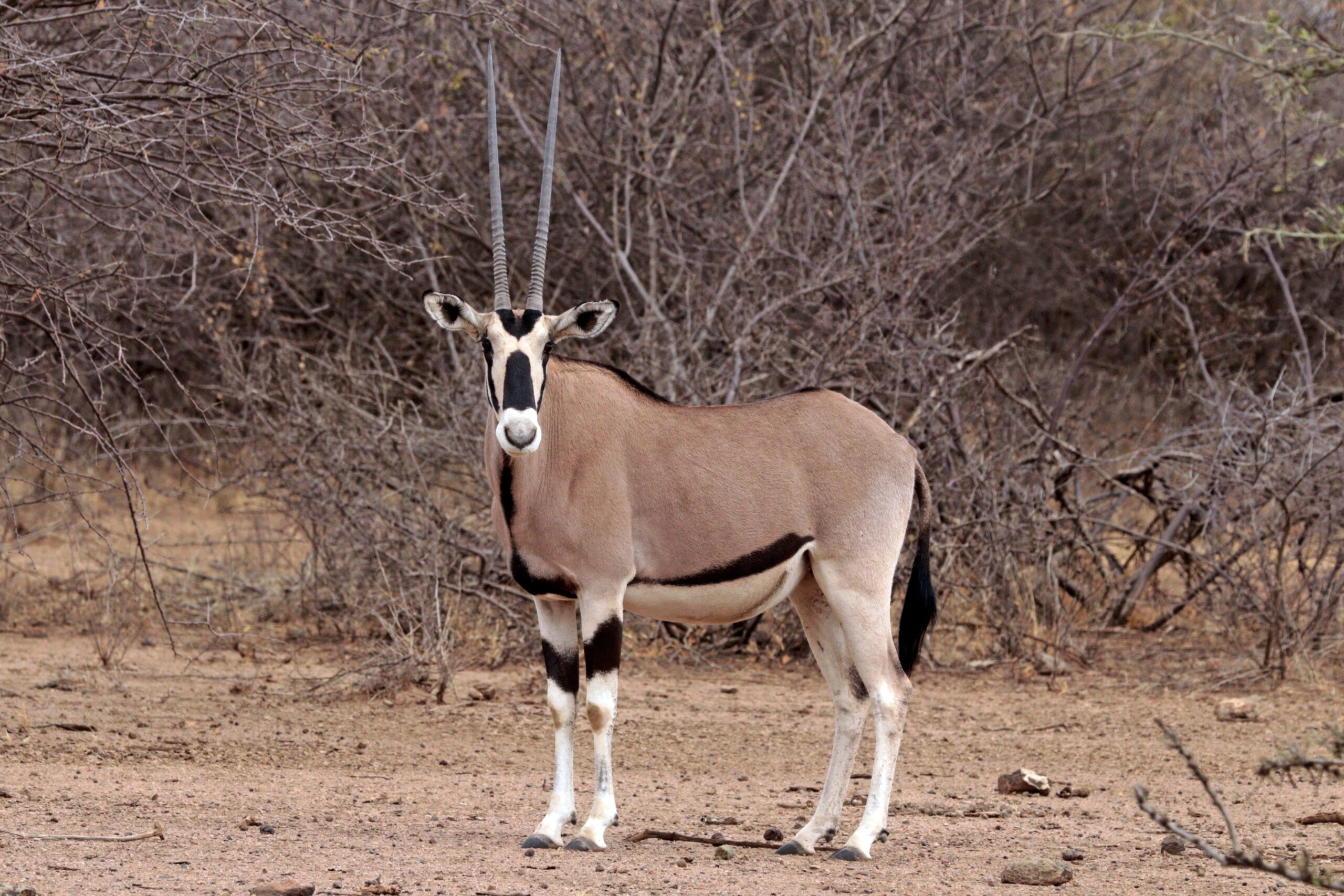
Few African antelopes are as striking as the beisa oryx. Its long, straight horns extend proudly from the head, while its face carries a bold black-and-white pattern. The coat is pale fawn with dark markings separating the flanks from the white underparts.
Indeed, the beisa oryx looks perfectly designed for life in harsh landscapes. Its impressive appearance matches its remarkable survival abilities.
What Is the Beisa Oryx?
The beisa oryx, Oryx beisa, belongs to the oryx group of large, straight-horned antelopes. These animals are adapted to dry and semi-arid environments.
In East Africa, the beisa is the main oryx species. It differs from Kenya’s fringe-eared oryx and southern Africa’s gemsbok.
An adult beisa oryx weighs between 167 and 209 kilograms. Its body length reaches 1.7 to 2 meters, while shoulder height averages about 1.2 meters.
Both males and females grow horns. These horns are long, straight, and slightly separated, reaching 75 to 110 centimeters.
Interestingly, female horns are often longer and thinner. They are used for defense, especially when protecting calves. A threatened female can strike predators with powerful forward movements, and even lions have been injured by oryx horn attacks.
Heat Tolerance: The Physiology of Desert Survival
The beisa oryx thrives in areas where temperatures regularly rise above 40 degrees Celsius. Its ability to manage heat is among the most impressive adaptations of any large mammal.
During extreme heat, the oryx can allow its body temperature to rise by several degrees. As a result, it stores heat instead of losing water through sweating.
This strategy reduces water loss and helps the animal survive in dry environments.
Furthermore, blood flowing toward the brain passes through a cooling network in the nasal passages. This system, known as the carotid rete, lowers blood temperature before it reaches the brain.
Therefore, the brain remains protected even when the body becomes extremely warm.
Range and Habitat in Kenya
Beisa oryx live across Kenya’s dry northern regions. They are found in Samburu, Buffalo Springs, Shaba, Marsabit, Isiolo, and Wajir.
They are among the most important large antelopes in Kenya’s semi-deserts. In the Samburu ecosystem, they share habitats with other dry-country specialists, including gerenuk, reticulated giraffe, and Grevy’s zebra.
Beisa oryx usually live in herds of 5 to 40 individuals. Herd structures vary depending on the season. Mixed groups, female groups with calves, and male bachelor groups can all be seen.
During breeding periods, dominant males often remain with mixed herds. However, males and females may separate outside this season.
Fringe-Eared Oryx: The Southern Kenya Form
The fringe-eared oryx, Oryx beisa callotis, is a subspecies of the beisa. It is recognized by the black fringes along its ears.
This form occurs in southern Kenya and northern Tanzania. It can be seen in Tsavo East, the Amboseli ecosystem, and parts of eastern Laikipia.
Both forms are impressive in the wild. However, visitors to southern Kenya usually encounter the fringe-eared variety, while the pure beisa is found farther north.
Plan Your Safari
Samburu National Reserve offers one of the best opportunities to see beisa oryx in East Africa. Large herds can often be spotted alongside other dry-country species.
A morning game drive in Samburu may reveal gerenuk, reticulated giraffe, Grevy’s zebra, and beisa oryx within a single route.
Therefore, few destinations combine such a unique collection of desert-adapted wildlife in such a compact area.
African Wild Trekkers designs northern Kenya safari circuits based in Samburu and Laikipia. Contact us to plan a Kenya safari that captures the dry north’s extraordinary dry-country wildlife alongside the Mara’s grassland spectacle.