Common Eland Facts: Africa’s Largest Antelope and Its Surprising Agility
The common eland is the largest antelope in Africa. An adult bull stands up to 1.7 metres at the shoulder and weighs up to 940 kilograms. Despite that mass, the eland jumps fences of 1.5 to 2 metres from a standing position. This combination of enormous size and surprising athletic ability defines the eland — an animal that looks unwieldy but moves with unexpected speed and power when required. The clicking sound its hooves produce with every step audible from 20 metres is the most characteristic field indication of an approaching eland herd.
What Is a Common Eland?
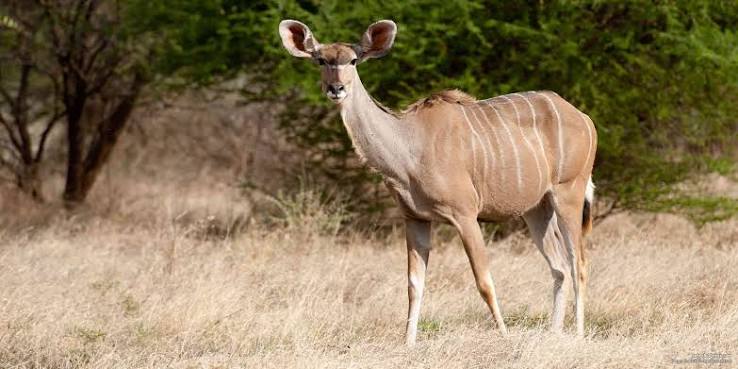
The common eland, Taurotragus oryx, is the larger of Africa’s two eland species the giant eland of West and Central Africa is marginally larger on average. Adults carry spiral horns with a strong keel both sexes carry horns, reaching 43 to 66 centimetres in females and up to 100 centimetres in males. The coat is tawny-brown with faint white vertical stripes on the sides more prominent in eastern subspecies than in southern populations. A large dewlap hangs from the throat in both sexes and grows more pendulous with age in bulls. Bulls develop a dark tuft of hair on the forehead that thickens over time.
The clicking sound that eland produce while walking comes from the foreleg tendons a mechanical click produced at each foreleg stride by a ligament mechanism in the carpus. This sound carries through dense bush and is a reliable indicator of eland approach well before visual contact.
Herd Structure and Social Life
Common eland live in fluid, fission-fusion herds of 25 to 70 individuals, though aggregations of several hundred occur seasonally where food and water concentrate animals. Females and their young form the core groups. Bulls join female herds to monitor reproductive status, competing with each other through neck wrestling and spiral horn wrestling rather than the running fights typical of smaller antelope. Old bulls tend toward small bachelor groups or solitary existence.
Eland herds migrate seasonally following rainfall and fresh grass flush. In East Africa they range widely across open savanna, woodland, and highland grassland, moving between wet-season and dry-season resource areas over distances of 50 to 200 kilometres. Their broad dietary range grass, leaves, pods, and fruit allows eland to cross habitat types that restrict more specialised feeders.
Diet and Browsing-Grazing Flexibility
Eland are mixed feeders with unusual dietary flexibility. In the wet season they graze heavily on fresh green grass. During the dry season they shift predominantly to browse leaves, seedpods, and succulent vegetation. This dietary switching across seasonal food availability allows eland to maintain body condition through both seasons in habitats where strict grazers or browsers face nutritional stress. Eland also break branches with their spiral horns to access leaves beyond direct reach a physical ability that improves browse access in taller trees.
Range in East Africa
Common eland occur widely across East Africa’s open savanna and woodland from Kenya’s Maasai Mara and Laikipia through Tanzania’s Serengeti and Ngorongoro to Uganda’s drier zones. They favour open terrain with good visibility and abundant mixed vegetation. Highland grasslands above 2,500 metres also hold eland populations in Kenya and Ethiopia.
Plan Your Safari
The Maasai Mara and Laikipia Plateau produce the most accessible eland encounters in Kenya. Large herds of 50 to 100 animals graze the Laikipia plateau during the wet season and produce spectacular dawn sightings on open plains. Tanzania’s Ngorongoro Crater floor holds a resident eland population year-round one of the most accessible eland viewing opportunities in Africa. The clicking tendon sound identifies approaching herds through thick bush on walking safaris before any visual contact occurs.
African Wild Trekkers designs Kenya and Tanzania safari itineraries that include open-country eland habitat. Contact us to plan a safari that captures the full scale and drama of Africa’s largest antelope.