Nile Monitor Facts: Africa’s Largest Lizard and Master of Two Worlds
The Nile monitor is not a mammal but it belongs in any honest account of East Africa’s remarkable wildlife. It is Africa’s largest lizard. It swims like a crocodile, climbs trees with ease, digs burrows efficiently, and eats almost anything it can catch or scavenge. On any East Africa game drive near water, it will appear. And it will reward a few minutes of attention with a display of physical competence that exceeds most visitors’ expectations of a lizard.
What Is a Nile Monitor?
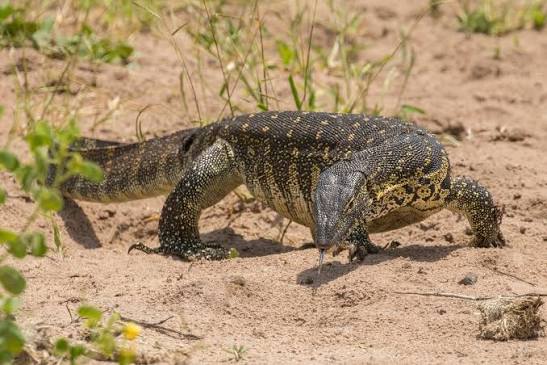
The Nile monitor, Varanus niloticus, is a member of the Varanidae the family that includes all monitor lizards and the Komodo dragon. An adult Nile monitor reaches 1.5 to 2.4 metres in total length. Weight ranges from 1 to 20 kilograms, with large males approaching the upper limit. The body is muscular and elongated. The neck is long and flexible. The tail is laterally compressed flattened from side to side making it an effective sculling organ in water.
The skin is grey-brown with yellowish spots on the back and yellowish bars and spots on the underside. The tongue is long, forked, and flicked constantly — the tongue delivers chemical signals from the environment to the Jacobson’s organ in the roof of the mouth, functioning as a highly sensitive chemosense system. A Nile monitor tonguing the air as it moves is actively scenting for prey, predators, and reproductive partners.
Semi-Aquatic Life
The Nile monitor is always found near permanent water. Rivers, lakes, papyrus swamps, and seasonal waterbodies all serve as habitat. In water, the monitor swims with the tail and body in a sinuous lateral movement identical to the swimming pattern of a crocodile. It is a strong swimmer that regularly crosses wide rivers. When pursued on land, it enters water and swims away the water crossing buys time against terrestrial predators that do not follow into deep water.
Basking is essential. As a reptile, the Nile monitor cannot generate its own body heat and relies on external heat sources to reach the body temperature needed for full physiological activity. Morning basking on sun-warmed rocks and fallen logs along waterways is the most common observation opportunity. A basking monitor is alert and aware of approaching threats it dives into water well before a vehicle reaches it unless it is fully habituated to human presence.
Diet: The Opportunist’s Menu
The Nile monitor eats everything available. Fish, frogs, crocodile eggs, bird eggs, small mammals, carrion, crabs, snails, and insects all appear in dietary analyses. Near bird colonies, monitors raid nests systematically. Near crocodile nests, they dig up and eat eggs when the mother is absent. waterbodies with high fish density, they hunt fish actively by ambushing at the water margin.
The egg-eating habit is particularly important ecologically. Nile monitors dig up the nests of Nile crocodiles, ground-nesting birds, and sea turtles in coastal areas. In areas with very high monitor densities, the egg predation load on crocodile populations is significant monitors are one of the primary natural controls on Nile crocodile nesting success in riverine ecosystems.
Nile Monitor Watching in East Africa
Nile monitors are visible on virtually every waterside game drive in East Africa. The Kazinga Channel in Uganda’s Queen Elizabeth National Park is one of the best locations monitors bask on the bank, swim beside the boat, and climb trees over the water with casual confidence. Uganda’s Murchison Falls and the Nile banks hold large individuals. Tanzania’s Serengeti rivers and Kenya’s Mara River both produce regular monitor sightings at waterholes and river crossings.
Plan Your Safari
Nile monitors are present on every East Africa safari that includes time near permanent water. The Kazinga Channel boat safari in Uganda is the best venue for close, unhurried observation. Large monitors adults over 1.5 metres are genuinely impressive animals that command sustained attention. A monitor raiding a nesting bird colony or investigating a crocodile nest is one of the most behaviourally interesting wildlife observations available on any East Africa game drive.
African Wild Trekkers includes Queen Elizabeth’s Kazinga Channel boat safari and riverside game drives in all Uganda and Tanzania circuits. Contact us to plan a safari that captures the full range of East Africa’s wildlife beyond the famous large mammals.