Ruaha National Park Tanzania: The Largest and Least-Visited Safari Park
Ruaha National Park in central Tanzania is the country’s largest national park and one of Africa’s greatest wildlife destinations — a fact that an astonishing number of East Africa safari travellers have never discovered. While the Serengeti and Ngorongoro attract the bulk of Tanzania’s international safari visitors, Ruaha quietly delivers game viewing of comparable quality in a landscape of greater visual drama, with almost none of the vehicle concentrations that characterise the northern circuit’s peak season. This guide introduces Ruaha to the travellers who have not yet found it and explains why it belongs on any serious Africa safari itinerary.
Why Ruaha Is Tanzania’s Most Underrated Park
Wildlife Density and Predator Quality
Lions and African Wild Dogs
Ruaha’s lion population is one of Tanzania’s finest, with pride sizes that regularly exceed twenty individuals and a hunting success rate on buffalo that reflects generations of cooperative experience in Ruaha’s rugged terrain. The park holds a significant portion of Tanzania’s total lion population, and the large buffalo herds along the Great Ruaha River create consistent hunting opportunities that keep pride territories stable and well-established. Ruaha’s lions are not the habituated, vehicle-accustomed animals of the Serengeti’s Seronera area — they are wilder, less predictable, and more genuinely challenging to find, but encounters with them feel correspondingly more earned and more intimate than a northern circuit sighting surrounded by five other vehicles.
African wild dogs — one of Africa’s most endangered large carnivores and one that Tanzania’s northern circuit rarely delivers reliably — have a meaningful presence in Ruaha. The park’s combination of open woodland, rocky terrain, and vast buffer zone areas adjacent to the national park creates suitable wild dog habitat, and pack territories in Ruaha’s northern and central sections deliver some of East Africa’s most reliable wild dog sightings. A morning spent following a Ruaha wild dog pack on the hunt — watching the pack’s coordination, their communication through large rounded ears, and the explosive acceleration of an impala chase across open miombo — delivers an experience that northern circuit travellers head south specifically to find.
Elephants and the Great Ruaha River
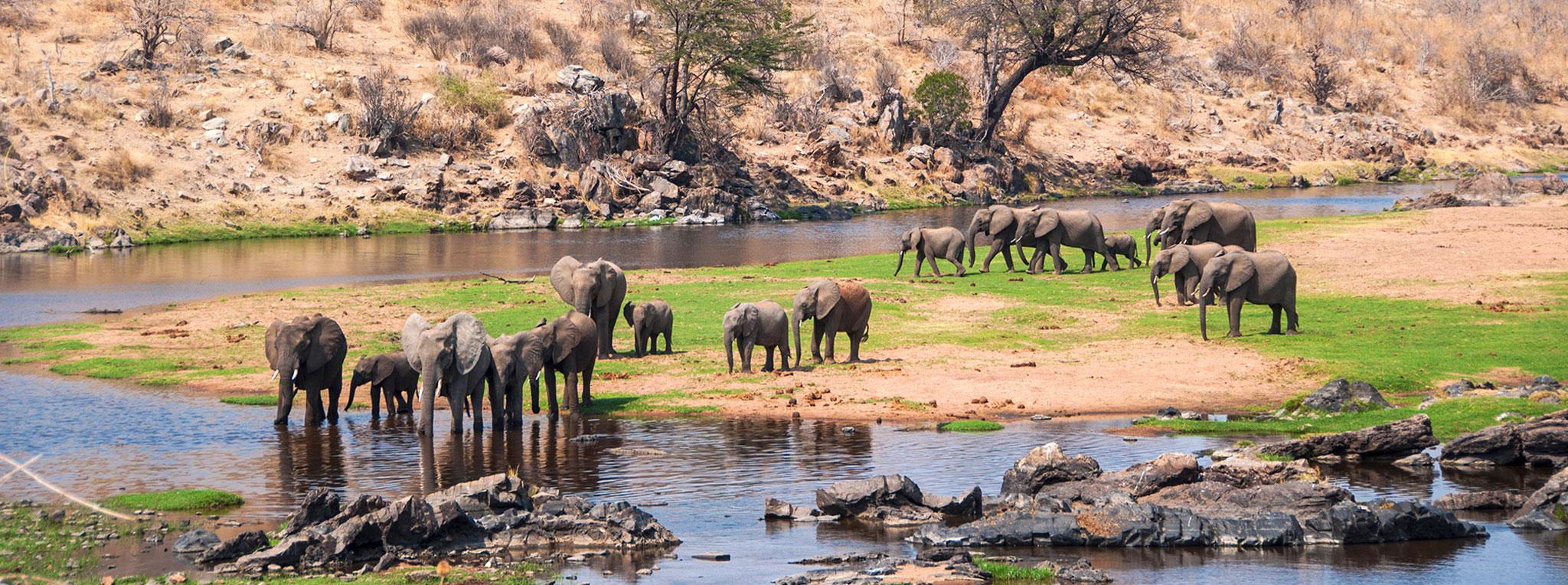
Ruaha holds Tanzania’s second-largest elephant population, and dry season concentrations along the Great Ruaha River deliver elephant viewing that rivals Tarangire’s famous herds in quantity while exceeding them in the wildness of the context. The river is a permanent water source in an otherwise semi-arid landscape, and the dry season gathering of elephants, buffalo, zebra, lion, and leopard at the riverbank creates a natural theatre that Ruaha’s river camp verandas overlook directly. A herd of two hundred elephants arriving at the river in the late afternoon — with the dust cloud they raise visible from ten kilometres away — is one of Tanzania’s most dramatic wildlife spectacles and one that Ruaha’s river delivers at regular intervals throughout the dry season months.
The Great Ruaha River also supports an impressive hippopotamus population and Nile crocodiles that reach immense sizes in this system, fed by a protein-rich food source and largely undisturbed in the remote southern Tanzania context. River camps positioned directly on the bank allow night listening — hippos grazing on the bank in the darkness, crocodiles slipping into the water at the guide’s torchlight — that adds a different dimension to the vehicle-based game drives forming the day’s core activity. Ruaha’s nights carry no artificial light beyond the camp itself, and the Milky Way above the river is one of the most spectacular night skies visible anywhere on the continent.
How to Get to Ruaha National Park
Access, Flights, and Logistics
Flying into Msembe Airstrip
Travellers reach Ruaha almost exclusively by light aircraft. The park’s Msembe airstrip receives flights from Dar es Salaam (one hour fifteen minutes), Arusha (approximately two hours with a connection), and Zanzibar (one hour fifteen minutes via Dar es Salaam). Coastal Aviation and Auric Air operate the most reliable scheduled service to Msembe, though flight frequencies run lower than on the Serengeti’s network and some days offer only a single flight option. Book Ruaha flights well in advance — at minimum three months ahead for peak season — because limited seat availability on small aircraft means last-minute bookings regularly fail. African Wild Trekkers confirms Ruaha flight bookings at the same time as camp reservations to ensure both are available on matching dates.
The overland alternative from Dar es Salaam covers a nine-to-twelve hour drive on roads that range from reasonable to poor depending on the season. Operators occasionally use this route for repositioning vehicles, but it is not the recommended approach for most safari visitors. Flying into Msembe takes ninety minutes from Dar and delivers you directly to the park boundary for a first game drive within hours of departure. The time savings are significant enough that the additional flight cost pays for itself in wildlife experience hours within the first day of the visit.
Best Time to Visit Ruaha
The optimal Ruaha safari window runs from June through October, when the dry season reduces vegetation cover, concentrates wildlife at the river, and opens the park’s tracks to all-terrain access. July and August deliver the peak dry conditions, with the river reduced to a narrow channel that draws every carnivore and herbivore in the surrounding area and creates the dense wildlife viewing that Ruaha is known for at its best. The shoulder months of June and October offer similar wildlife conditions with marginally less visitor traffic — though Ruaha’s low visitor numbers mean even peak season is quieter than the northern circuit’s low season.
The wet season from November through May closes access to the park’s southern and eastern sections, which become impassable in heavy rain. January and February bring lighter rains and the park accepts visitors with appropriate vehicle selection, though some camps close entirely during the wettest months. Ruaha in the green season delivers outstanding bird life — over 570 species recorded in the park — and lush vegetation creates photography opportunities the dry season’s brown landscape cannot match. Travellers who focus on birding sometimes visit Ruaha in December or early January for this reason. African Wild Trekkers advises on monthly conditions and camp availability before confirming any Ruaha booking.
Accommodation in Ruaha National Park
Camps and Lodges on the River
What Ruaha’s Camps Offer
Ruaha’s accommodation concentrates in the mid-range to luxury tier, with most quality camps sitting directly on the Great Ruaha River bank where game viewing from the veranda is a constant feature of the stay. Camps in this category typically house between eight and twenty guests, ensuring an intimate group size and a high staff-to-guest ratio that delivers personalised service and flexible activity scheduling. Most Ruaha camps include morning and afternoon game drives in a private 4×4 with a dedicated guide, full board meals in an open-sided dining structure overlooking the river, and evening briefings preparing guests for the following day’s activities.
Walking safaris are a defining Ruaha activity that most northern circuit parks do not permit in the same depth. An armed walking guide and an armed tracker lead the walk through woodland and kopje terrain that no vehicle can access, delivering a completely different quality of wildlife encounter — approaching a giraffe through mopane woodland on foot, reading a lion’s pugmark in the dust beside the morning waterhole, and listening to the landscape’s sounds without a vehicle’s filter. Most Ruaha camps include walking safaris as a standard activity, and African Wild Trekkers specifically recommends Ruaha to clients who want walking as a core component of their Tanzania experience.
Plan Your Safari
Ruaha National Park delivers a Tanzania safari experience that complements or surpasses the northern circuit in wildlife quality while providing complete exclusivity and walking safari access that the north largely does not offer. African Wild Trekkers has run Ruaha safaris for many years and knows the park’s seasonal wildlife patterns, each camp’s individual strengths, and the internal flight connections in detail. The team advises clients on whether Ruaha as a standalone southern circuit destination or as a northern-and-southern circuit combination best matches their Tanzania goals.
Every Ruaha booking includes the Msembe arrival flight coordination, camp accommodation with all activities and full board, and the departure flight to Dar es Salaam, Zanzibar, or the northern circuit depending on the itinerary structure. The team confirms all flights and camp reservations in writing before any deposit is requested. Ruaha’s camp availability is limited by the small number of beds in the park, so early booking matters more here than in any northern circuit park.
Contact African Wild Trekkers at africanwildtrekkers.com/contact with your Tanzania travel dates and we will advise on the best Ruaha itinerary and camp combination within 24 hours.