White-backed Vulture: East Africa’s Most Abundant and Important Scavenger
The white-backed vulture is East Africa’s most commonly encountered vulture and the backbone of the region’s scavenging bird community. It is typically the most numerous species at any large carcass gathering in the savanna. When the wildebeest and zebra migration brings mass mortality events to the Serengeti and Maasai Mara, the skies fill with hundreds of circling white-backed vultures that locate carcasses from kilometres away and descend to feed in congregations of dozens to over a hundred individuals at a single large kill.
The white-backed vulture performs an ecological service of extraordinary importance. It removes carcasses from the savanna at a speed that no other scavenging species can match. A single large carcass can be reduced to bare bones by a feeding group of white-backed vultures in under an hour. Without this rapid carcass removal, the disease load in the savanna ecosystem would be vastly higher.
Identification
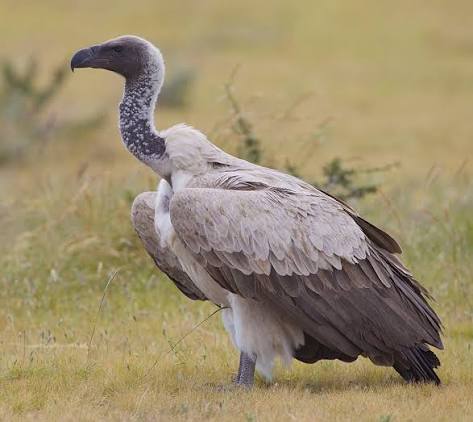
The adult white-backed vulture measures 94 to 98 centimetres. The underparts are pale brown. The bare head and neck skin is dark grey to blackish. The bill is dark and heavy with a pale tip. The eye is dark brown.
In flight overhead, the combination of brown body, dark head, and the white lower back patch visible on the upper surface identifies the species at considerable height. The white back is not visible from directly below but is clearly apparent from above or from the side as the bird soars on extended wings overhead.
The species is most easily confused with Rüppell’s vulture in the field. The white-backed vulture shows a more uniform brown back without the scaled pattern and a dark eye. These differences require close range or good binocular views for reliable assessment.
Carcass Feeding Behaviour
White-backed vultures locate carcasses by soaring at great heights on thermals and watching for the behaviour of other vultures below. A descending vulture is immediately visible to all other vultures within line of sight, creating a cascade of descending birds from kilometres away that can empty a large sector of sky of soaring vultures within minutes of the first bird spotting a carcass.
At the carcass, white-backed vultures compete aggressively with each other and with other species. The largest individuals dominate the most productive feeding positions at the carcass opening. Smaller individuals wait at the periphery and move in when dominant birds are briefly displaced.
The crop below the throat is visible as a distended bulge when the bird has fed heavily. A white-backed vulture that has consumed a full crop of meat faces difficulty in taking off and requires a running take-off of several metres before achieving sufficient airspeed for flight. Groups of crop-heavy vultures waddling away from a depleted carcass to attempt take-off is a characteristic post-feeding spectacle at any large carcass site.
Conservation Status
The white-backed vulture is classified as Endangered on the IUCN Red List despite being the most abundant vulture in Africa. The species’ population has declined by over 50 percent in the last 30 years. The primary drivers of decline are poisoning, persecution, trapping for the traditional medicine trade, and electrocution.
Supporting eco-tourism that generates revenue for the conservation of East Africa’s national parks and anti-poaching programmes that reduce the incentive for poisoning is the most direct contribution that safari visitors can make to white-backed vulture conservation.
East Africa’s protected area network provides the most secure remaining habitat for white-backed vultures in Africa. The Serengeti ecosystem, the Maasai Mara, and the parks of Uganda and Tanzania all carry breeding populations that are substantially better protected than vulture populations in unprotected farmland areas.
Plan Your Birding Safari
White-backed vulture sightings are virtually guaranteed on any game drive in Tanzania’s Serengeti or Kenya’s Maasai Mara during the dry season. The species is the most visible large soaring bird in East Africa’s skies above any area with significant herbivore populations.
Tanzania’s Serengeti wildebeest calving season from January to March provides the most spectacular white-backed vulture concentrations in Africa, with hundreds of birds gathering daily at predator kills and natural mortality events across the short grass calving grounds.
African Wild Trekkers designs Tanzania and Kenya safari itineraries through the core vulture habitat zones where white-backed vulture gatherings are a daily wildlife spectacle. Contact us to plan a safari that experiences East Africa’s vulture community at its most spectacular.