Africa Safari Cost Comparison 2026: Kenya vs Tanzania vs Rwanda vs South Africa
Africa Safari Costs in 2026: Country-by-Country Price Comparison
Understanding the real cost differences. Beyond the headline lodge prices that dominate comparison searches. Helps travelers allocate their budget more effectively. The comparison between Kenya, Tanzania, Rwanda, and South Africa covers the four countries that most international safari travelers consider when planning an Africa wildlife trip. It reveals why the same budget delivers very different experiences in each country. This guide covers the full cost picture: park fees, accommodation, permits, guides. And the specific experiences that justify each country’s price level.
Kenya: Mid-to-High Cost Safari Destination
Kenya sits in the middle of the Africa safari price range for guided wildlife experiences. But the Masai Mara’s conservancy fee structure pushes total costs higher than many travelers initially expect when they look only at headline lodge rates.
Kenya Park Fee Structure 2026
Kenya Wildlife Service park entry fees for non-citizen adults in 2026 are approximately $80 per person per day for the Masai Mara National Reserve. The private conservancies surrounding the Mara. Where the best safari experiences and off-road access are available. Charge conservancy fees of $80 to $150 per person per night on top of the park entry fee. This total fee burden of $120 to $230 per person per day in fees alone, before accommodation costs, makes the Masai Mara one of East Africa’s more expensive park fee environments. Other Kenya parks including Amboseli, Tsavo, and Samburu have lower entry fees of approximately $60 per person per day. These are more cost-effective alternatives for budget-conscious travelers who are flexible about which Kenya park they visit.
Kenya accommodation ranges from mid-range tented camps at approximately $200 to $350 per person per night all-inclusive to premium private concession camps at $600 to over $1,500 per person per night. All-inclusive means meals, game drives, and guide are included. The Kenya safari market has strong mid-range competition that provides genuine quality at the lower end of this range, particularly in Amboseli and Samburu. Fewer premium camps compete with the mid-range market in those parks. The Masai Mara’s premium camp market has inflated as demand from high-spending international travelers has grown. The best-positioned tented camps in the most exclusive conservancies now approach the pricing of Rwanda’s premium gorilla lodges.
Tanzania: Comparable Costs with Premium Fee Pressure
Tanzania’s Northern Circuit parks have seen significant fee increases in recent years. Total visitor costs now sit at levels comparable to Kenya’s Masai Mara for equivalent accommodation quality. The Ngorongoro Crater’s additional conservation levies add a meaningful premium beyond the standard TANAPA entry fees.
Tanzania Fee Structure and Accommodation
Tanzania National Parks (TANAPA) entry fees for the Serengeti in 2026 are approximately $70 per person per day for non-residents. Ngorongoro Crater entry requires both a TANAPA fee and a separate Ngorongoro Conservation Area Authority conservation levy. This levy adds $70 to $100 per person per visit on top of the standard entry. These fees compound across a multi-park Tanzania Northern Circuit itinerary. A typical five-day Northern Circuit package accumulates a total park fee burden of $500 to $700 per person, before accommodation costs. Tanzania accommodation pricing follows a similar distribution to Kenya’s. Mid-range lodges in the $200 to $400 per person per night range and premium Serengeti private concession camps at $600 to $2,000. The southern circuit parks — Ruaha and Nyerere — are somewhat cheaper in both park fees and accommodation than the Northern Circuit. They are better value for budget-conscious travelers willing to forego the Serengeti’s migration spectacle.
Tanzania’s total safari cost advantage over Kenya lies primarily in the Serengeti’s greater size and seasonal variation. This provides year-round wildlife experiences in different zones that Kenya’s more contained Masai Mara cannot match. For travelers on similar budgets, Tanzania’s broader geographic range creates a sense of space and scale that justifies comparable per-day costs. The ability to access different Serengeti zones by scheduled light aircraft adds to this value. Kilimanjaro as an additional Tanzania offering. Adding a mountain experience that has no Kenya equivalent. Further differentiates Tanzania’s overall value proposition despite comparable park fee structures.
Rwanda: Expensive but Justified by Exclusivity
Rwanda is Africa’s most expensive per-day safari destination for most traveler budgets. This is driven primarily by the $1,500 gorilla trekking permit cost that anchors every Rwanda wildlife itinerary.
Rwanda’s High-Value Cost Structure
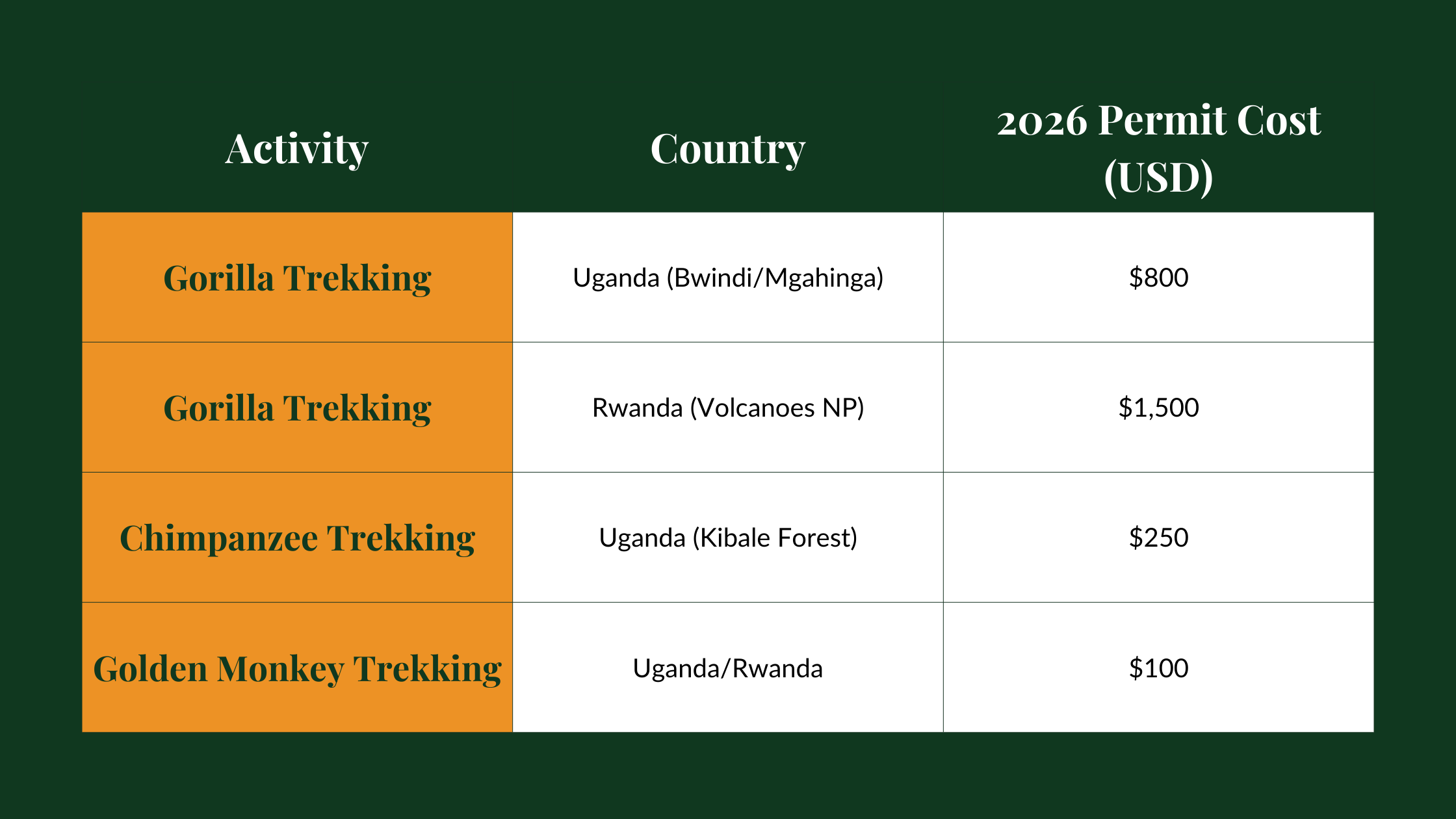
The gorilla trekking permit at $1,500 per person is the defining cost of any Rwanda wildlife visit. It is non-negotiable and non-refundable. Rwanda’s national park fees beyond the gorilla permit are comparable to other East Africa countries. Akagera National Park’s entry fees are reasonable relative to other open savannah parks in the region. Rwanda’s lodge accommodation in the Volcanoes National Park area ranges from mid-range options at $400 to $600 per person per night to premium properties at $1,000 to $2,000 per person per night. These premium properties compete directly with the most exclusive properties in East Africa for interior quality and service level. The total cost of a three-day Rwanda gorilla trekking visit, including one permit night and two accommodation nights, ranges from approximately $2,800 to over $6,000 per person depending on accommodation choice.
Rwanda’s high cost is justified by the quality and exclusivity of what it delivers. Mountain gorilla trekking is genuinely irreplaceable. It cannot be experienced at lower cost with equivalent quality anywhere in the world. Rwanda’s luxury lodge standard, compact geography, and well-maintained infrastructure create a seamless premium experience. Travelers with the budget to access it consistently rate it as extraordinary value. For travelers comparing Rwanda and Uganda for gorilla trekking, Uganda’s lower permit at $700 and significantly lower accommodation costs make Uganda the clear choice for budget-conscious gorilla seekers. Rwanda’s higher price delivers a measurably more luxurious experience in a more compact and efficiently managed country.
South Africa: The Best Value Major Safari Destination
South Africa offers the best value Big Five safari experience of any major African country. This applies to travelers who prioritise cost-effectiveness over the specific East Africa experiences. Gorilla trekking, wildebeest migration. That are unavailable in the south.
South Africa’s Cost Advantage
Kruger National Park’s public camp accommodation starts at under $50 per person per night for chalets and bungalows in SANPARKS rest camps. This makes self-drive Kruger safari accessible to a budget market that no equivalent East Africa national park can serve. The private reserves adjoining Kruger charge $400 to $2,000 per person per night for all-inclusive packages. These include game drives in vehicles with off-road driving privileges unavailable in the public park. Even these premium private reserve costs are competitive with or lower than comparable luxury camp experiences in the Serengeti or Masai Mara. South Africa’s lower accommodation costs are partly explained by the country’s strong domestic tourism market. This maintains competitive pricing that East Africa’s more internationally dependent market does not face to the same degree.
International flights to South Africa from most source markets are comparable to or cheaper than flights to East Africa. This further reduces the total trip cost for comparable holiday lengths. South Africa’s malaria-free safari options in the Eastern Cape. Addo Elephant National Park and several private reserves. Eliminate the medication cost that all East Africa parks require. This adds a further cost advantage for specific traveler profiles. For travelers whose primary safari goal is accessible Big Five game viewing rather than the specific East Africa experiences of gorilla trekking and wildebeest migration, South Africa delivers the best value of any major African safari destination in 2026.
Plan Your Safari
East Africa safari costs across Kenya, Tanzania, Rwanda, and Uganda vary significantly based on destination choice, route, accommodation level, and permit requirements. African Wild Trekkers provides fully transparent pricing for all East Africa itineraries with no hidden costs. Allowing accurate budget planning before any commitment is made. Every quote includes all park fees, permits, accommodation, guide fees, and transfers in a single all-inclusive figure.
Itineraries are available at all budget levels, from mid-range lodge packages in Uganda and Kenya at $200 to $400 per person per night to premium private concession and luxury gorilla lodge experiences at higher price points. Contact us with your budget parameters and we will design the best available East Africa experience within your constraints.
Contact African Wild Trekkers at africanwildtrekkers.com/contact with your budget and travel dates and we will design the most cost-effective East Africa safari available within your parameters within 24 hours.