White-Tailed Mongoose: Africa’s Largest Mongoose and Master of the Night
The white-tailed mongoose is the biggest mongoose in Africa. At up to 5 kilograms, it dwarfs the dwarf mongoose by a factor of fifteen. It hunts alone at night. Its most unmistakable feature — a pure white tail held high as it trots — makes it impossible to misidentify on a night drive. Once seen, it is never forgotten.
What Is the White-Tailed Mongoose?
The white-tailed mongoose, Ichneumia albicauda, is the sole member of its genus. It is Africa’s largest mongoose species by body weight. It belongs to the family Herpestidae and is most closely related to the yellow mongoose of southern Africa. Its scientific name references the white tail—”albicauda” means “white tail” in Latin.
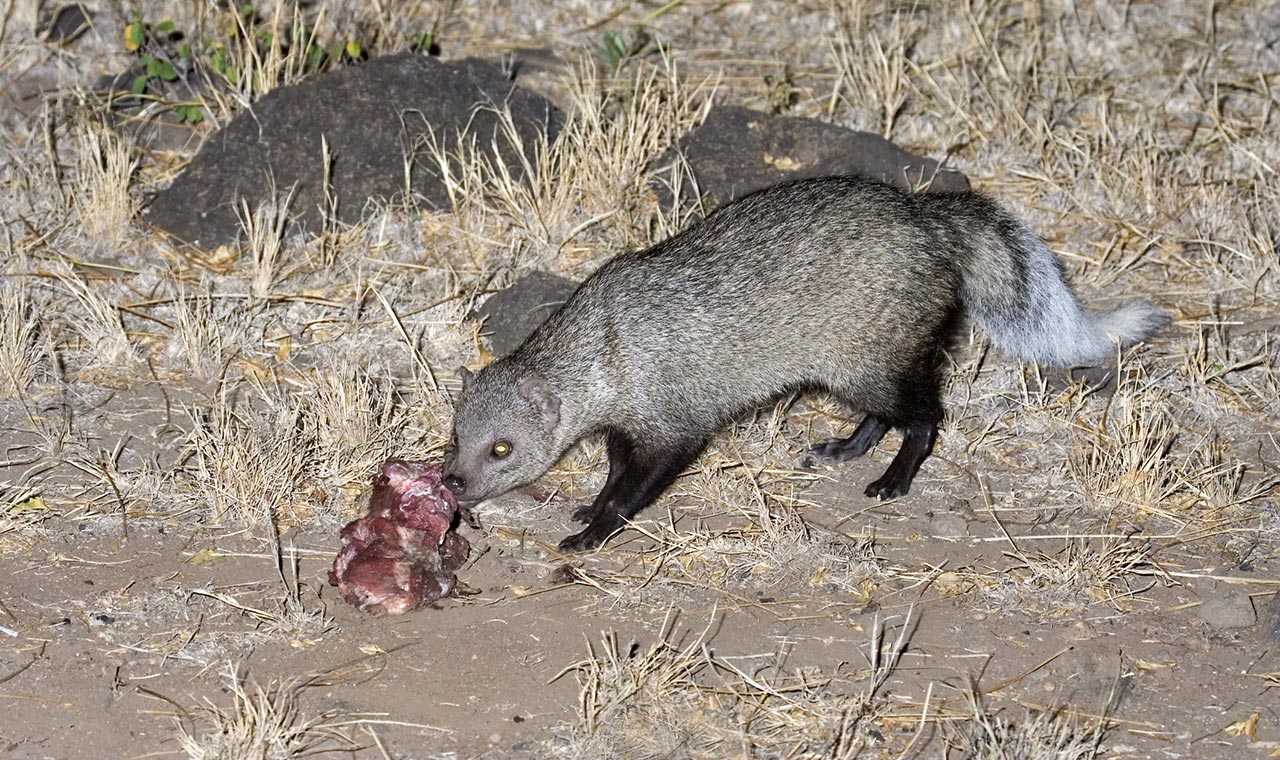
An adult white-tailed mongoose weighs between 3 and 5 kilograms, with some individuals reaching 5.2 kilograms. Body length reaches up to 72 centimeters. The tail adds another 40 centimeters. The legs are long and slender for a mongoose. The overall build is lean and powerful.
The White Tail: Identification and Function
The body coat of the white-tailed mongoose is greyish-brown to dark brown. The legs are black. The tail begins dark at the base and transitions to pure white along most of its length. In the beam of a spotlight, this white tail is immediately visible from a considerable distance. It hangs low when the animal is relaxed and raises when it trots quickly.
The function of the white tail is not entirely resolved. It may serve as a visual signal to other individuals in darkness. It may deter predators through aposematic display—communicating that this animal has chemical defenses worth avoiding. The mongoose does possess anal glands that produce a powerful musky secretion. Whether the tail and the scent glands function as a coordinated warning system remains an open question.
Nocturnal Hunting and Diet
The white-tailed mongoose is almost entirely nocturnal. It emerges after dark and forages alone until before dawn. Its diet is dominated by insects — beetles, dung beetles, termites, and large grasshoppers form the bulk of meals. It also eats small mammals, frogs, lizards, snakes, bird eggs, and wild fruit.
The white-tailed mongoose attacks venomous snakes with confidence. It is partially immune to snake venom, as are several other mongoose species. Studies show a modified acetylcholine receptor in mongoose muscle cells that reduces sensitivity to neurotoxic venom. The white-tailed mongoose uses this immunity aggressively, tackling cobras and puff adders that most carnivores avoid entirely.
Solitary Behaviour and Territory
White-tailed mongooses are solitary except during breeding. Each individual holds a large territory, typically 0.5 to 3 square kilometers. Territories overlap between individuals of the same sex. The mongoose marks its range with anal gland secretions, urine, and feces deposited on prominent objects along regular routes.
The white-tailed mongoose is not aggressive toward humans and retreats quickly when approached. It is not defensive of its food or territory in the way that civets or genets can be. On night drives, it often trots ahead of a vehicle for some distance before veering off into long grass.
Range in East Africa
The white-tailed mongoose is widespread across East Africa. It lives in savanna, grassland, open woodland, and rocky areas. It avoids dense rainforest but lives on forest edges. Uganda, Kenya, Tanzania, and Rwanda all support good populations. It is particularly common in Uganda’s savanna parks and across the Serengeti ecosystem.
The White-Tailed Mongoose’s Chemical Defence
Like other large mongooses, the white-tailed mongoose possesses anal scent glands that produce a powerfully pungent secretion. This secretion is used primarily for scent marking along territorial boundaries and is not a spray-based active defense like the zorilla or skunk. The smell is strong, but the delivery mechanism requires the gland to contact a surface rather than projecting at a distance. The secretion’s primary social function is chemical communication with conspecifics.
When physically threatened, the white-tailed mongoose erects its tail, raises its back hair, and releases the anal gland secretion onto the attacker during close contact. The effect is immediately deterrent to most predators. Jackals and smaller cats that make contact once typically retreat and do not repeat the attempt. Larger predators—lions and leopards—are not reliably deterred and will take white-tailed mongooses when the opportunity arises. The chemical defense works best against medium-sized predators in the 5 to 15 kilogram range.
Conservation Status and Population
The white-tailed mongoose is classified as Least Concern by the IUCN. It is widespread across sub-Saharan Africa and remains common throughout East Africa. Population trends are stable in most areas. The species tolerates modified habitats, including farmland edges and secondary woodland. Camera trap surveys in Uganda’s savanna parks place it among the five most frequently recorded nocturnal carnivores.
Bushmeat hunting affects white-tailed mongoose populations in some areas. The animal is large enough to be worth targeting and is caught in wire snares set for other species. Road mortality adds additional pressure where roads bisect savanna habitat. Neither threat appears to affect population viability at the continental level, but localized depletion near settlements with high snaring pressure is documented in parts of Tanzania and Uganda.
Plan Your Safari
The white-tailed mongoose is one of the most reliable night-drive sightings in East Africa. Night drives in Uganda’s Queen Elizabeth National Park, Tanzania’s Serengeti, and Kenya’s Maasai Mara regularly produce white-tailed mongoose encounters. The white tail in a spotlight is unmistakable. The slow trot makes it easy to follow and observe.
African Wild Trekkers includes night drive permits in recommended East Africa itineraries. Contact us to build a safari that covers the continent’s nocturnal mammals properly.