African Golden Cat: Facts About the Congo’s Most Elusive Forest Cat
Scientists have studied the African golden cat for decades. They have seen it in the wild fewer times than they care to count. No other cat in Africa generates so few verified field observations. Camera traps capture it occasionally. Direct sightings are events. Most wildlife biologists working in its range go entire careers without laying eyes on one. This cat is Africa’s great unseen predator.
What Is the African Golden Cat?
The African golden cat, Caracal aurata, was placed in the genus Profelis until 2006. Genetic analysis then showed its closest relative was the caracal. Both species now occupy the genus Caracal in most taxonomic treatments. The African golden cat is the only wild cat in sub-Saharan Africa that lives exclusively in dense tropical forests.
An adult African golden cat weighs between 5.5 and 16 kilograms. Males are significantly heavier than females. Body length reaches about 80 centimeters. The tail adds another 35 centimeters. The build is stocky and powerfully muscled—suited to forest hunting rather than open-country pursuit.
Colour Variation: A Confusing Species
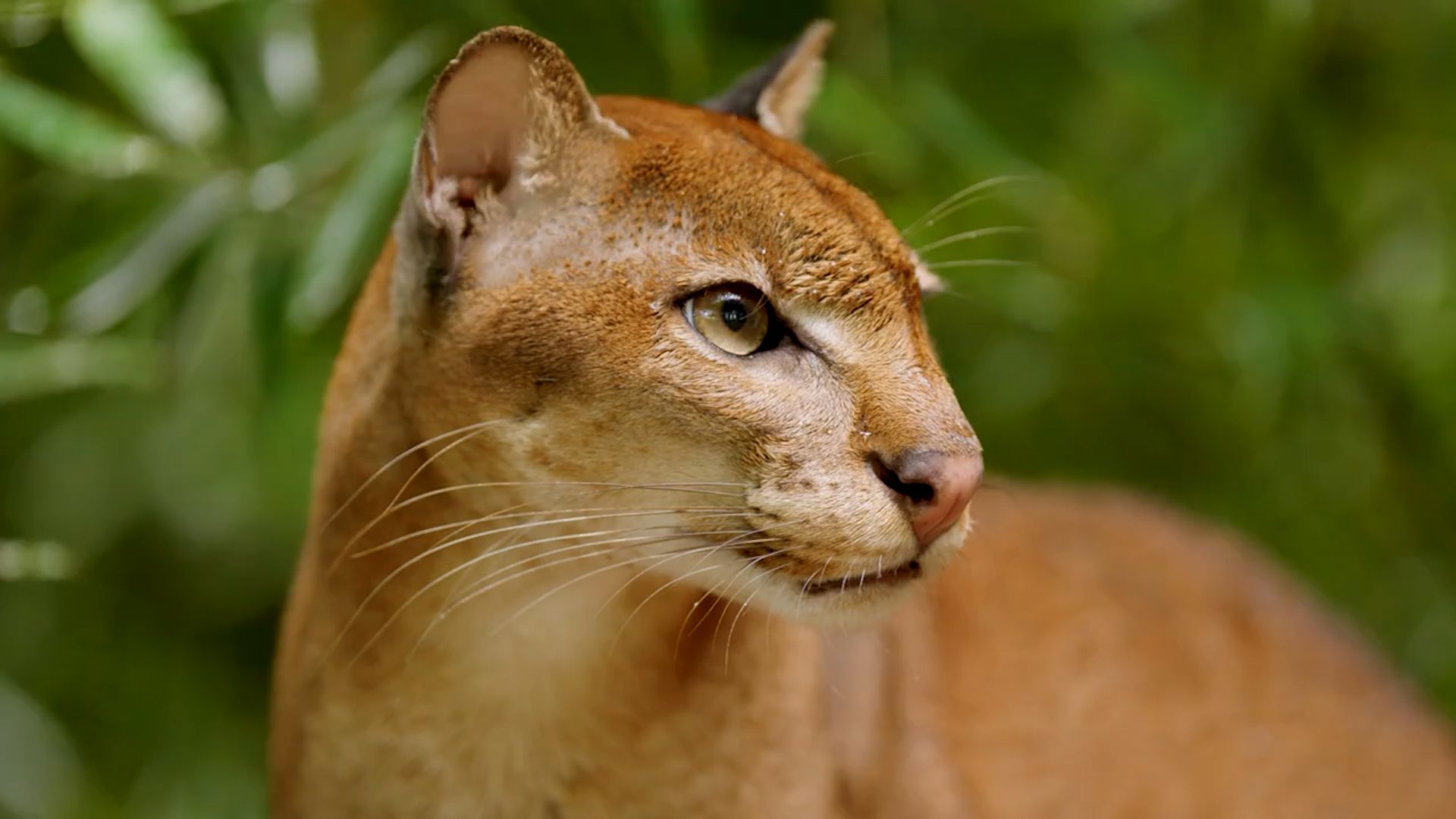
The African golden cat’s coat color varies widely and was once thought to represent multiple species. Some individuals are bright golden-orange or rufous. Others are grey-brown or dark brownish-grey. Some carry faint spotting across the body. Others are nearly uniform in color. All of these are the same species. The same forest and the same population can contain individuals of radically different coat types.
This variation puzzled early naturalists considerably. Museum specimens from different parts of the range looked different enough to be different species. Genetic analysis resolved the confusion. The variation appears to correlate somewhat with geography—golden and rufous forms are more common in parts of West Africa, and grey forms are more common in Central and East Africa—but individuals of all types occur across the range.
Diet and Forest Hunting
The African golden cat eats small to medium-sized forest mammals. Rodents and small ungulates like duikers and bay duikers form the primary prey. It also hunts forest birds, small primates, and hyraxes. Camera trap data shows it hunting at any hour — it is not strictly nocturnal like many forest carnivores.
The forest environment shapes its hunting strategy. It cannot rely on open-ground pursuit. It ambushes prey in dense vegetation, using the forest floor’s maze of root tangles and understory plants as concealment. Its stocky build and powerful forepaws allow it to overpower prey considerably larger than itself. Duiker kills are common in areas with high duiker density.
Why So Little Is Known
Forest density makes camera trapping difficult. Setting cameras across enough of a forest to achieve statistical capture rates requires enormous resources. Most camera trap grids cover only small areas. The golden cat’s home range is large—males likely patrol 30 square kilometers or more. Crossing a camera trap grid happens rarely.
The secretive temperament compounds the problem. Golden cats avoid human presence aggressively. They detect human scent and move away. Direct observations are almost always accidental—a brief glimpse crossing a forest trail before vanishing. No long-term study has successfully habituated an individual.
Range: Uganda, Congo, and Rwanda
The African golden cat lives in the Congo Basin and adjacent forest zones. In East Africa, Uganda holds the most accessible population. The forests of Bwindi Impenetrable National Park, Kibale Forest, and the other western Uganda forests all support golden cats. Rwanda’s Nyungwe Forest holds a population. Eastern DRC’s forests are a stronghold. Kenya and Tanzania lack suitable forest habitat, and the golden cat does not occur there.
Conservation Status: Near Threatened
The African golden cat is classified as Vulnerable by the IUCN. This makes it the most threatened wild cat in East Africa after the lion and cheetah in terms of formal conservation status. The Congo Basin forest — the species’ primary stronghold — is losing cover at an accelerating rate. Logging, agricultural expansion, and artisanal mining are the main drivers. As forest fragments, golden cat home ranges are bisected. Animals cannot move between patches safely across open agricultural land.
Bushmeat hunting in central Africa affects golden cats through two mechanisms. Direct hunting for the bushmeat trade kills some individuals. Snare-based hunting of duikers and forest pigs—which are the golden cat’s primary prey—removes prey populations and forces cats into larger ranges to find enough food. In areas with intensive snare hunting, golden cats disappear from forest patches that still have adequate tree cover because their prey base has been removed.
Research and Camera Trap Studies
Most of what is known about the African golden cat comes from camera trap studies conducted since 2008. The cat was almost impossible to study before widespread camera trap deployment. Early camera trap studies in Uganda’s Bwindi and Kibale established baseline occurrence data. Recent multi-year studies in Uganda, Rwanda, and the DRC have built on this foundation to estimate relative abundance and map habitat use across forest types.
Bwindi’s golden cat camera trap detections correlate strongly with forest interior and forest edge zones near permanent water. The cats use logging tracks and game trails as movement corridors through otherwise impenetrable understory. Research teams from the Wildlife Conservation Society and the African Wildlife Foundation are coordinating camera trap arrays across western Uganda’s forest blocks to produce the first landscape-scale abundance estimates for the East African golden cat population.
Plan Your Safari
You will not plan to see an African golden cat. You will plan for gorilla trekking, chimp tracking, or forest birding in Uganda or Rwanda—and if the forest grants you a golden cat sighting, you count yourself extraordinarily fortunate. Bwindi’s night forest and Kibale’s afternoon trails produce the most sighting reports in East Africa, almost all accidental.
African Wild Trekkers designs Uganda forest safaris covering Bwindi, Kibale, and the other western Uganda forests. Contact us to plan a trip into the habitat where East Africa’s most elusive cat lives.