Baboon Troop Behavior: Hierarchy, Politics and Daily Life in a Savanna Troop
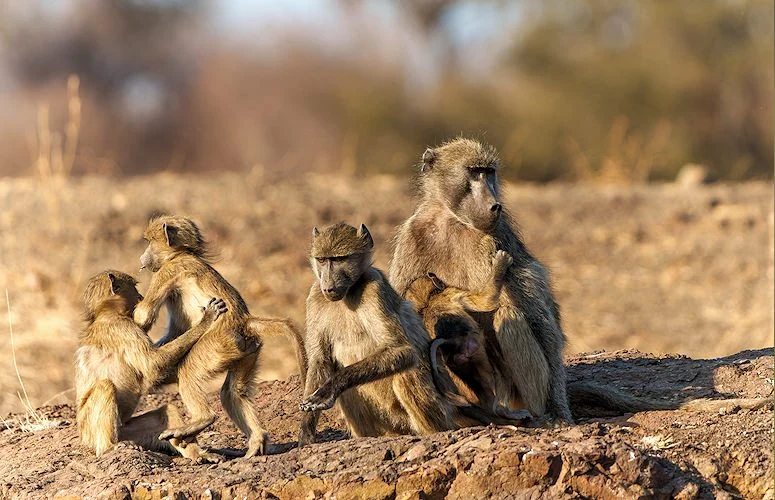
No primate on an African game drive behaves with more visible social complexity than the baboon. In ten minutes of observation, you can watch a dominance display, three grooming partnerships, a juvenile’s first attempt at alliance-building, and a collective response to a distant eagle. The baboon troop compresses a remarkable range of social behaviour into every hour of its waking day.
Troop Size and Structure
Olive baboon troops in East Africa range from 8 to 200 individuals. The average savanna troop numbers between 30 and 80. Each troop contains multiple adult males, multiple adult females, juveniles of various ages, and infants. The troop is a stable social unit. Core members remain together for years. New males join by immigration from other troops. Resident males leave to join other troops after losing dominance status.
The troop moves, feeds, and sleeps as a unit. It has no fixed territory in most habitats but follows predictable routes between sleeping sites, water sources, and feeding areas. The daily march covers between 3 and 10 kilometres, depending on food availability and season. A troop returns to the same sleeping trees — usually large, isolated acacias or fever trees — night after night for months.
Male Dominance Hierarchy
Male baboons compete fiercely for rank. High-ranking males gain priority access to food, resting sites, and mating opportunities. Rank among males shifts constantly. A new immigrant male challenges established residents in the weeks after arrival. The outcome depends on body size, fighting ability, and the alliances each male can recruit.
Male alliances drive much of the social action in a troop. Two lower-ranking males cooperate to displace a dominant male from a consorting female. The cooperation is temporary and transactional. The male that provides active support in the fight receives access to the female. The male that displaced the dominant male retains access for a period. These shifting coalitions make male baboon politics genuinely complex and genuinely competitive.
Female Hierarchy and Kinship
Female baboons are philopatric — they stay in their natal troop for life. Their rank is inherited from their mothers. A high-ranking female’s daughters occupy high rank from birth, supported by their mother’s interventions in disputes. A low-ranking female’s daughters rank low regardless of their individual abilities. Female rank is therefore highly stable across generations.
Female kinship groups form the stable core of the troop. Mothers, daughters, sisters, and aunts groom each other frequently and support each other in aggressive encounters. These matrilineal alliances are the most durable social bonds in baboon society. Research from Amboseli showed that females with strong kinship group bonds had higher infant survival rates and longer lifespans than socially isolated females.
Grooming as Social Currency
Baboons spend more time grooming each other than any other single activity outside of feeding. Grooming removes parasites and is physiologically beneficial. It also functions as social currency. Low-ranking individuals groom high-ranking ones to access tolerance near food sources. Males groom females to build relationships that improve mating access. Females groom high-ranking males to gain protective alliance for their infants.
The exchange value of grooming is measurable. Studies show that baboons groom allies before soliciting their support in aggressive interactions. The interval between grooming a partner and receiving support from that partner is shorter in high-quality relationships than in weak ones. Baboons track relationship quality and spend grooming time strategically in accordance with current social needs.
How Troops Handle Predators
A troop’s response to predators is immediate and coordinated. Alarm barks from any individual trigger rapid tree-climbing by females and juveniles. Adult males stay on the ground and mob the threat collectively. A group of adult male baboons pursues leopards, cheetahs, and hyenas aggressively. Documented cases of baboons killing adult leopards exist, though serious injuries to both species commonly result from such encounters.
Baboons recognise different predators and respond differently to each. The response to a martial eagle differs from the response to a lion. Each predator type triggers a distinct alarm call in the olive baboon’s call system — a finding first documented by Dorothy Cheney and Robert Seyfarth in their landmark baboon communication research. The specificity of the call system communicates threat type, not just threat presence.
Plan Your Safari
Baboon troops are among the easiest and most rewarding primates to watch in East Africa. They are active in daylight, habituated to vehicles in all major parks, and their social interactions are visible and interpretable with minimal specialist knowledge. Uganda’s Murchison Falls, Queen Elizabeth National Park, and Lake Mburo all hold large, approachable troops. Kenya’s Amboseli and the Maasai Mara have well-studied troops that have contributed to decades of published research.
African Wild Trekkers builds East Africa safaris that include time watching primates as well as the big game. Contact us to design an itinerary that covers the full range of East Africa’s extraordinary wildlife.