Red-Tailed Monkey: Uganda’s Acrobatic Forest Primate with the Distinctive Face
A white nose patch in the dark forest canopy. A flash of chestnut red on the tail. Then it’s gone, bouncing between branches with a speed and lightness that makes it look weightless. The red-tailed monkey is one of Uganda’s most energetic and visually distinctive forest primates—and one of the most rewarding to watch when a group settles in a fruiting tree above you.
What Is the Red-Tailed Monkey?
The red-tailed monkey, Cercopithecus ascanius, is a member of the guenon family. It is one of the most common forest monkeys in central and East Africa. The species name honors Jean-Pierre Ascanius, an eighteenth-century naturalist. Multiple subspecies exist across its range. The Uganda population belongs to the subspecies Cercopithecus ascanius schmidti, named the Schmidt’s red-tailed monkey.
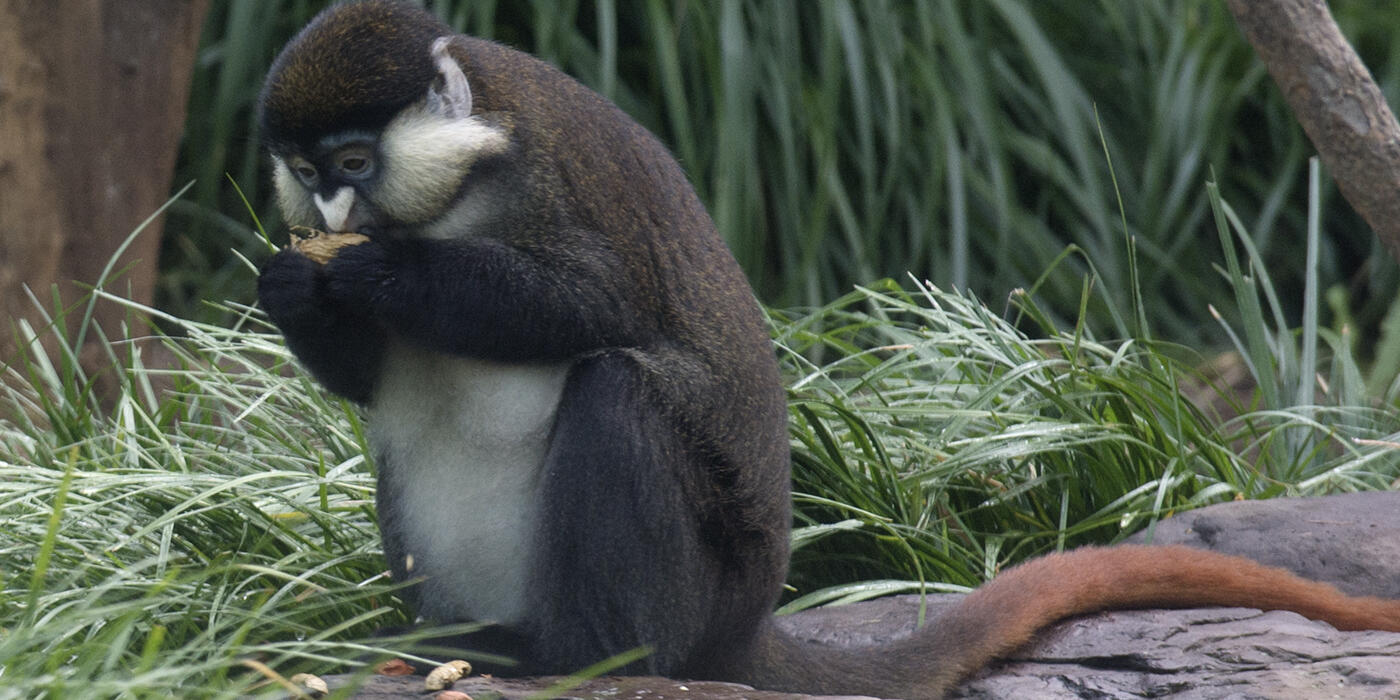
An adult red-tailed monkey weighs between 2.5 and 4.5 kilograms, making it one of the smaller guenon species. The body length reaches about 45 centimeters. The tail—significantly longer than the body at up to 75 centimeters—is the species’ most conspicuous feature. It is chestnut-red along most of its length, visible against forest green from a considerable distance.
Physical Features: White Nose and Red Tail
The red-tailed monkey’s face is dark with a distinctive white-heart-shaped nose patch. This nose patch makes the species immediately identifiable among Uganda’s forest monkeys. No other Ugandan primate carries a similar facial marking. The cheeks show a faint yellowish or white tinge. The overall body coat is dark olive-brown above and paler below.
The tail colorization shifts from dark at the base to increasingly red toward the tip. The red tip is the most visible field mark after the white nose. In a mixed-species canopy group, the red-tailed monkey’s tail tip allows rapid species identification even when the body is obscured by foliage. Experienced forest guides identify the species by tail color alone before any other feature is visible.
Forest Habitat and Range in Uganda
Red-tailed monkeys occupy Uganda’s major lowland and medium-altitude forest blocks. Kibale National Park holds the species at very high density. The park’s research program has studied individual red-tailed monkey groups continuously for decades. Budongo Forest, Bwindi, Kyambura Gorge, Semuliki, and the Zika Forest near Entebbe all hold red-tailed monkey populations.
The species occupies the lower and middle canopy strata—below the blue monkey’s typical range and above the forest floor. It descends to the ground to cross gaps and collect fallen fruit but spends the large majority of its active time between 5 and 20 meters above ground. This middle-story niche complements rather than directly competes with its common forest companions.
Mixed-Species Groups and Social Life
Red-tailed monkeys frequently associate with blue monkeys, grey-cheeked mangabeys, and black-and-white colobus in polyspecific groups. These mixed groups move through the forest together for hours or days at a time. Each species maintains its own social structure and internal hierarchy within the combined group. The collective group provides better predator detection than any single-species group could achieve.
Red-tailed monkey social groups contain one adult male and multiple females with offspring. Group sizes typically range from 7 to 35 individuals. The resident male calls loudly when neighboring males approach. Females remain in their natal group permanently. Males transfer between groups after displacement by rivals. The one-male group structure and female philopatry mirror that of the blue monkey, though the two species are not closely related within the guenon group.
Diet in Uganda’s Forests
Fruit forms the primary diet of red-tailed monkeys in Kibale. Figs are consumed in large quantities whenever available. Insects supplement the fruit diet year-round—particularly beetles, caterpillars, and large arthropods found under bark and in leaf axils. The small body size of the red-tailed monkey suits it to searching bark surfaces and twig tips for invertebrates that larger primates miss. This niche differentiation reduces competition with blue monkeys and mangabeys in shared forest areas.
Plan Your Safari
Kibale National Park is the best location in the world to watch red-tailed monkeys. The park’s forest walks pass through habituated groups regularly. The chimpanzee tracking experience at Kibale almost always includes red-tailed monkey encounters. The species is also common at Bwindi, where forest walks around Buhoma and Nkuringo produce reliable sightings.
African Wild Trekkers designs Uganda forest safaris that cover Kibale, Bwindi, and the other major forest blocks. Contact us to build a Uganda itinerary that captures the full richness of the country’s primate diversity.