Patas Monkey Africa: The Fastest Primate on the Ground
Most primates escape predators by climbing. The patas monkey escapes by running. At full speed, the patas monkey reaches 55 kilometers per hour. No other primate comes close. This commitment to ground-level life in open savanna has shaped everything about the patas monkey—itsg limbs, its group structure, its behavior,nd its distribution across Africa’s driest grasslands.
What Is the Patas Monkey?
The patas monkey, Erythrocebus patas, belongs to the family Cercopithecidae. It is the sole member of its genus. And it occupies open, semi-arid grassland across the West African savanna zone and extends into East Africa’s dry northern regions. It is the most terrestrial of all Old World monkeys, spending over 90 percent of its active time on the ground.
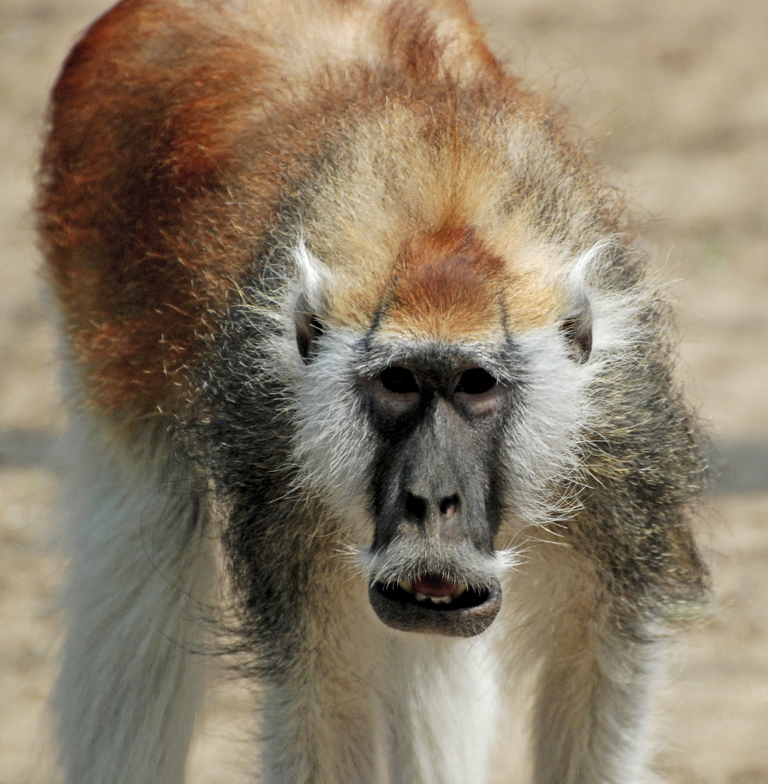
An adult male patas monkey weighs between 7 and 13 kilograms. Females are considerably smaller at 4 to 7 kilograms. Adult males have a distinctive appearance—a-brown back coat, white underparts, a white mustache,nd a blue scrotum visible at close range. The limbs are long and slender, built for speed rather than climbing strength.
Physical Features Built for Running
The patas monkey’s limb proportions are unique among primates. The hindlimbs are extremely long relative to body length. The digits are short and strong—better gripping ground than branches. The spine is flexible and elongated, contributing to a galloping gait that looks more like a running dog than a monkey. The shoulder girdle is narrower than most primates’, reducing wind resistance at speed.
This running specialization comes with trade-offs. The patas monkey is less agile in trees than forest monkeys. It cannot leap between branches with the ease of a vervet or colobus. When it does climb — to scan for predators or access fruiting trees — it moves cautiously and descends quickly. The tree is a temporary refuge, not a primary habitat.
Ground-Living Life in Open Savanna
Patas monkey groups forage across large areas of open grassland and acacia bush. Daily ranging distances of 10 to 12 kilometers are common. The group spreads widely while foraging—individuals be 50 to 100 meters apart as they search for food. This widespread increase covers a largers a largers a larger areand reduces food competition within the group.
Vigilance is continuous and distributed. Group members raise their heads regularly to scan the horizon. The single adult male in the group spends more time in vigilance than any other individual. He positions himself on elevated objects—termitends, low rocks, and and and bare tree stumps—andns while females and juveniles forage below. When a predator is detected, his response is to run as a decoy in the opposite direction from the group, drawing attention away from the females and young.
Social Structure: One Adult Male
Patas monkey groups contain one adult male and multiple adult females with their offspring. This one-male group structure is unusual among African savanna primates. The single adult male monopolises mating access to all females in the group. He also provides vigilance and decoy defense as described above. He does not provide food or direct parental care.
All-male groups of bachelor males exist alongside one-male groups. These bachelors challenge the resident male periodically, particularly during the breeding season. A successful challenge results in the resident male’s expulsion and the challenger’s takeover of the group. Expelled males join other all-male groups or live solitarily. Male tenure in a one-male group averages about two years before a successful challenge occurs.
Range in East Africa
Patas monkeys occur in East Africa’s drier northern zones. In Uganda, they live in the semi-arid areas of the Karamojamojamoja region around Kidepo Valley National Park. In Kenya, they inhabit the dry northern areas around Samburu, Marsabit, and the Laikipia Plateau. They are absent from wetter highland areas and do not occur in forest or dense woodland.
Plan Your Safari
Patas monkeys are a genuine bonus sighting in East Africa’s drier parks. Kidepo Valley National Park in Uganda is the most reliable East Africa destination for patas monkey encounters. Kenya’s Laikipia Plateau and Samburu also produce sightings in open grassland areas. Look for the distinctive running profile—long-limbed, to the ground, moving fast across open areas—or a male scanning from an elevated position while the group forages around him.
African Wild Trekkers includes Kidepo Valley National Park in Uganda itineraries specifically because of its exceptional and unusual wildlife. Contact us to design a trip to East Africa’s most underrated national park.