Vervet Monkey Facts: The Adaptable Primate Found Everywhere in East Africa
The vervet monkey is everywhere in East Africa. It lives in savanna, woodland, riverine forest, suburban gardens, and tourist lodges. It is intelligent, bold, socially complex, and remarkably tolerant of human presence. Yet despite its ubiquity, the vervet monkey rewards careful watching with a level of behavioral sophistication that surprises most observers who take the time to look.
What Is a Vervet Monkey?
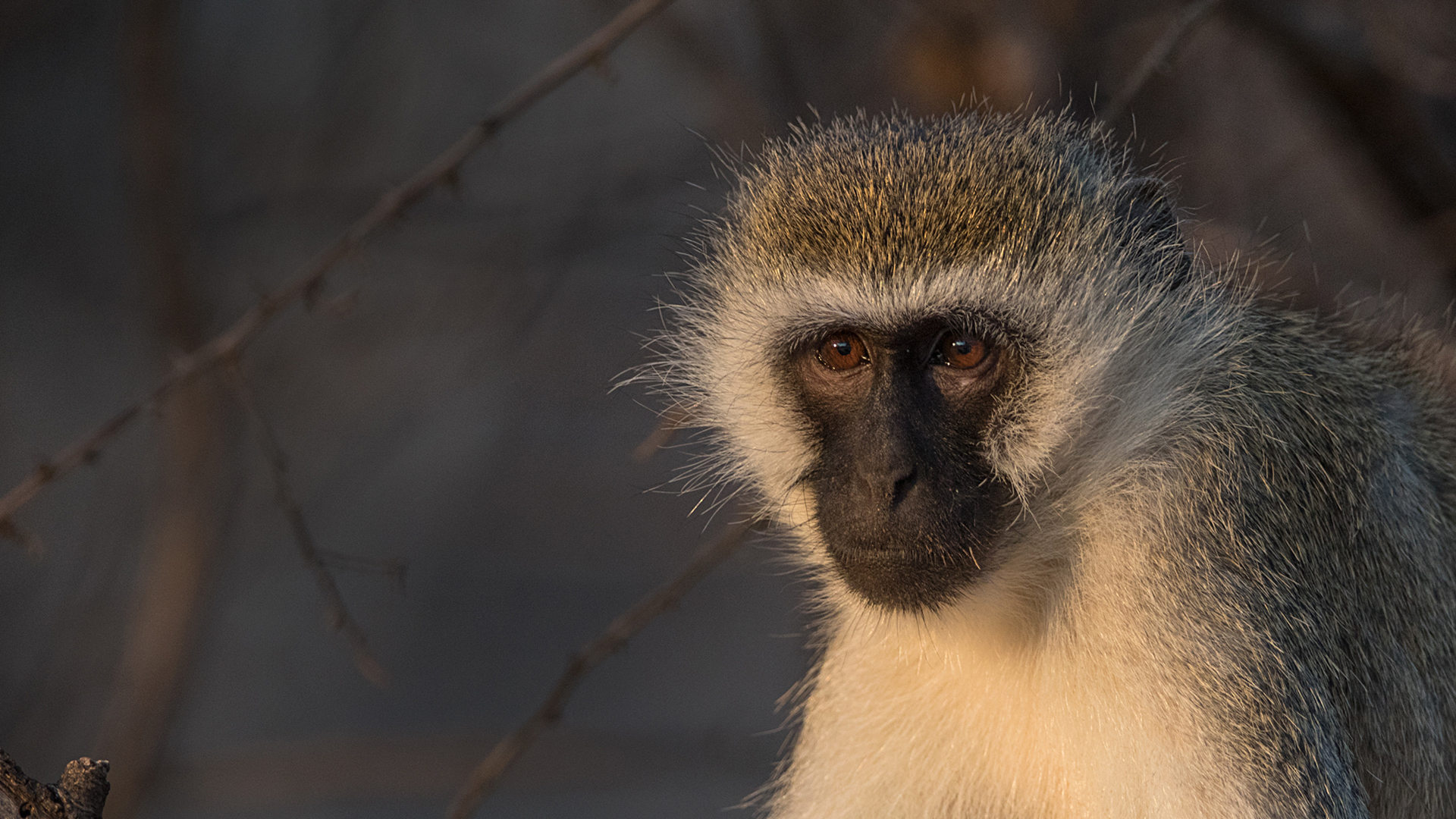
The vervet monkey, Chlorocebus pygerythrus, belongs to the family Cercopithecidae—the Old World monkeys. It is one of the most widely distributed non-human primates in Africa. Five subspecies exist across sub-Saharan Africa, differing in coat color and facial markings. The East African vervet has a greyish-green coat, a black face framed by white facial fur, and a pale underside. Adult males have a distinctive bright blue scrotum—one of the most immediately recognizable features of the species.
An adult male vervet weighs between 3.9 and 8 kilograms. Females are lighter at 3.4 to 5.3 kilograms. Body length reaches about 50 centimeters, with a tail adding another 60 centimeters. The tail is held in a characteristic arch while moving—upward at the base and curving down toward the tip—which is a reliable field identification mark.
The Alarm Call System
Vervet monkeys produce distinct alarm calls for different predator types. The call for a martial eagle triggers an immediate drop from the tree canopy to the ground and into dense bush. The call for a leopard triggers rapid tree-climbing, and the call for a python triggers the vervets to stand upright and look at the ground around them. Each call type triggers the correct escape behavior from other group members who cannot see the predator.
This call specificity was first documented by Dorothy Cheney and Robert Seyfarth working in Amboseli in the 1970s. Their research on vervet alarm calls became one of the foundational studies of animal communication. Young vervets produce imperfect versions of these calls—applying eagle calls to any bird overhead and snake calls to many long, thin objects. Adults produce the correct calls reliably. The refinement from broad to specific calling appears to involve observational learning from older group members.
Social Structure and Group Life
Vervet monkeys live in stable groups of 10 to 70 individuals. Each group contains multiple adult males, multiple adult females, and their offspring. Female vervets are philopatric—they remain in their natal group for life. Males transfer between groups when they reach sexual maturity. Rank among females is inherited from the mother, as in baboons. The kinship structure of female relatives forms the stable social core of each group.
Grooming binds the group together. High-ranking females receive more grooming than they give. Lower-ranking females give grooming as a form of social investment in more powerful allies. Males invest grooming time strategically in females whose infants they may have fathered and whose support improves their rank position.
Diet and Urban Adaptation
Vervets eat fruits, seeds, flowers, leaves, insects, and small vertebrates. Their diet shifts substantially with season and habitat. In agricultural and suburban areas, they add crops, garden produce, and human food to this list. Urban vervet groups near safari lodges and towns become bold, persistent raiders. They learn which windows are unlocked, which lodge staff carry food, and which guests are likely to make careless mistakes with luggage.
This urban adaptation is cognitively impressive. Urban vervets have learned to use traffic patterns, to identify specific individuals as safe or dangerous, and to exploit food sources that require multi-step problem-solving. Their flexibility makes them one of the most successful primates in a rapidly changing African landscape.
Plan Your Safari
Vervet monkeys are visible in virtually every East Africa national park and most safari lodges. Amboseli National Park in Kenya is the site of the foundational vervet alarm call research and still holds the habituated study groups. Queen Elizabeth National Park and Murchison Falls in Uganda have large, easily observed populations. For dedicated vervet watching, any lodge on a river or lake edge in East Africa will have a resident group that visits daily.
African Wild Trekkers designs East Africa safaris that treat primates with the same attention as the large mammals. Contact us to build an itinerary that covers the full range of East Africa’s remarkable primate diversity.