Colobus Monkey Diet: How the Black-and-White Leaf Monkey Survives on Leaves
Most primates eat fruit. The colobus monkey eats leaves. This single dietary choice separates it from every other forest monkey in East Africa and shapes everything about its anatomy, behavior,and ecology. Leaves are abundant, require no competitive acquisition, and are available year-round. But they are also low in nutrients, high in toxins, and difficult to digest. The colobus solved this problem over millions of years of evolution with one of the most specialized digestive systems in the primate world.
What Is the Colobus Monkey?
Black-and-white colobus monkeys of the genus Cololobus are distributed across central and East Africa’s forests. East Africa has two main species: the guereza colobus of Uganda’s’s and Kenya’s forests andthe Angolan colobus of higher-altitude zones. Both eat predominantly leaves. Both have the same specialized digestive anatomy. The common name “colobus” derives from a Greek word meaning “mutilated”—aeference to the reduced thumbs the genus carries.
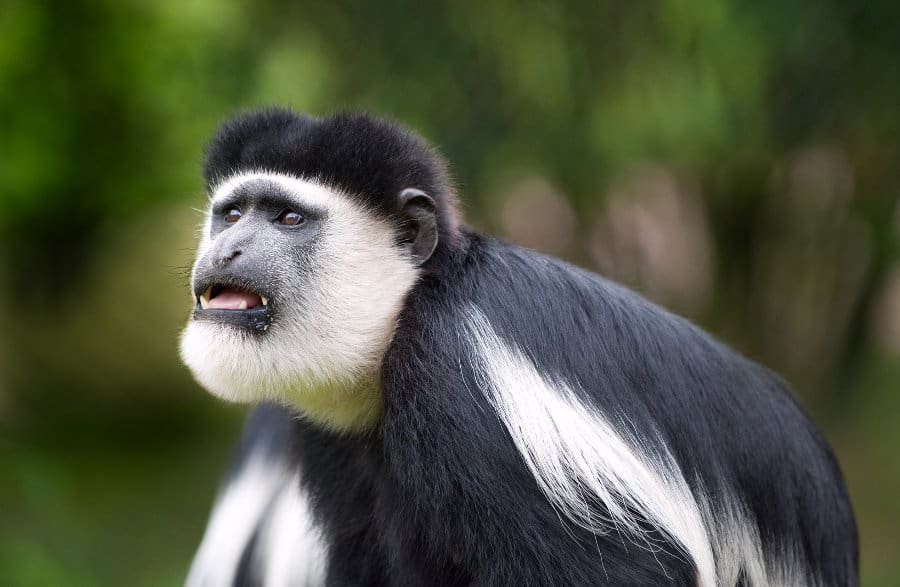
An adult colobus monkey weighs between 7 and 14 kilograms. Males are larger than females. The striking black-and-white coat—jetlack body, white facial fringe, white mantle on the shoulders and flanks, and and white tail tip—makeshe colobus one of Africa’s most visually dramatic monkeys. The long white tail functions as a visual signal during leaping and social interactions in the canopy.
Why Leaves? The Dietary Strategy
Leaves are the most abundant food source in any forest. A colobus group occupying a small forest patch eats from a food source that fruit-eating monkeys cannot exploit efficiently. This means colobus groups maintain smaller home ranges than fruit-eating primates of comparable size. A colobus group needs only 15 to 40 hectares of forest — far less than the 100-plus hectares that a chimpanzee community requires.
The trade-off is nutritional. Leaves have lower caloric density than fruit. They contain higher levels of cellulose, tannins, and secondary plant compounds. The colobus absorbs more energy per gram of leaves than any other primate because of its specialized stomach—butt still needs to consume large quantities and spend significant time digesting.
The Specialised Stomach
The colobus has a multi-chambered stomach unlike any other Old World monkey. The first chamber — the forestomach — contains bacteria that ferment cellulose into digestible short-chain fatty acids. This is the same basic process that cattle, sheep, and other ruminants use. No other non-human primate has evolved this fermentation system to the same degree.
The fermentation process takes time. A colobus monkey spends up to 30 percent of the day resting and digesting after feeding bouts. This resting posture — slumped in a tree fork with a visibly swollen belly — is one of the most characteristic field signs of a colobus group. The swelling is not fat but gas produced during fermentation. The resting colobus is quite literally brewing its lunch.
Leaf Selection: Not All Leaves Are Equal
Colobus monkeys do not eat all leaves indiscriminately. They select actively for young, tender leaves over mature ones. Young leaves have lower tannin concentrations, lower cellulose content, and higher protein levels than mature leaves. A group invests most feeding time in trees producing young leaves and revisits the same trees daily through the flush period.
Colobus groups also eat mature leaves of specific tree species with known low toxin loads. Individual trees within a species show variation in leaf chemistry. Colobus groups preferentially visit trees that have lower secondary compound concentrations—aorm of individual-tree selection that suggests chemical assessment of food quality before committing to feeding.
Other Foods
Despite their leaf specialization, colobus monkeys eat fruit, seeds, flowers, and bark when available. Fruit is consumed during peak abundance periods. Unripe seeds are a valued food—theard protective coatings are cracked with the teeth and the seed embryo consumed. Some tree seeds with high fat and protein content form important nutritional supplements to the leaf diet. Bark and stem pith are eaten when other foods are scarce.
Plan Your Safari
Black-and-white colobus monkeys are among the most visible primates in East Africa’s forest parks. They favor the upper canopy, and their striking colorization makes them easy to spot from below. Kibale National Park in Uganda, Nyungwe Forest in Rwanda, and Kenya’s Aberdare and Mt. Kenya forests all hold large populations. The resting, digesting behavior makes extended observation easy—a group settled after a feeding bout stays in the same trees for an hour or more.
African Wild Trekkers includes forest primate watching in Uganda and Rwanda itineraries. Contact us to plan a trip into East Africa’s forests where colobus monkeys are a daily feature of the wildlife.