Zanzibar Red Colobus: The Endemic Primate Found Only on Zanzibar Island
One hundred kilometers off the Tanzanian coast, on an island of spice farms, coral-rag forests, and beach resorts, a primate lives that exists nowhere else on earth. The Zanzibar red colobus is an island endemic. It evolved in isolation from its mainland relatives and adapted to a degraded, fragmented forest habitat over centuries. It is now one of Africa’s most threatened primates—and one of the most accessible.
What Is the Zanzibar Red Colobus?
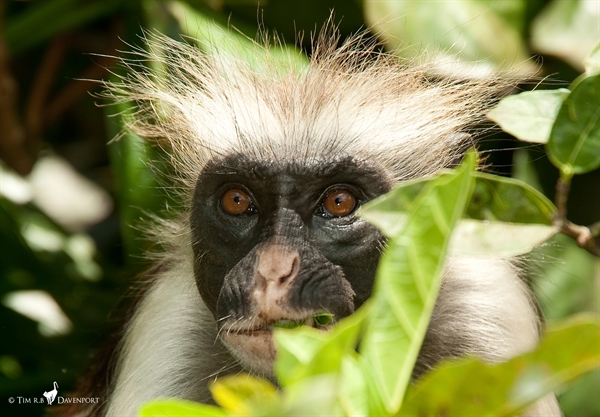
The Zanzibar red colobus, Piliocolobus kirkii, is named after Sir John Kirk, the British naturalist and diplomat who first described it in the nineteenth century. It belongs to the red colobus group—a distinct lineage from the black-and-white colobus—and represents the easternmost member of this lineage in Africa. The island isolation that separated the Zanzibar population from mainland red colobus populations produced enough divergence over thousands of years to justify full species status.
An adult Zanzibar red colobus weighs between 5.5 and 11 kilograms. Males are larger than females. The body is stocky. The limbs are moderately long with reduced thumbs, characteristic of all colobus species. The coat is reddish-brown on the back and flanks, with a pale or whitish underside. The face is dark with a pink-tinged bare patch around the nostrils.
Jozani Forest: The Last Stronghold
Most Zanzibar red colobus live in or near Jozani-Chwaka Bay National Park, a protected area covering 50 square kilometers of groundwater forest, mangrove, and coral reef scrub in central Zanzibar. Jozani holds between 1,500 and 2,000 colobus in habituated groups that have been visited by tourists and researchers for over two decades. These groups are approachable within a few meters and represent one of Africa’s most intimate primate wildlife experiences.
Outside Jozani, small fragmented populations persist in private landholdings, coconut plantations, and secondary scrub across Zanzibar’s interior. These populations are less studied and under higher pressure from habitat loss and human disturbance. The Jozani population functions as a source population for periodic recolonization of adjacent forest patches.
Social Behaviour and Group Structure
Zanzibar red colobus live in mixed groups of 30 to 50 individuals. Unlike black-and-white colobuses with one-male groups, the Zanzibar red colobus lives in multi-male, multi-female groups. Multiple adult males share the group; mating is distributed among males rather than monopolized by one individual. This multi-male system is characteristic of all red colobus species.
Groups are vocal and active. The adult males produce loud, raucous calls that carry clearly through Jozani’s relatively open forest. These calls coordinate group movement and warn of predators. The groups move through large home ranges within the park, making extended loop movements over several days before returning to preferred feeding areas.
Diet in Zanzibar’s Degraded Forest
The Zanzibar red colobus diet reflects its unusual habitat. Jozani’s forest has been heavily modified by human use over centuries, while native tree species have been partially replaced by introduced trees—including mango, coconut, and unique ornamentals. The colobus has adapted to eat these introduced species alongside native forest trees. It eats mango leaves, charcoal tree leaves, and the leaves of several coral rag species not eaten by mainland colobuses.
This dietary flexibility is unusual in a leaf specialist. It may reflect the adaptive pressure of island isolation with limited forest diversity. The colobus also eats flowers, fruit, and bark in Jozani — a broader diet than most mainland colobus populations. This breadth helps it survive in a forest that has lost much of its original species composition.
Conservation Status: Endangered
The Zanzibar red colobus is classified as Endangered by the IUCN. The total population is estimated at 3,000 to 5,000 individuals. Habitat loss is the primary threat. Zanzibar’s population density is high, and agricultural land use continues to fragment forest patches outside the park. Road mortality on Zanzibar’s expanding road network kills colobus that cross between forest patches regularly.
Conservation programs coordinate between the park authority, local communities, and international organizations. Tourist revenue from Jozani visits directly funds conservation management and community education around the park boundaries. The Zanzibar red colobus is Zanzibar’s flagship conservation species and its most marketable wildlife attraction.
Plan Your Safari
The Zanzibar red colobus is one of the easiest primates to see in East Africa. A half-day visit to Jozani Forest from any Zanzibar beach resort produces close-range encounters with habituated groups. The forest walk takes about 90 minutes with a guide. The colobus groups are present every day. The combination of a beach holiday and primate encounter makes the Zanzibar red colobus a uniquely accessible and memorable wildlife experience.
African Wild Trekkers includes Zanzibar extensions in Tanzania safari itineraries. Contact us to combine Tanzania’s wildlife circuits with a Zanzibar beach and forest visit.