Thick-Tailed Bushbaby: The Largest Galago in Africa
In the forests of East Africa, a sound erupts at night that stops conversation cold. It is loud, guttural, and entirely unexpected from an animal weighing under 2 kilograms. For it rises and falls in a complex series of clucks, squawks, and rolling calls. It is the thick-tailed bushbaby—Africa’s largest galago—announcing its presence to every other animal in the forest with complete confidence.
What Is the Thick-Tailed Bushbaby?
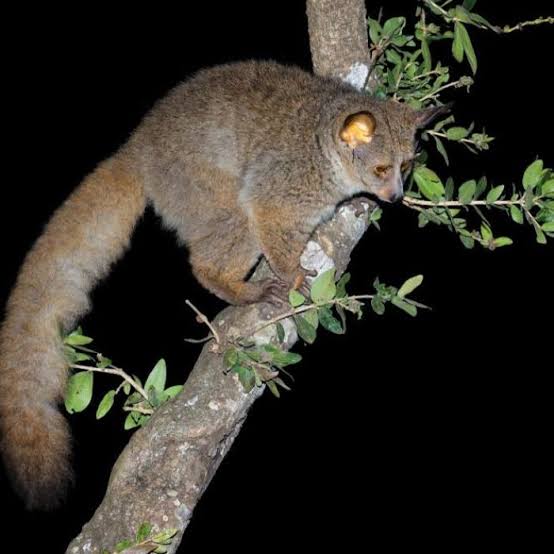
The thick-tailed bushbaby, Otolemur crassicaudatus, is the largest member of the family Galagidae. It is sometimes called the greater galago or the large-eared greater galago. The genus name Otolemur means “ear lemur”—a reference to the large, mobile ears that characterize all galagos. The species name “crassicaudatus” means “thick-tailed” and refers to the full, bushy tail that distinguishes it from the slimmer-tailed lesser galagos.
An adult thick-tailed bushbaby weighs between 1 and 2 kilograms — five to ten times heavier than the lesser galago. Body length reaches about 35 centimeters. The tail adds another 40 centimeters. The body is compact and muscular. The hindlimbs are powerfully built for vertical clinging and leaping. The eyes are large but proportionally smaller than those of the lesser galago relative to skull size.
Physical Features and the Thick Tail
The coat is grey-brown to yellowish-brown above and pale below. The face has a pointed muzzle, very large and mobile ears, and forward-facing eyes with amber irises. The thick tail is the most immediately noticeable feature — it is bushy along its entire length, carried horizontally when the animal moves, and raised during social displays. The tail thickness likely functions partly as a fat reserve during lean seasons, as it does in several nocturnal mammal species.
The hands and feet of the thick-tailed bushbaby are broad with strong gripping power. The second toe of the foot carries a toilet claw—a specialized grooming claw present in all galagos and other prosimians. This claw replaces the flat nail found on the other digits and is used specifically for combing hair and removing ectoparasites from areas the animal cannot reach with its mouth.
Nocturnal Behaviour and Habitat
The thick-tailed bushbaby is strictly nocturnal. It emerges at dusk from day-sleeping sites in dense vegetation or hollow trees. It forages alone through the night, covering a home range of 5 to 15 hectares. The home ranges of females overlap with those of a dominant male. The male visits female ranges regularly, checking scent marks for reproductive status and maintaining familiarity with several potential mating partners.
Unlike the lesser galago, which favors open savanna and acacia woodland, the thick-tailed bushbaby prefers denser forest—riparian forest, forest edge, and forest mosaic landscapes. It descends to the forest floor more readily than lesser galagos and moves through the understory as well as the canopy. It is less committed to the outer canopy zone that the lesser galago exploits most intensively.
Diet: Gum, Fruit, and Prey
The thick-tailed bushbaby eats fruit, flowers, insects, small vertebrates, and large quantities of tree gum. Its large size allows it to take bigger prey than the lesser galago — frogs, lizards, small birds, and large insects are all consumed. Gum is exploited extensively in forest edge habitats, particularly from Acacia and Commiphora species. The dental comb structure used for gum gouging is less specialized than in the lesser galago, but gum remains an important dry-season food source.
The thick-tailed bushbaby is one of the few small primates documented catching vertebrate prey regularly. It locates frogs by their calls and catches them by leaping onto them from above. Birds roosting in low vegetation are pinned with the hands during short, vertical leaps. This predatory behavior is more developed in the thick-tailed bushbaby than in any smaller galago species.
The Calling System: Why So Loud
The thick-tailed bushbaby produces one of the loudest calls relative to body size of any primate in Africa. The call complex includes loud yelps, rolling barks, and a distinctive “loud call” series that carries over 500 meters in the forest. This call advertises the male’s territory and coordinates communication with females across a large area. The call also functions as an alarm signal—a series of rapid barks alerts other individuals to approaching predators.
Social groups maintain contact through quieter calls while foraging at night. The contact call is a soft, repeated chirp that sounds nothing like the loud territorial call. When two individuals meet at a fruiting tree, vocal exchanges sort out access priority quickly and with little physical conflict. The thick-tailed bushbaby’s complex calling system does for its social life at night what facial expressions and gestures do for diurnal primates in the day.
Plan Your Safari
The thick-tailed bush baby is the galago most commonly encountered on night drives in Uganda’s forest edge habitats. Queen Elizabeth National Park’s Mweya Peninsula trees and the forest edges around Kibale National Park produce regular sightings. Tanzania’s Ruaha and Selous hold populations in riverine forests. Kenya’s highland forest lodges—particularly those in the Aberdare foothills—have resident thick-tailed bushbabies that visit at night.
African Wild Trekkers builds night drive options into East Africa safari itineraries. Contact us to plan a trip that includes the nocturnal primates and mammals that day safaris miss completely.