Waterbuck Facts Africa: The Antelope That Lives Where Others Cannot
No antelope in East Africa is more tightly tied to permanent water than the waterbuck. It drinks daily and retreats to water when threatened.
It grazes the dense grass of river banks, lake shores, and swamp edges that most other antelopes avoid because the grass there is too coarse and too wet.
This water dependency is a specialization that gives waterbuck access to resources other species cannot exploit—and restricts them to a narrow band of habitat around permanent water sources.
What Is a Waterbuck?
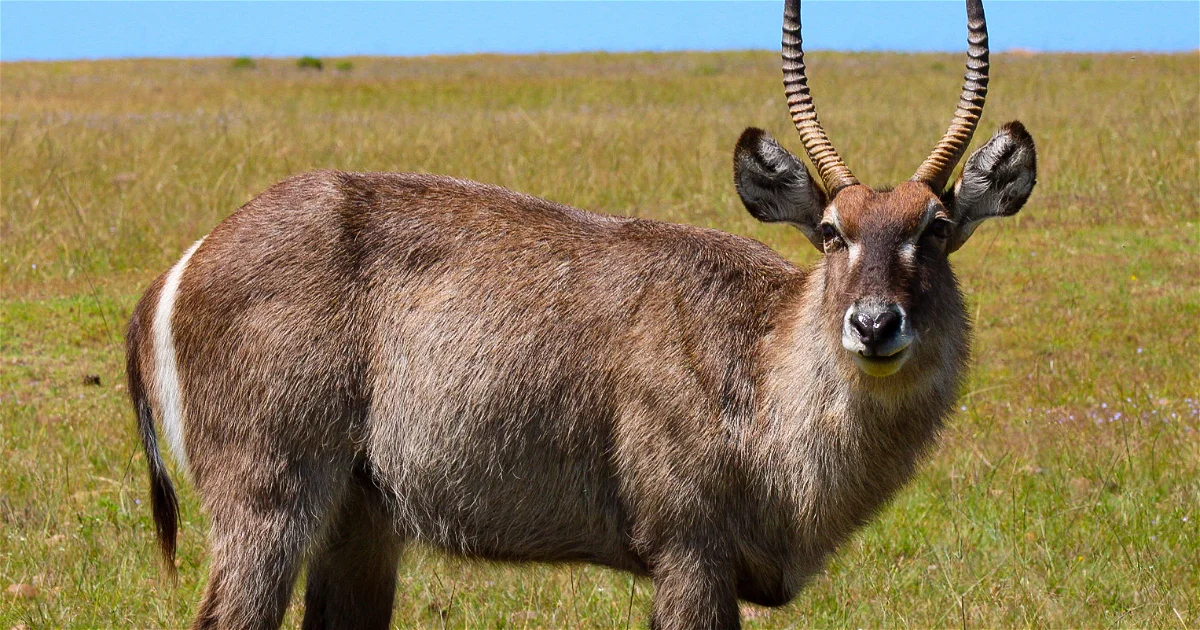
Waterbuck belong to the genus Kobus. Two species relevant to East Africa exist. The common waterbuck, Kobus ellipsiprymnus ellipsiprymnus, has a distinctive white ring on the rump—a circle of white hair around the base of the tail.
The defassa waterbuck, Kobus ellipsiprymnus defassa, replaces it in Uganda and western Kenya—it has a solid white rump patch rather than a ring.
The two forms meet in a transition zone in central Kenya and Tanzania where intermediate coat patterns occur.
An adult male waterbuck weighs between 200 and 300 kilograms. Females are lighter at 160 to 200 kilograms. Shoulder height in males reaches 1.3 meters. The coat is shaggy and grey-brown.
Adult males develop a darker, greyish coat as they age. The skin produces a greasy secretion with a distinctive musky smell—one of the most immediately recognizable scents of any African antelope.
The Greasy Coat: Water Resistance and Smell
The waterbuck’s skin secretes an oily substance that waterproofs the coat. This secretion allows the animal to enter water repeatedly without becoming waterlogged.
The strong, musky smell of this oil is legendary among safari visitors and guides. It is pungent and distinctive — once smelled, it is never confused with anything else. Whether the smell deters predators is debated.
Lions, leopards, and hyenas all kill waterbuck regularly, so any deterrent effect is modest at best.
The smell may function primarily as a territorial and social signal. Males with higher-quality secretions may advertise dominance or reproductive fitness through their scent profile.
Females may use male odor to assess mate quality. The chemical complexity of the secretion—which contains multiple identifiable compounds—is consistent with a communication function rather than a purely structural waterproofing role.
Water as Defence
When threatened, waterbuck enter water. Lions that pursue waterbuck into deep water disengage—the lion’s fur becomes saturated, reducing its mobility and making it vulnerable to the waterbuck’s horns in water.
Crocodiles take waterbuck that enter rivers, which limits how deep the anti-predator water entry strategy can be pushed.
The balance between crocodile risk in the water and lion risk on land means waterbuck make nuanced decisions about when and how far to enter.
This water use in defense is most visible in Uganda’s Queen Elizabeth National Park, where waterbuck enter the Kazinga Channel and the lake margins regularly when lions approach from land.
Boat safaris on the channel produce regular waterbuck-in-water sightings, sometimes with lions watching from the bank.
Territorial Bulls and Herd Structure
Male waterbuck establish and defend territories near water. A territory of 100 to 600 hectares is held by a single dominant bull.
This territory is marked through urine, dung, and secretion rubbing on vegetation. Female herds of 6 to 30 individuals move freely through multiple bull territories.
Territorial bulls herd females that enter their territory and attempt to prevent them from leaving during oestrus.
Bachelor males live in separate groups outside territorial areas. They challenge territorial bulls through display confrontations and occasional sparring.
Successful challenges replace the resident bull — but only in areas where prime territory adjacent to reliable water is contested. Most bulls never hold prime territory.
Plan Your Safari
Uganda’s Queen Elizabeth National Park is the finest waterbuck destination in East Africa. The Kazinga Channel boat safari passes waterbuck standing in the shallows or grazing on the bank at close range throughout the cruise.
The defassa subspecies present in Uganda has the solid white rump that photographically is even more striking than the ringed rump of Kenya’s common waterbuck.
Kenya’s Maasai Mara and Tanzania’s Serengeti both hold common waterbuck along the Mara River and other permanent water courses.
African Wild Trekkers includes the Kazinga Channel boat safari in all Uganda itineraries. Contact us to design an East Africa safari that captures both savanna and riverine wildlife in one trip.