Sitatunga of Uganda: The Swamp-Dwelling Antelope of the Albertine Rift
The sitatunga is built for water. Its hooves are elongated and splayed — ideal for walking on soft, boggy ground.
Its legs are coated with an oily, water-repellent secretion. It wades into papyrus swamps chest-deep without hesitationIt swims between reed beds and hides in water up to its neck when threatened, breathing through a raised muzzle with only its nostrils above the surface.
No other antelope in East Africa occupies the wetland niche as completely as the sitatunga.
What Is a Sitatunga?
The sitatunga, Tragelaphus spekii, belongs to the spiral-horned antelope group. It is named after John Hanning Speke, the British explorer who first described the Nile’s source.
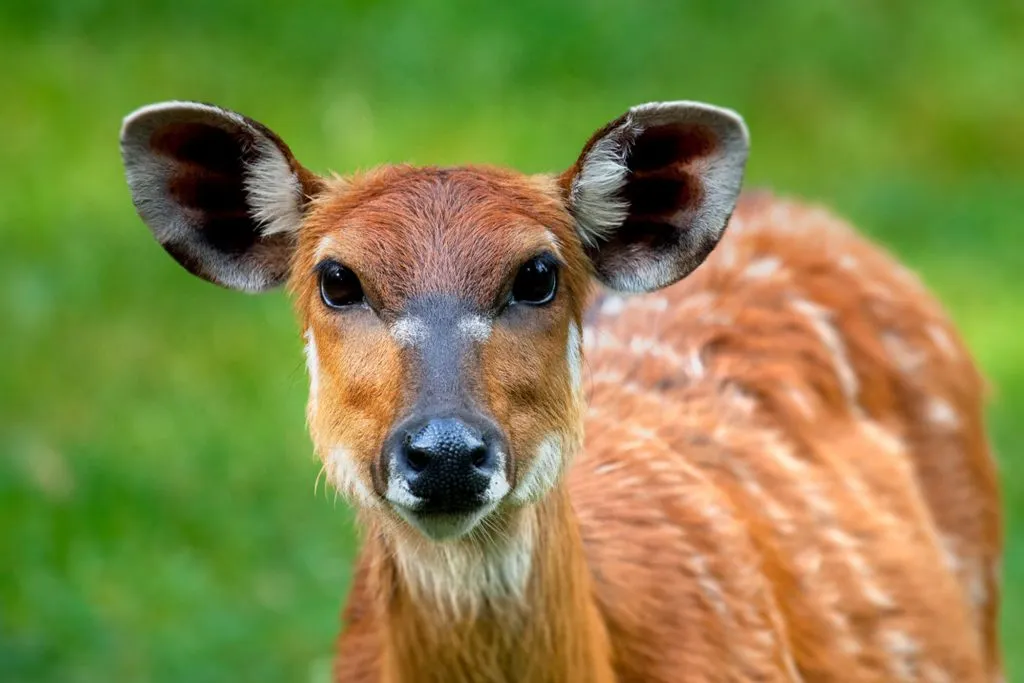
An adult male weighs between 75 and 125 kilograms. Females are smaller at 40 to 60 kilograms. The male’s coat is a deep chocolate-brown with white vertical stripes and spots on the flanks—a pattern shared with other tragelaphine antelopes.
Females are brighter rufous-brown with more prominent white markings.
Only males carry horns. The horns are gently spiraled and diverge outward, reaching 45 to 90 centimeters. Unlike the greater kudu’s tight spiral, the sitatunga’s horns open in a wide, gentle curve.
In a charging male, the horns are angled forward and downward—effectively placed for forward thrusting in dense papyrus.
Swamp Adaptation: Hooves and Oil
The sitatunga’s hooves are elongated by 30 percent compared to similarly sized woodland antelopes.
This elongation spreads the animal’s weight over a larger surface area on soft ground — the same engineering principle as a snowshoe.
The pastern joint is flexible enough to allow the hoof to fold upward during the swing phase of a stride and splay forward on contact with soft mud, maximizing the weight-distribution area at each step.
The skin produces a greasy oil — similar to the waterbuck’s secretion but less pungent — that waterproofs the coat during repeated wading.
This oil prevents the coat from absorbing water and becoming sodden, which would add weight and reduce mobility.
The sitatunga’s combination of splayed hooves and waterproof coat represents a coherent morphological package for semi-aquatic life in papyrus swamps.
Habitat in Uganda
In Uganda, sitatungas live wherever there are permanent papyrus swamps. The Bigodi Wetland Sanctuary adjacent to Kibale National Park is the most accessible sitatunga site in the country.
Guided boardwalk walks through Bigodi’s papyrus produce yield sitatunga sightings regularly.
The Saiwa Swamp National Park in western Kenya—primarily known for De Brazza’s monkeys—also holds a sitatunga population that can be watched from elevated viewing platforms above the swamp.
Other Ugandan sitatunga sites include the swamps along the Kazinga Channel in Queen Elizabeth National Park, the Katonga Wildlife Reserve, and the papyrus margins of Lake Victoria’s islands.
The species is more widespread than most Uganda safari visitors realize—it simply requires walking specifically to look at swamps rather than driving across open plains.
Predators and Escape Behaviour
In the swamp, the sitatunga’s predator avoidance revolves around water depth. A threatened sitatunga wades into deep papyrus where no terrestrial predator can follow efficiently. Crocodiles are the primary aquatic threat. Leopards and pythons take sitatunga at the swamp margins. The balance of risk leads to a behavior pattern of grazing at the swamp edge during low-predator-activity periods and retreating deeper into the papyrus under threat.
Plan Your Safari
The Bigodi Wetland Sanctuary near Kibale Forest is the easiest sitatunga site in East Africa. A two-hour walk with a local guide on the raised boardwalk path produces sitatunga sightings on most visits. The sanctuary also holds papyrus gonolek, African jacana, and other swamp specialties. Adding Bigodi to a Kibale chimpanzee tracking visit costs half a day and delivers wildlife encounters unavailable anywhere else in the same area.
African Wild Trekkers includes Bigodi Wetland in all Uganda itineraries based . Contact us to design a Uganda safari that captures the full range of this extraordinary country’s wildlife habitats.