Honey Badger Facts: Africa’s Most Fearless Small Predator
The honey badger attacks cobras. It raids beehives. It eats porcupine quills along with the porcupine. It has been observed harassing lion cubs, chasing leopards off kills, and taking food from wild dogs. A honey badger weighs about 12 kilograms. It regularly challenges animals that outweigh it by a factor of ten or more — and frequently wins. The honey badger’s fearlessness is not bravado. It is the product of physical adaptations that make it genuinely very difficult to kill.
What Is a Honey Badger?
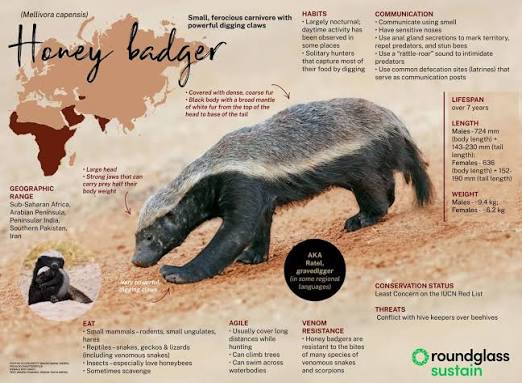
The honey badger, Mellivora capensis, belongs to the mustelid family the same family as weasels, otters, and wolverines. It is the sole member of the genus Mellivora. An adult male weighs between 9 and 16 kilograms. Females weigh 5 to 10 kilograms. Body length reaches 55 to 77 centimetres. The tail adds another 12 to 30 centimetres. The build is squat and powerful a low, wide, heavily-muscled frame on short, strong legs with long, curved front claws.
The coat is bicoloured. The upper surface from head to tail is silver-white or pale grey. The underparts, legs, and face are jet black. This high-contrast pattern is a warning signal the aposematic colouration of an animal that wants to be noticed and recognised as dangerous rather than overlooked as harmless.
The Skin: Thick, Loose, and Resistant
The honey badger’s skin is its primary defence asset. The hide is extremely thick up to 6 millimetres on the neck and back and extremely loose. A large predator gripping a honey badger through the skin cannot simultaneously control the animal’s movement, because the skin slides over the underlying musculature. The honey badger twists inside its own skin to face the direction from which it is being held and attacks the restraining grip with its jaws and claws.
The skin resists penetration remarkably well. Bee stings do not appear to cause significant pain. Porcupine quills penetrate but do not incapacitate. Snake fangs even those of highly venomous cobras — deliver venom but the honey badger appears to have substantial venom resistance. Documented cases of honey badgers surviving bites from puff adders and cobras that would kill a dog within minutes exist from multiple East Africa populations.
The Bee Raid: Partnership and Plunder
The honey badger’s relationship with the greater honeyguide bird is one of the most celebrated interspecies partnerships in African wildlife. The honeyguide leads the honey badger to a beehive through a specialised “guiding” behaviour calling, flitting ahead, and calling again until the honey badger follows. The honey badger tears open the hive with its front claws. It eats honey, bee larvae, and wax. The honeyguide eats the wax and larvae left behind after the honey badger departs.
Both partners benefit. The honey badger gains a guided food source. The honeyguide gains access to a hive it cannot open alone. The partnership is loose honeyguides guide humans and baboons as well as honey badgers. But honey badgers and honeyguides have the longest documented history of this specific interaction, and it appears to be reliably beneficial to both.
Diet and Ecological Role
The honey badger eats almost anything. Rodents, snakes, scorpions, bee larvae, honey, eggs, fruit, fungi, and carrion all appear in dietary records. It digs rapidly for burrowing rodents, scorpions, and termites. It climbs trees for bee nests and eggs. follows vultures to carcasses. This dietary breadth makes the honey badger one of the most ecologically flexible carnivores in East Africa’s savanna ecosystem.
Plan Your Safari
Honey badgers are nocturnal and solitary reliable sightings require dedicated night drive time and some luck. Night drives in Kenya’s Laikipia, Uganda’s Queen Elizabeth, and Tanzania’s Ruaha produce honey badger sightings with the best frequency. Early morning game drives occasionally catch honey badgers still active before they retire. Any East Africa park with adequate prey and sufficient wild space holds honey badgers they are widespread but infrequently seen.
African Wild Trekkers includes night drive options across East Africa’s best wildlife areas. Contact us to plan a safari that gives the continent’s nocturnal and small carnivore life the attention it deserves.