Golden Monkey Rwanda: The Bamboo Forest Primate of the Virunga Volcanoes
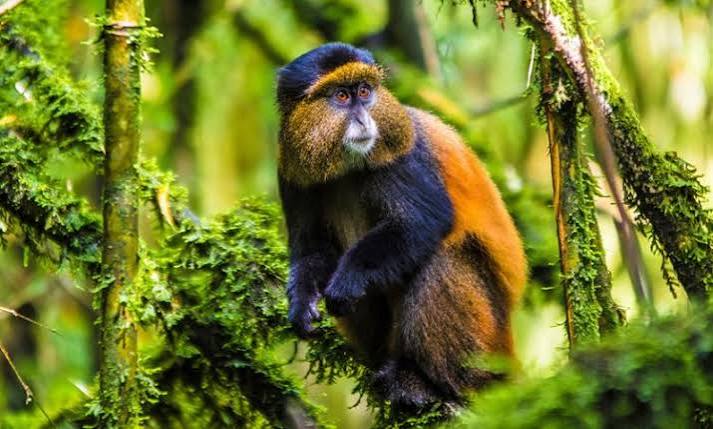
In Rwanda’s Volcanoes National Park, most visitors come for mountain gorillas. Many overlook the golden monkey entirely. This is a mistake. The golden monkey is one of Africa’s most visually striking primates a medium-sized monkey with a vivid orange-gold back, dark limbs, and a bold, dark-framed face that makes it look as if it arrived from a different, more colourful continent. It lives in bamboo forest at altitude, at the base of the same volcanoes that shelter the gorillas above.
What Is the Golden Monkey?
The golden monkey, Cercopithecus kandti, was long classified as a subspecies of the blue monkey. Genetic analysis confirmed it as a distinct species in the early 2000s. It belongs to the guenon group the Old World monkeys of the genus Cercopithecus. An adult golden monkey weighs between 3 and 5 kilograms. Body length reaches about 50 centimetres with a tail of similar length.
The coat is the species’ most immediately striking feature. The back, flanks, and upper limbs carry vivid orange-gold fur a colour that has no equivalent among other East African forest monkeys. The face is dark with a grey-black brow and cheek area. The limbs, tail, and crown are dark grey to black. The orange-and-black combination is bold and unmistakable in the dappled light of bamboo forest.
Bamboo Habitat and Diet
The golden monkey is closely associated with bamboo the dominant vegetation at altitudes of 2,200 to 3,400 metres in the Virunga Massif. Bamboo provides the majority of the diet year-round. Young bamboo shoots are the preferred food they are consumed in large quantities during the bamboo flush season when new growth emerges rapidly. Bamboo leaves and the fruit of bamboo plants are also eaten. Outside the bamboo zone, the golden monkey supplements its diet with fruit, invertebrates, and leaves from other forest trees.
This bamboo specialisation ties the golden monkey’s distribution tightly to the bamboo belt of the Virunga volcanoes. It does not range widely into the adjacent forest types above or below the bamboo zone. This habitat specificity makes the golden monkey unusually vulnerable to any change that reduces the bamboo belt’s extent a consideration in conservation planning for the Virunga ecosystem.
Social Groups and Behaviour
Golden monkeys live in groups of 30 to 80 individuals among the largest group sizes of any guenon species. Each group has multiple adult males and multiple adult females with offspring. This multi-male, multi-female structure is unusual in the guenon family, which more typically organises into one-male groups. The large group size provides excellent collective predator detection in the bamboo forest, where visibility is limited and the approach of an eagle or leopard can be detected from a wider radius with many eyes watching.
Group movements through the bamboo forest are noisy and energetic. The animals call loudly as they move, crash through bamboo culms with apparent indifference to the sound produced, and feed at pace through areas of dense new growth. Watching a group of 50 golden monkeys move through a bamboo grove produces an impression of orchestrated chaos loud, fast, and visually overwhelming.
Trekking Golden Monkeys in Volcanoes National Park
Two habituated golden monkey groups are available for trekking in Volcanoes National Park. The trek begins at the same trailheads used for gorilla trekking. The approach time is typically 30 minutes to 2 hours, shorter on average than gorilla treks because the bamboo zone is lower on the volcano slopes and more accessible than the gorilla families’ forest habitats.
The hour of observation time with a golden monkey group is a genuinely different experience from the gorilla encounter. The energy level is higher, the movement faster, and the number of individuals visible at any one moment larger. Golden monkeys frequently come within 1 to 2 metres of observers closer, on average, than habituated gorillas. The visual impact of a tree full of orange-and-black monkeys 2 metres away in morning light is extraordinary.
Conservation Status
The golden monkey is classified as Endangered on the IUCN Red List. Its range is extremely limited it lives only in the Virunga Massif and the adjacent Gishwati Forest in Rwanda. The global population is estimated at 3,000 to 4,000 individuals. The same protected area management that has benefited the mountain gorilla has also protected the golden monkey Volcanoes National Park’s effective conservation has kept both species’ Rwanda populations stable and growing.
Plan Your Safari
Combining a golden monkey trek with gorilla trekking in Volcanoes National Park requires only one extra day and a second permit. Many visitors do both in a two-to-three day Volcanoes stay. The golden monkey permit costs significantly less than the gorilla permit and delivers an encounter that most visitors rate as one of the highlights of their entire Rwanda experience.
African Wild Trekkers builds Rwanda itineraries that combine gorilla trekking, golden monkey trekking, and Nyungwe Forest primate walks. Contact us to plan a Rwanda safari that captures the country’s extraordinary primate diversity.