Giant Forest Hog Facts: Africa’s Largest Wild Pig
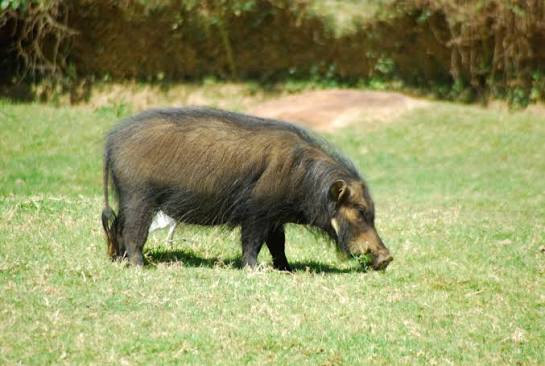
The giant forest hog is the world’s largest wild pig. A full-grown boar weighs up to 275 kilograms. The head carries enormous facial warts and preorbital pouches that give the face a prehistoric, almost absurd appearance. It lives in montane and lowland forest, dense thicket, and gallery woodland across central and East Africa. Despite its size, it is less well-known than the common warthog because it occupies habitats that most game drive tourists never explore on foot.
What Is the Giant Forest Hog?
The giant forest hog, Hylochoerus meinertzhageni, belongs to the family Suidae. It is the sole member of its genus. The species name honours Richard Meinertzhagen, the British soldier-naturalist who collected the first specimens from the Aberdare Mountains of Kenya in 1904. An adult male called a boar weighs between 130 and 275 kilograms. Sows weigh 100 to 180 kilograms. Body length reaches up to 2.1 metres.
The body is covered in long, coarse, dark brown to black hair. The face carries the large preorbital glands inflatable facial pouches below the eyes that distinguish it from all other African pigs. The upper canine tusks of boars are thick, slightly curved, and reach 25 to 35 centimetres. The tusks are used in male-male competition and in self-defence against predators.
Habitat: Forest and Montane Grassland
The giant forest hog is a specialist of highland forest and adjacent grassland. It occupies the transition zone between closed-canopy montane forest and open montane grassland — the bamboo zone, forest edge clearings, and moorland margins above the tree line. This habitat preference puts it in terrain that safari vehicles rarely access.
In Uganda, the giant forest hog lives in the forest zones of Mount Elgon, the Rwenzori foothills, Bwindi Impenetrable Forest, and the Echuya Forest Reserve near Kabale. In Kenya, the Aberdare Mountains and Mount Kenya’s forest zone hold significant populations. The species is most often encountered at night — it is primarily nocturnal and crepuscular, feeding in open areas at dawn and dusk and resting in dense forest during the day.
Family Group Structure
Giant forest hogs live in family groups sounders of 6 to 12 individuals. Each sounder contains one dominant boar, one or more sows, and their offspring from successive years. The dominant boar defends the sounder vigorously. Challenges from rival boars involve head-on confrontations with snout-to-snout pushing, escalating to shoulder charges. The thick facial skin and the inflatable preorbital pouches provide cushioning during these head contacts.
Offspring from the previous year remain with the sounder after the next litter is born. Young males are expelled at sexual maturity and become solitary or join temporary bachelor groups. These expelled males challenge sounders’ dominant boars for access to females during the breeding season.
Diet and Ecological Role
The giant forest hog eats grass, sedge, herbs, leaves, fruit, and fungi. It grazes extensively in open clearings and glades within forest. It roots for bulbs and tubers in soft soil at forest margins. In areas where giant forest hogs are abundant, their rooting creates disturbances in the forest floor that accelerate nutrient cycling and create microsites for germination of light-demanding plant species. This ecosystem engineering at the forest-grassland transition zone is poorly studied but likely significant.
Leopards take juvenile giant forest hogs. Lions take subadults and sows. An adult boar has few natural predators its size, tusks, and willingness to charge make it a dangerous target. Spotted hyenas occasionally take injured or weakened adults. In the Aberdare Mountains, African wild dogs where present are the primary predator capable of taking adult giant forest hogs through coordinated pack hunting.
Plan Your Safari
The Aberdare National Park tree hotels Treetops and The Ark offer the most reliable giant forest hog encounters in East Africa. Illuminated waterhole areas attract giant forest hogs at night, and multi-hour nocturnal observation sessions from the viewing deck produce close, prolonged encounters with family groups. Uganda’s Mount Elgon National Park and the Bwindi forest margins produce sightings on early morning forest walks with experienced guides who know the local sounder locations.
African Wild Trekkers includes the Aberdare tree hotels in Kenya highland circuits. Contact us to plan a Kenya itinerary that combines the Maasai Mara’s open plains with the Aberdare’s forest wildlife.