Nile Crocodile Facts: Africa’s Ancient Ambush Predator
The Nile crocodile has existed essentially unchanged for 70 million years. It survived the same mass extinction event that ended the dinosaurs. Every river system and permanent lake in East Africa holds them. They are patient beyond any mammal’s patience — lying motionless for hours in the same position. And when the moment arrives, they are among the fastest animals in Africa over the first two metres. The Nile crocodile is not just an ancient creature. It is a perfected one.
What Is the Nile Crocodile?
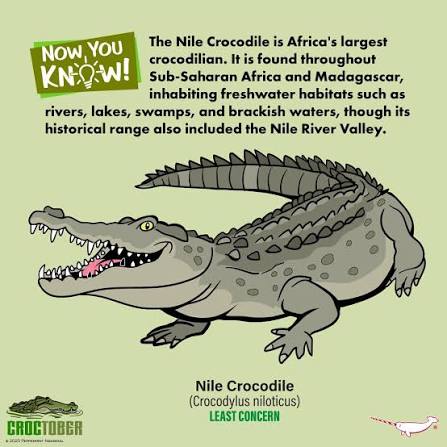
The Nile crocodile, Crocodylus niloticus, is Africa’s largest reptile and the world’s second-largest living crocodilian after the saltwater crocodile of Australia and Southeast Asia. Adult males reach 4 to 5 metres in length and weigh 225 to 750 kilograms. The largest verified individual measured 6.45 metres. Females are smaller typically 3 to 3.7 metres. The species is present in every permanent water system in sub-Saharan Africa from the Nile south to South Africa.
The body is fully armoured with osteoscutes bony plates embedded in the skin. The coloration is olive-grey above and pale yellow-white below. The eyes, ears, and nostrils are positioned on top of the skull, allowing the animal to be completely submerged with only these three sensory organs above the waterline. The jaw closes with approximately 2,200 kilograms of force per square centimetre the highest bite force of any living animal measured.
Ectothermy and Temperature Management
Nile crocodiles cannot generate body heat internally. They regulate body temperature through behaviour — basking in sun to warm up and entering the water or shade to cool down. This thermoregulation is precise and active. A crocodile basking with its mouth open is not displaying aggression it is cooling through buccal evaporation, the same principle as a panting dog. The open mouth presents a large, moist mucous membrane surface to the air, allowing evaporative cooling of the blood in the head and brain.
The ectothermic lifestyle has major metabolic advantages over warm-blooded animals of the same size. A crocodile uses 50 to 70 times less food per unit body weight per day than a lion of comparable mass. A large crocodile can survive on as few as 50 large meals per year. This low food requirement allows crocodiles to persist through dry seasons and prey scarcity that would kill an equivalent mammalian predator.
Hunting: The Ambush From Below
The Nile crocodile’s primary hunting technique is ambush from the water surface or from a submerged position. It lies still near a bank or crossing point where prey animals drink or cross. When prey wades to drink within range of the explosive lunge the crocodile surges forward with the hindleg and tail-driven power of the entire body, grips the prey with the jaws, and rolls into the water to drown it.
The death roll a rapid rotation of the whole body while gripping prey in the jaws serves two functions. It disorients the prey and accelerates drowning. It also tears off pieces of flesh when feeding on a carcass too large to swallow whole. Crocodiles cannot chew. They swallow pieces torn from the carcass. A large wildebeest at a Mara River crossing may feed twenty or more crocodiles simultaneously, each twisting and tearing in death rolls around the submerged carcass.
Nesting and Maternal Care
Female Nile crocodiles are attentive mothers. They excavate nest holes in sandy or loamy soil above the flood line and lay 25 to 80 eggs. The female remains near the nest throughout the 90-day incubation period, guarding against monitor lizards, hyenas, and other egg predators. When the eggs begin hatching signalled by calls from the hatchlings inside the eggs the mother excavates the nest and carries hatchlings to the water in her mouth.
Both parents in rare crocodilian behaviour protect the hatchlings in a nursery pool for several weeks. Hatchling mortality is high from wading birds, large fish, and other crocodiles. The parental protection period significantly improves hatchling survival compared to unattended nests.
Plan Your Safari
The Mara River between Tanzania and Kenya is the most famous crocodile-watching location in East Africa. During the wildebeest migration crossings from July to October, dozens of large crocodiles gather at crossing points and the encounters between crocodiles and migrating wildebeest are among the most dramatic predator-prey events in wildlife watching. Uganda’s Murchison Falls National Park holds large crocodile concentrations at the base of the falls and along the Nile banks below. The Kazinga Channel in Queen Elizabeth also holds dense crocodile populations visible from the boat safari.
African Wild Trekkers designs migration safaris timed to the Mara River crossings. Contact us to plan a Kenya or Tanzania trip around the most dramatic wildlife event in East Africa.